


















Lesson 7 of 52 · Organization of the Body
Chemistry of life: atoms, water, pH and biomolecules
Learn the chemistry every body system uses: atoms, ions and bonds, why water is special, how pH works, the four biomolecule families, ATP and enzymes.
Chemistry is not a separate subject that you must survive before reaching the "real" biology. When a muscle contracts, a nerve fires, or your stomach digests lunch, chemistry is what is happening. Atoms trade electrons, molecules change shape, and ions flow across membranes. This lesson gives you the minimum chemistry that anatomy and physiology need, with each idea tied to the body.
The plan: first the atom and the bonds between atoms, then the one molecule that dominates the body (water) and the pH scale, then the four families of large biological molecules, and finally ATP and enzymes, which power and speed up the chemistry.
What you will learn
- The structure of an atom, and the meaning of element, isotope and ion.
- The three main bond types: ionic, covalent and hydrogen bonds.
- Why water behaves as it does, and what pH measures.
- The four biomolecule families, and the roles of ATP and enzymes.
Key terms
- Element: a substance made of one kind of atom, defined by its number of protons (the atomic number).
- Ion: an atom or molecule that carries an electrical charge because it has gained or lost electrons.
- Covalent bond: a bond formed when atoms share electrons.
- pH: a number from 0 to 14 describing how acidic or basic a solution is.
- Enzyme: a protein that speeds up a chemical reaction without being used up.
- ATP: adenosine triphosphate, the cell's immediate energy currency.
Atoms, elements and ions
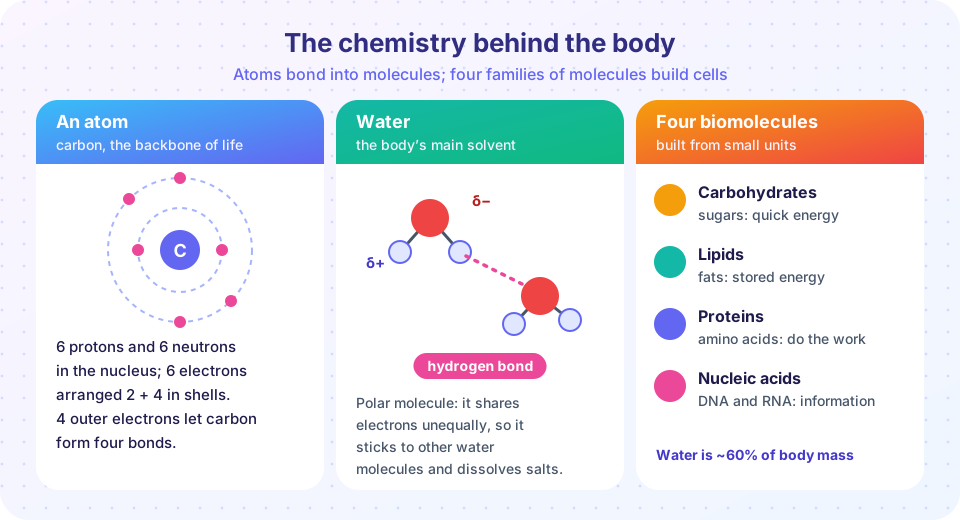
An atom has a central nucleus with protons (positive charge) and neutrons (no charge), surrounded by electrons (negative charge) arranged in shells. A neutral atom has equal numbers of protons and electrons. The number of protons is the atomic number and defines the element: every atom with 6 protons is carbon. The sum of protons and neutrons is the mass number.
Isotopes are atoms of the same element with different numbers of neutrons. Carbon-12 and carbon-14 both have 6 protons, but carbon-14 has 8 neutrons and is radioactive. Medicine uses isotopes as tracers: a PET scan follows a radioactive form of fluorine attached to a glucose-like molecule to find where cells are using energy.
Four elements dominate the body by mass: oxygen (about 65%), carbon (about 18.5%), hydrogen (about 9.5%) and nitrogen (about 3.2%). Calcium and phosphorus, mostly in bone, add around 2.5%. Sodium, potassium, chlorine, sulfur, magnesium and others appear in small amounts but matter greatly: sodium and potassium make nerves fire, calcium triggers muscle contraction, and iron carries oxygen in hemoglobin.
Press Run (or Ctrl + Enter) to see the result here.
Program input · what you'd type while the program runs
Type the answers before you press Run, one per line. Each time the program reads a line (with input()), it gets the next line from this box.
An ion forms when an atom gains or loses electrons. Sodium (Na) gives away one electron to become Na⁺; chlorine takes one to become Cl⁻. Ions dissolved in body fluids that conduct electricity are called electrolytes: sodium, potassium, calcium, chloride, bicarbonate, magnesium and phosphate. Almost every nerve signal and muscle contraction is a story about ions moving.
Chemical bonds
Atoms bond to reach a stable arrangement of outer-shell electrons. Three kinds of bond matter most:
- Ionic bond. One atom transfers electrons to another, and the resulting opposite charges attract. Table salt (Na⁺Cl⁻) is the classic example. In water, ionic compounds usually fall apart into their ions.
- Covalent bond. Atoms share electrons. When the sharing is equal (as in the oxygen molecule, O₂) the bond is nonpolar. When one atom pulls harder, as oxygen does in water, the bond is polar: one end is slightly negative and the other slightly positive. Covalent bonds are strong, and they hold together the large molecules of life.
- Hydrogen bond. A weak attraction between a slightly positive hydrogen (already bonded to oxygen or nitrogen) and a slightly negative atom nearby. One hydrogen bond is weak, but millions together are strong. They hold the two strands of DNA together, shape proteins and give water its special properties.
Water: the body's main solvent
Water makes up roughly 60% of body weight in an adult male and a bit less, about 50% to 55%, in an adult female because of differences in fat and muscle. Each water molecule is polar, so water molecules stick to each other with hydrogen bonds and surround and separate charged particles. That gives water four properties you will use again and again:
- Excellent solvent. Ions and polar molecules (salts, sugars, amino acids) dissolve easily. Chemical reactions in cells happen in water, and blood plasma, which is about 92% water, carries nutrients and wastes.
- High heat capacity. It takes 4.18 joules to warm 1 gram of water by 1 °C, much more than for most liquids. A body that is mostly water resists sudden temperature swings.
- High heat of vaporization. Evaporating sweat takes a lot of heat away from the skin, which is why sweating cools you.
- Cohesion and lubrication. Hydrogen bonding makes water stick together (this also helps blood move) and makes it an effective lubricant in serous fluid, joint fluid and tears.
Acids, bases and pH
When an acid dissolves in water it releases hydrogen ions (H⁺); a base takes them up or releases hydroxide ions (OH⁻). The pH scale measures the hydrogen ion concentration: pH = -log10 [H⁺], where [H⁺] is in moles per liter. Because the scale is logarithmic, each step of 1 pH unit is a tenfold change in concentration. Pure water at 25 °C has pH 7 (neutral). Lower is acidic, higher is basic.
The body keeps pH within tight limits. Arterial blood is normally pH 7.35 to 7.45. A change of only a few tenths of a unit disrupts enzymes and can be dangerous. The body defends pH with buffers, chemicals such as the bicarbonate system that soak up or release H⁺ to resist change, and with the lungs (which control carbon dioxide) and the kidneys (which excrete acid or base). Chapter 8 returns to this. Try the scale below; it is a teaching demonstration of the scale and not a health test.
The four biomolecule families
Most of the carbon-based, or organic, molecules in the body belong to four families. Each is built by joining small units (monomers) into long chains (polymers) by dehydration synthesis, which removes a water molecule at each join. Hydrolysis adds water to break the chain apart again, which is what digestive enzymes do.
| Family | Building blocks | Examples | Main roles |
|---|---|---|---|
| Carbohydrates | simple sugars (monosaccharides) | glucose, sucrose, glycogen | quick energy, short-term storage |
| Lipids | glycerol and fatty acids (not true polymers) | triglycerides, phospholipids, cholesterol | long-term energy storage, membranes, hormones |
| Proteins | 20 kinds of amino acids | enzymes, hemoglobin, collagen, antibodies | structure, transport, defense, enzymes |
| Nucleic acids | nucleotides | DNA, RNA, ATP | genetic information, energy transfer |
Carbohydrates have the general formula (CH₂O)ₙ. Glucose, C₆H₁₂O₆, is the main fuel of cells and circulates in blood. Two sugars joined make a disaccharide (sucrose is glucose plus fructose); hundreds joined make a polysaccharide, such as glycogen, the starch-like energy store in liver and muscle.
Lipids do not mix well with water. Triglycerides (three fatty acids on a glycerol backbone) store energy compactly: a gram of fat holds about 9 kilocalories versus about 4 for a gram of carbohydrate or protein. Phospholipids have a water-loving head and two water-fearing tails and form the double layer of every cell membrane. Steroids such as cholesterol are four-ring molecules that stabilize membranes and are the starting point for hormones including estrogen, testosterone and cortisol.
Proteins are chains of amino acids folded into precise shapes. Shape equals function: if the shape changes (denaturation, caused by heat or extreme pH) the protein stops working. An egg turning white when cooked is denatured protein. Proteins include structural proteins such as collagen, transport proteins such as hemoglobin, hormones such as insulin and antibodies.
Nucleic acids store and use genetic information. DNA is a double helix of two strands of nucleotides, and its sequence of four bases (A, T, C and G) codes for proteins. RNA is usually single-stranded and helps make proteins.
ATP and enzymes
Cells do not burn glucose directly to do work. They transfer the energy into ATP, a nucleotide with three phosphate groups. Removing the last phosphate (making ADP) releases energy that cells use to contract, pump ions or build molecules; mitochondria then rebuild ATP from ADP. An adult makes and uses roughly their own body weight in ATP each day, recycling each molecule many times.
Many reactions would be far too slow at body temperature. Enzymes are protein catalysts that lower the activation energy, the energy barrier a reaction must cross. Each enzyme fits specific reactants, called substrates, at its active site, like a key in a lock (more precisely, the site adjusts slightly to the substrate, the induced fit model). Enzyme names usually end in -ase: lactase breaks down lactose, and amylase breaks down starch. Their speed rises with substrate concentration until all active sites are busy, then levels off at a maximum rate.
Press Run (or Ctrl + Enter) to see the result here.
Program input · what you'd type while the program runs
Type the answers before you press Run, one per line. Each time the program reads a line (with input()), it gets the next line from this box.
Common misconceptions
- "Chemicals are unnatural or harmful." Everything in the body, including water and sugar, is a chemical. Natural and synthetic substances are both made of the same atoms.
- "Acids are always dangerous." Your stomach acid (pH about 2) is vital for digestion. Danger depends on strength and context.
- "Enzymes get used up." An enzyme speeds up a reaction and comes out unchanged, ready for another substrate molecule.
- "Fats are all bad." Lipids form every cell membrane and make steroid hormones. Problems arise from particular types and amounts, not from fat itself.
Check your understanding
Quick check · 5 questions
of 5 answered You scored / 5 · perfect!
-
1. What does the atomic number of an atom tell you?
The number of protons defines the element. -
2. Which bond is formed when atoms share electrons?
In a covalent bond atoms share electrons. Ionic bonds transfer electrons, and hydrogen bonds are weak attractions between molecules. -
3. A solution changes from pH 6 to pH 4. What happens to its hydrogen ion concentration?
Each pH unit is a tenfold change, so two units mean 10 x 10 = 100 times more H+. -
4. Which biomolecule family forms the double layer of cell membranes?
Phospholipids have a polar head and nonpolar tails and arrange themselves into a bilayer. -
5. What does an enzyme do?
Enzymes are catalysts that speed up reactions without being consumed.
Summary
- Atoms have protons, neutrons and electrons; the number of protons defines the element, and ions are charged atoms.
- Ionic, covalent and hydrogen bonds hold matter together at different strengths.
- Water is polar, so it is an excellent solvent with high heat capacity; pH measures H⁺ on a log scale, and blood is held at 7.35 to 7.45.
- Carbohydrates, lipids, proteins and nucleic acids are the four biomolecule families.
- ATP carries energy, and enzymes speed up reactions by lowering activation energy.
Track your progress
Create a free account to tick off lessons and pick up where you left off on any device.
of Anatomy and Physiology lessons completed