


















Lesson 50 of 52 · Projects and Practice
Glossary of key terms: chapters 5 to 8
Definitions of more than sixty terms from the endocrine, cardiovascular, respiratory, digestive, urinary, reproductive, immune, metabolic and homeostasis chapters.
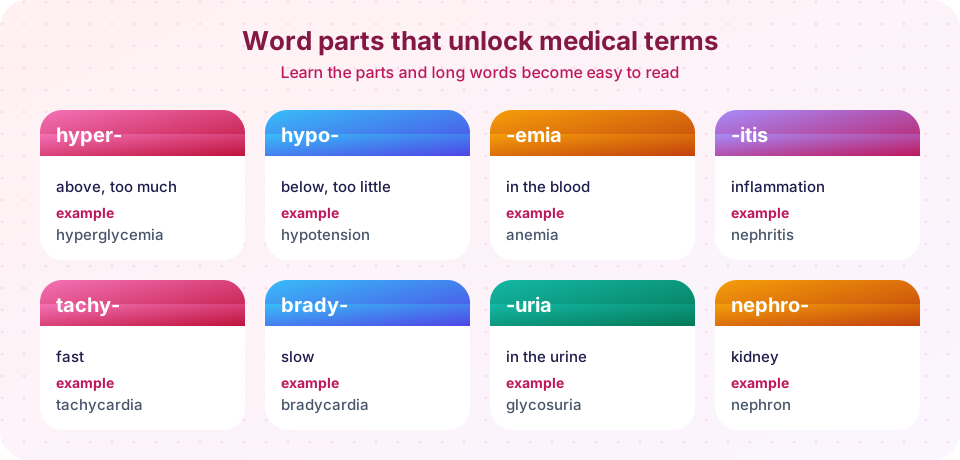
Anatomy and physiology has a reputation for long words, but the vocabulary is far more regular than it looks. Most terms are built from a few Greek and Latin parts that repeat: hyper- means above or too much, -emia means in the blood, nephro- means kidney. Once you know about forty of these parts, you can read an unfamiliar term and guess its meaning with good accuracy. This glossary lists the key terms from chapters 5 to 8 in alphabetical order, with a short definition and the lesson they come from, followed by a guide to the word parts and a decoder tool.
What you will learn
- Define the main terms of chapters 5 to 8 in your own words.
- Break a medical term into prefix, root and suffix.
- Use the glossary to find which lesson to revisit.
Key terms
Prefix: a word part at the start that modifies the meaning, such as hypo-.
Root: the core of the word, often an organ, such as cardi-.
Suffix: a word part at the end that says what is happening, such as -itis.
Eponym: a term named after a person, such as the islets of Langerhans.
Abbreviation: a short form, such as GFR or ATP; define each when you first use it.
Glossary
| Term | Definition |
|---|---|
| Aldosterone | Adrenal steroid that makes the kidney retain sodium and water |
| Alveolus | Microscopic air sac where gas exchange occurs |
| Antibody | Y-shaped protein made by plasma cells that binds one antigen |
| Antigen | A molecule that triggers an adaptive immune response |
| Aorta | Largest artery; carries blood from the left ventricle to the body |
| ATP | Adenosine triphosphate, the cell's energy currency |
| Atrium | Upper heart chamber that receives blood |
| Baroreceptor | Pressure sensor in the carotid sinus and aortic arch |
| Bile | Fluid from the liver that emulsifies fat |
| Bohr effect | Lower hemoglobin oxygen affinity at lower pH or higher CO₂ |
| Capillary | Thin vessel where exchange between blood and tissue occurs |
| Cardiac output | Volume pumped by a ventricle per minute (HR × SV) |
| Chyme | Semi-liquid food and gastric juice leaving the stomach |
| Complement | Blood proteins that mark and lyse microbes |
| Corpus luteum | Ovarian structure that makes progesterone after ovulation |
| Diastole | Relaxation phase of the cardiac cycle |
| Electrolyte | Substance that forms ions in water, such as sodium |
| Endocrine gland | Ductless gland that releases hormones into blood |
| Enzyme | Protein that speeds a chemical reaction |
| Erythropoietin | Kidney hormone that stimulates red blood cell production |
| Feedforward | Response that starts in anticipation of a change |
| Filtrate | Fluid that passes from the glomerulus into the nephron |
| Gamete | Egg or sperm cell with 23 chromosomes |
| GFR | Glomerular filtration rate, about 125 mL/min |
| Glomerulus | Capillary tuft in the kidney where filtering occurs |
| Glucagon | Pancreatic hormone that raises blood glucose |
| Glycogen | Branched glucose store in liver and muscle |
| Glycolysis | Splitting of glucose into pyruvate in the cytoplasm |
| Hematocrit | Percentage of blood volume made of red cells |
| Hemoglobin | Iron-containing oxygen carrier in red blood cells |
| Homeostasis | Maintenance of a stable internal environment |
| Hormone | Chemical messenger carried in the blood |
| Hypothalamus | Brain region linking nervous and endocrine systems |
| Inflammation | Local response with redness, heat, swelling and pain |
| Insulin | Pancreatic hormone that lowers blood glucose |
| Lacteal | Lymph vessel in a villus that absorbs fat |
| Lymph | Fluid returned to the blood by lymphatic vessels |
| Meiosis | Cell division that halves the chromosome number |
| Memory cell | Long-lived lymphocyte that gives a rapid second response |
| Metabolism | All the chemical reactions of the body |
| Micturition | Emptying of the bladder |
| Mitochondrion | Organelle where most ATP is made |
| Nephron | Microscopic filtering unit of the kidney |
| Osmolality | Concentration of dissolved particles in a fluid |
| Ovulation | Release of an egg from an ovarian follicle |
| Pacemaker | The sinoatrial node, which sets heart rhythm |
| Partial pressure | The pressure of one gas in a mixture |
| Peristalsis | Wave of muscle contraction that moves contents along a tube |
| Phagocytosis | Engulfing and digesting a particle by a cell |
| Placenta | Organ where maternal and fetal blood exchange materials |
| Plasma | Liquid portion of blood |
| Platelet | Cell fragment that helps blood clot |
| Pyrogen | Substance that raises body temperature |
| Receptor | Protein that binds a specific hormone or signal |
| Renin | Kidney enzyme that starts the renin-angiotensin system |
| Set point | Target value of a regulated variable |
| Stroke volume | Volume ejected by a ventricle per beat |
| Surfactant | Lipid and protein mix that lowers alveolar surface tension |
| Systole | Contraction phase of the cardiac cycle |
| Tidal volume | Air moved in one quiet breath, about 500 mL |
| Vaccine | Preparation that creates immune memory without disease |
| Vasodilation | Widening of blood vessels |
| Villus | Finger-like projection of the small intestine |
| Zygote | Fertilized egg, with 46 chromosomes |
Word parts
| Part | Meaning | Examples |
|---|---|---|
| hyper- | above, excessive | hypertension, hyperglycemia |
| hypo- | below, deficient | hypotension, hypoglycemia |
| tachy- / brady- | fast / slow | tachycardia, bradycardia |
| a- / an- | without | anemia, apnea |
| dys- | difficult, abnormal | dyspnea |
| -emia | in the blood | glycemia, anemia |
| -uria | in the urine | glycosuria, polyuria |
| -itis | inflammation | gastritis, nephritis |
| -ectomy | surgical removal | appendectomy |
| -pathy | disease | nephropathy |
| cardi- | heart | cardiac, tachycardia |
| nephr- / ren- | kidney | nephron, renal |
| hepat- | liver | hepatic |
| gastr- | stomach | gastric |
| pulmon- | lung | pulmonary |
| hem- / hemat- | blood | hemoglobin, hematocrit |
| gluc- / glyc- | sugar | glucose, glycogen |
A habit that helps: when you meet a new term, split it, guess it, and then check the glossary. The act of guessing makes the definition stick.
Terms that are easily confused
Some pairs of terms look alike and are regularly mixed up. It helps to contrast them directly.
- Artery and vein. Defined by direction relative to the heart (away and toward), not by oxygen content.
- Systole and diastole. Contraction and relaxation. Blood pressure is written systolic over diastolic.
- Endocrine and exocrine. Hormones into the blood versus products through a duct.
- Ventilation and respiration. Ventilation is breathing in and out; cellular respiration is the use of oxygen to make ATP.
- Filtration, reabsorption and secretion. Three directions of movement in the nephron: blood to filtrate, filtrate to blood, and blood to filtrate again through the tubule wall.
- Innate and adaptive. General and fast versus specific and remembering.
- Antigen and antibody. The foreign molecule versus the protein that binds it.
- Anabolism and catabolism. Building up versus breaking down.
- Acidosis and acidemia. Acidosis is the process that lowers pH; acidemia is a blood pH below 7.35.
Making a short list of your own confusing pairs, and testing yourself on them, is one of the most efficient ways to improve exam answers.
Common misconceptions
"Terms are just labels to memorize." Most are descriptions. Hypoglycemia literally says "below-sugar-in-the-blood", which is exactly what it is.
"Abbreviations are universal." Some abbreviations differ between fields or countries, and some are easily confused, so spell out a term on first use.
"Eponyms tell you what something is." Names such as islets of Langerhans or loop of Henle honor discoverers but do not describe function; learn their structure and role as well.
Try it
First, a word-part decoder. Type a term, such as tachycardia or glycosuria, and the tool shows the parts it recognizes. It uses a small dictionary, so some terms will not be recognized.
Second, a term-matching drill.
Check your understanding
Quick check · 4 questions
of 4 answered You scored / 4 · perfect!
-
1. What does hypoglycemia literally mean?
hypo- (below), glyc- (sugar), -emia (in the blood). -
2. What does the suffix -itis mean?
-itis means inflammation, as in gastritis or nephritis. -
3. What is chyme?
Chyme is the mixture of food and gastric juice passed to the small intestine. -
4. Which pair of terms is correctly matched?
Diastole is relaxation and systole is contraction; atria are the upper chambers.
Summary
- The glossary defines the core terms of the chapters and points to where each is used.
- Splitting a term into prefix, root and suffix lets you read unfamiliar words.
- Check meanings by explaining them in your own words and linking them to a mechanism.
Track your progress
Create a free account to tick off lessons and pick up where you left off on any device.
of Anatomy and Physiology lessons completed