


















Lesson 47 of 52 · Immunity, Metabolism and Homeostasis
Chapter 8 review: Immunity, Metabolism and Homeostasis
Review innate and adaptive immunity, ATP production and the fed and fasting states, and feedback in thermoregulation, with a summary picture and a nine-question quiz.
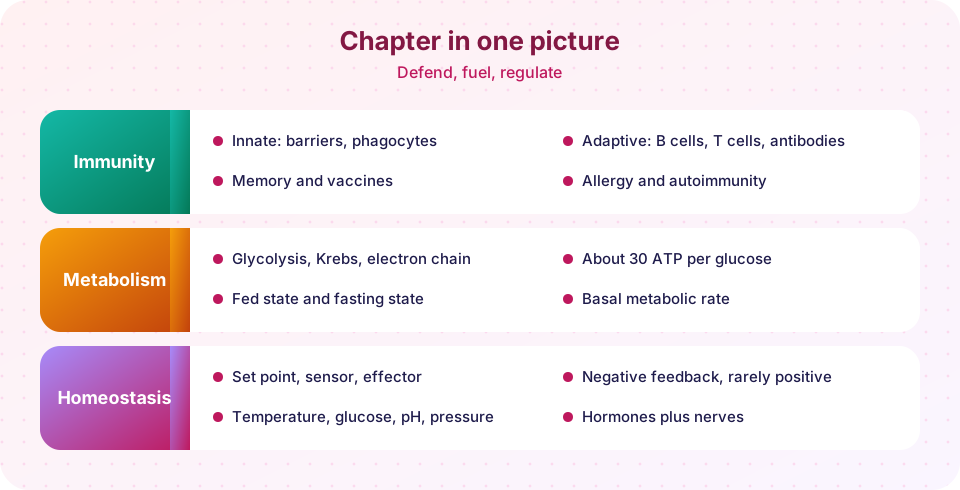
This chapter had three themes: defend, fuel and regulate. Each could fill a course of its own, so the review focuses on the few ideas that recur everywhere. Innate defenses act fast and generally; adaptive defenses act slowly and specifically, with memory. Cells turn glucose into ATP in three stages, and most of the yield needs oxygen. Every regulated variable has a set point, a sensor, a control center and an effector. If you can state these three sentences and justify them with examples, you have the core of the chapter.
What you will learn
- Link immunity, metabolism and homeostasis in one explanation.
- Check recall of cells, pathways, formulas and feedback loops.
- Find the lesson to revisit for any weak area.
Recap table
| Topic | Key idea | Names and numbers |
|---|---|---|
| Barriers | Skin, mucus, acid, lysozyme, normal flora | pH of skin about 4 to 6 |
| Innate cells | Neutrophils, macrophages, dendritic cells, NK cells, mast cells | Metchnikoff discovered phagocytes (1882) |
| Inflammation | Alarm, vessels open, cells arrive | Redness, heat, swelling, pain |
| Complement and interferons | Mark and lyse microbes; warn neighbors about viruses | Opsonization |
| Adaptive cells | B cells make antibodies; helper and killer T cells | Clonal selection (Burnet) |
| Antibodies | IgG, IgM, IgA, IgE, IgD | IgG crosses the placenta |
| Memory and vaccines | Faster, larger second response | Jenner 1796; smallpox eradicated 1980 |
| Herd immunity | Share immune needed to stop spread | 1 − 1/R₀ |
| Cellular respiration | Glycolysis, Krebs cycle, electron transport | About 30 ATP per glucose |
| Fuels | Fat 9 kcal/g, carbohydrate and protein 4 kcal/g | Beta-oxidation |
| Fed and fasting | Insulin versus glucagon | Ketone bodies in a long fast |
| BMR | Set by lean mass and size | Mifflin-St Jeor equation |
| Homeostasis | Set point, sensor, control center, effector | Cannon 1926; Bernard 1850s |
| Thermoregulation | Hypothalamus; radiation, conduction, convection, evaporation | 37 °C; fever raises the set point |
Questions to ask of any new topic
What is being defended, fueled or regulated? Identify the variable. In an infection it is the freedom of tissue from microbes; in the muscle it is the supply of ATP; in a fever it is core temperature.
Who senses, who decides and who acts? Break the process into a sensor, a control center and an effector, as you did for temperature. This habit works equally well for a drop in blood pressure or a rise in blood acidity.
How fast, how specific, how long? Compare fast general responses (innate immunity, adrenaline, anaerobic glycolysis) with slow specific ones (adaptive immunity, steroid hormones, kidney acid excretion). Every system uses both, and the combination is what makes the body robust.
A worked scenario
You catch a cold. Barriers failed; the virus entered cells in the nose. Interferons from the infected cells warn their neighbors, NK cells kill infected cells, and inflammation brings blood and cells to the site, producing a blocked, warm, swollen feeling. Macrophages and dendritic cells carry antigen to the lymph nodes, where helper T cells and B cells are activated, and about a week later antibodies appear and clear the virus. A fever raises the hypothalamic set point, so you shiver and feel cold while the temperature rises. Fighting the infection costs energy, so metabolic rate rises, and the heat produced is part of the fever. Afterwards memory cells remain. Every theme of this chapter appears in this single ordinary illness.
Try it
First, flashcards for the whole chapter. Click to flip.
Second, practice calculations from the chapter.
Press Run (or Ctrl + Enter) to see the console output here.
No output.
Check your understanding
Quick check · 9 questions
of 9 answered You scored / 9 · perfect!
-
1. Which is a feature of innate immunity?
Innate defenses are fast and general; adaptive immunity is slow and specific. -
2. Which cell type recognizes antigen on MHC proteins and then orchestrates the response?
Helper T cells recognize antigen presented on MHC and release cytokines that activate B cells and killer T cells. -
3. What does a vaccine create?
Vaccines show the immune system an antigen safely, so memory cells form. -
4. What is the herd immunity threshold for R₀ = 10?
1 − 1/10 = 0.9. -
5. Where is most ATP made from a glucose molecule?
About 26 of roughly 30 ATP come from oxidative phosphorylation. -
6. What happens to pyruvate when oxygen is short?
Lactate formation regenerates NAD⁺, letting glycolysis continue at 2 ATP per glucose. -
7. Which hormone pattern is typical of fasting?
Falling insulin and rising glucagon mobilize fuel stores. -
8. In the thermostat analogy, which part is the effector for cooling?
Effectors carry out the response: sweating and vasodilation. The hypothalamus is the control center. -
9. Which route of heat loss is still effective when the air is hotter than the body?
Evaporation of sweat removes heat even when the environment is warmer than the skin.
Summary
- Innate defenses are fast and general; adaptive defenses are slow, specific and leave memory, which vaccines use.
- Glucose yields about 30 ATP, mostly in the oxygen-dependent last stage; fats are the densest fuel.
- Insulin dominates the fed state and glucagon the fasting state; BMR depends mainly on lean mass.
- Homeostasis uses sensors, control centers and effectors; temperature control shows negative feedback, and fever shows a raised set point.
Track your progress
Create a free account to tick off lessons and pick up where you left off on any device.
of Anatomy and Physiology lessons completed