


















Lesson 4 of 52 · Getting Started
The eleven organ systems and how they cooperate
Meet the eleven organ systems, their main organs and jobs, and see how several systems cooperate during everyday actions such as running or eating.
An organ is a structure made of two or more tissue types that performs a specific job: the stomach, the heart, a kidney. An organ system is a group of organs that work together toward a shared goal. Textbooks usually count eleven systems in the human body. The count is a convenience: some books combine the lymphatic and immune systems, and others treat the reproductive system as two. What matters is the principle that the body is organized into teams, each with a clear task, and that the teams constantly talk to each other.
This lesson is a quick tour of all eleven so that when each one gets its own chapter, you already know its place in the whole.
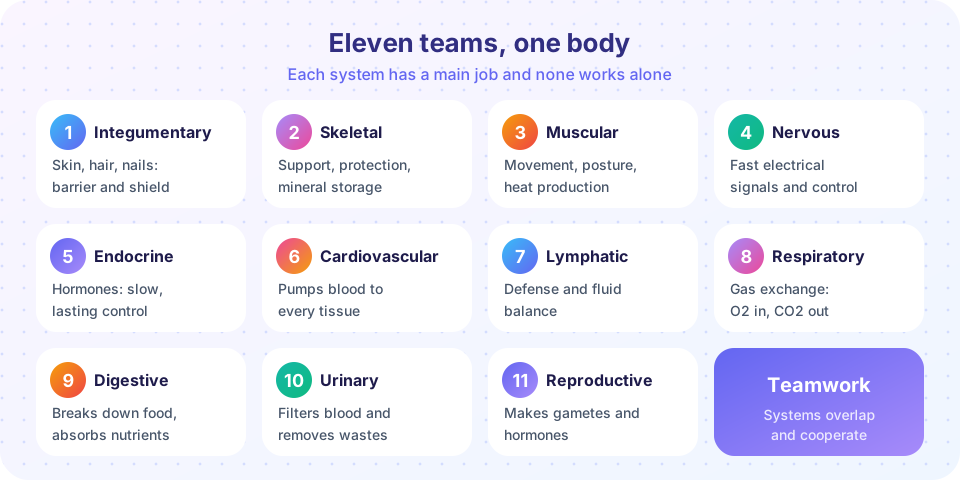
What you will learn
- The eleven organ systems, their main organs and their main functions.
- Which systems you will study in which chapter.
- How several systems cooperate during a single everyday activity.
- Why the "one organ, one job" idea is a useful simplification, not a rule.
Key terms
- Organ: a structure of two or more tissue types performing a specific function.
- Organ system: a group of organs cooperating to achieve a common function.
- Integration: the coordinated working of several systems.
- Organism: a complete living individual made of all organ systems working together.
The eleven systems
Protection, support and movement
The integumentary system is the skin, hair, nails and the glands in the skin. The skin is the body's largest organ, with an area of roughly 1.5 to 2 square meters in an adult. It keeps water in and germs out, helps control body temperature through sweating and blood flow, senses touch and makes vitamin D when sunlight hits it.
The skeletal system consists of bones, cartilage and ligaments. An adult has 206 named bones. They support the body, protect organs (the skull protects the brain, the rib cage protects the heart and lungs), store calcium and phosphate, and house the bone marrow where blood cells are made.
The muscular system here means the skeletal muscles, the muscles attached to bones by tendons. There are more than 600 of them. Muscles pull on bones to produce movement, hold posture and release heat as a by-product, which is why you shiver when cold. (Two other kinds of muscle, cardiac and smooth, belong to the heart and to the walls of hollow organs, and are covered in the next chapter.)
Control and communication
The nervous system (brain, spinal cord, nerves and sense organs) detects changes, decides what to do and sends rapid electrical signals to muscles and glands. Its effects begin in milliseconds and usually last a short time.
The endocrine system is a collection of glands (pituitary, thyroid, adrenals, pancreas, ovaries, testes and others) that release hormones into the blood. Hormones act more slowly than nerve signals, over seconds to days, but their effects last longer. Together the nervous and endocrine systems are the body's two communication networks.
Transport and defense
The cardiovascular system is the heart, blood vessels and blood. At rest the heart pumps about 5 liters of blood per minute, which means the body's whole blood supply passes through it roughly once a minute. The blood carries oxygen, nutrients, hormones and heat to cells and carries away carbon dioxide and waste.
The lymphatic system (lymph vessels, lymph nodes, spleen, thymus, tonsils) returns leaked tissue fluid to the blood and houses white blood cells. It is closely tied to the immune system, which defends the body against pathogens such as bacteria and viruses. Many books present them as one system, "lymphatic and immune".
Exchange, intake and output
The respiratory system (nose, pharynx, larynx, trachea, bronchi, lungs) brings oxygen in and removes carbon dioxide. Gas exchange happens in hundreds of millions of tiny air sacs, the alveoli, whose combined surface is far larger than the skin.
The digestive system is the mouth, esophagus, stomach, small and large intestines, and helpers such as the liver, gallbladder and pancreas. It breaks food into molecules small enough to absorb, absorbs them, and removes undigested waste.
The urinary system (kidneys, ureters, urinary bladder, urethra) filters the blood, removes metabolic waste, and regulates the volume, salt content and acidity of body fluids. Your kidneys filter about 180 liters of fluid a day, but you make only about 1 to 2 liters of urine because almost all the filtered water is reabsorbed.
Continuing the species
The reproductive system (gonads, ducts and associated glands) produces gametes (eggs and sperm), sex hormones and, in females, supports a developing embryo. It is the only system not needed to keep an individual alive, yet it is essential to the survival of the species.
| # | System | Key organs | Chapter |
|---|---|---|---|
| 1 | Integumentary | skin, hair, nails | 2 |
| 2 | Skeletal | bones, joints | 3 |
| 3 | Muscular | skeletal muscles | 3 |
| 4 | Nervous | brain, nerves | 4 |
| 5 | Endocrine | glands | 5 |
| 6 | Cardiovascular | heart, vessels | 5 |
| 7 | Lymphatic and immune | nodes, spleen | 8 |
| 8 | Respiratory | lungs, airways | 6 |
| 9 | Digestive | stomach, intestines | 6 |
| 10 | Urinary | kidneys, bladder | 7 |
| 11 | Reproductive | gonads, ducts | 7 |
Systems work as teams
Real events involve many systems at once. Consider a sprint to catch a bus. Your eyes (nervous) see the bus. The brain signals the muscles (muscular), which pull on bones (skeletal). Your heart rate climbs and blood vessels in the muscles widen (cardiovascular), while breathing speeds up (respiratory). The adrenal glands release adrenaline (endocrine). Sweat glands cool you (integumentary). Digestion and urine formation slow down as blood is redirected to the muscles (digestive and urinary). Afterwards, the immune system is not involved in the sprint itself, but it keeps guarding the skin you scraped in the stumble.
The heatmap below captures that story as a qualitative picture. The scores from 0 to 3 are teaching estimates written for this lesson, not measurements: they show which systems are most engaged at each stage, so you can see integration at a glance.
Press Run (or Ctrl + Enter) to see the result here.
Program input · what you'd type while the program runs
Type the answers before you press Run, one per line. Each time the program reads a line (with input()), it gets the next line from this box.
Common misconceptions
- "Each organ belongs to exactly one system." Many organs serve two. The pancreas is both digestive (enzymes) and endocrine (insulin). The ovaries and testes are reproductive and endocrine. The pharynx is shared by respiratory and digestive pathways.
- "There are exactly eleven systems." Eleven is a common teaching count. Some sources list more or fewer, depending on how they group things.
- "The nervous system is faster, so the endocrine system is less important." They differ in speed and duration, not importance. Growth, metabolism, blood sugar and reproduction rely on hormones.
- "The skin is just a covering." It is an organ system with sensing, temperature control, defense and vitamin D production.
Check your understanding
Quick check · 5 questions
of 5 answered You scored / 5 · perfect!
-
1. Which system produces hormones that travel in the blood?
Endocrine glands release hormones into the blood, giving slower but longer-lasting control than nerve signals. -
2. Which organ belongs to both the digestive and the endocrine systems?
The pancreas makes digestive enzymes and also releases insulin and glucagon. -
3. How many named bones does an adult skeleton have?
An adult has 206 named bones. Babies have more because some bones fuse during growth. -
4. Why do digestion and urine production slow down during a sprint?
During intense activity the body prioritizes blood flow to muscles, heart and lungs. -
5. Which system is the only one not needed for the survival of the individual?
You can live without reproducing, but the species cannot continue without it.
Summary
- The body has about eleven organ systems, each a team of organs with a main job.
- Control comes from the nervous and endocrine systems; transport from the cardiovascular and lymphatic systems; exchange from the respiratory, digestive and urinary systems.
- Support, protection and movement come from the integumentary, skeletal and muscular systems; the reproductive system continues the species.
- Real activities such as running involve many systems at once, and several organs belong to more than one system.
Next: Chapter 1 review
Track your progress
Create a free account to tick off lessons and pick up where you left off on any device.
of Anatomy and Physiology lessons completed