


















Lesson 5 of 52 · Getting Started
Chapter 1 review: the language of the body
Review anatomical position, directions, planes, cavities, membranes, quadrants and the eleven organ systems with a recap table, flashcards and a ten-question quiz.
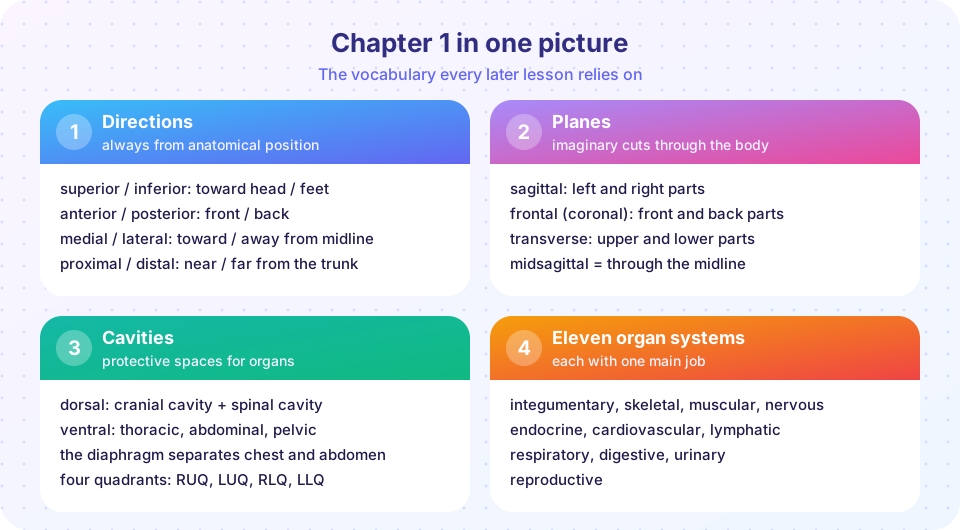
Chapter 1 gave you the vocabulary that every later chapter relies on. You learned where to stand (anatomical position), how to point (directional terms and planes), where things live (cavities, membranes and quadrants) and how the body is organized into eleven teams (organ systems). Before you move on to cells and tissues, this lesson pulls everything into one picture and then tests you.
What you will learn
- A one-page recap of the whole chapter.
- Which ideas to revisit before moving on.
- How spaced review works, with a model you can play with.
Recap table
| Topic | The essentials |
|---|---|
| Anatomical position | Upright, facing forward, palms forward, feet flat. Reference only. |
| Directions | Superior/inferior, anterior/posterior, medial/lateral, proximal/distal, superficial/deep, ipsilateral/contralateral |
| Planes | Sagittal (left and right), frontal or coronal (front and back), transverse (upper and lower) |
| Regions | Cephalic, cervical, thoracic, brachial, femoral, popliteal and others |
| Dorsal cavity | Cranial cavity (brain) and spinal cavity (cord), wrapped by meninges |
| Ventral cavity | Thoracic (two pleural cavities, pericardial cavity, mediastinum) and abdominopelvic (abdominal and pelvic) |
| Serous membranes | Parietal layer lines the wall, visceral layer covers the organ, fluid between |
| Quadrants | RUQ, LUQ, RLQ, LLQ; nine regions for more detail |
| Organ systems | Eleven teams, each with one main job, all cooperating |
Putting the pieces together: a worked example
Suppose a report says: "a small mass is visible on a transverse scan, anterior to the spine and just medial to the right kidney, in the retroperitoneal space." Decode it step by step.
- Transverse scan means a cross section: you are looking at a slice from above, with the patient's right on your left.
- Anterior to the spine places the mass in front of the vertebral column, so it is not in the dorsal cavity.
- Medial to the right kidney means closer to the midline than the kidney, on the patient's right side.
- Retroperitoneal tells you it lies behind the peritoneum, against the back wall of the abdominal part of the abdominopelvic cavity, the same place the kidneys sit.
In one sentence you now know the plane, the side, the depth and the cavity. This is exactly what the vocabulary of Chapter 1 is for. Try writing your own sentences like this about the heart, the stomach and the bladder.
Where students trip up
Three habits cause most lost marks in this chapter. First, mixing up frontal and sagittal: remember that a sagittal plane splits left from right, like an arrow (the Latin sagitta) flying front to back through the body. Second, treating "anterior" as meaning "toward the face" for a person who is lying down: the term does not change with posture. Third, forgetting that quadrant names use the patient's sides. If you can avoid these three, the rest of the chapter is largely memory work, and the flashcards and spaced reviews below are the right tool for that.
Remember it for the long term
Facts fade unless you revisit them. In the 1880s, the German psychologist Hermann Ebbinghaus memorized lists of nonsense syllables and measured how fast he forgot them. He found that forgetting is steepest soon after learning and then slows down, and that each review makes the memory last longer. The simple model below captures that idea: retention falls off like an exponential curve, and each review multiplies the memory's "stability". The numbers are a teaching model for the shape of the curve, not a prediction for any individual.
Press Run (or Ctrl + Enter) to see the result here.
Program input · what you'd type while the program runs
Type the answers before you press Run, one per line. Each time the program reads a line (with input()), it gets the next line from this box.
Now test your recall of the whole chapter with these flashcards. Say each answer first, then reveal it.
Common misconceptions
- "If I understand the words, I can skip drawing." Terms like sagittal only stick when you apply them to a picture. Sketch the body with its planes and cavities from memory.
- "The mediastinum is a lung cavity." It sits between the lungs.
- "Left and right are the examiner's." They are always the patient's.
Check your understanding
Quick check · 10 questions
of 10 answered You scored / 10 · perfect!
-
1. Which plane would separate the heart from the spine?
The heart is anterior to the spine, so a frontal plane, which divides front from back, passes between them. -
2. Which statement about anatomical position is correct?
Directions are always described as if the body were in this reference posture. -
3. The hand is ___ to the elbow.
Distal means farther from the trunk or point of attachment. -
4. Where is the heart located?
The heart lies in the mediastinum, enclosed by the pericardium. -
5. A stab to the right upper quadrant is most likely to injure which organ?
Most of the liver lies in the RUQ. The spleen is in the LUQ. -
6. What does the visceral layer of a serous membrane touch?
The visceral layer covers the organ; the parietal layer lines the wall. -
7. Which pair of terms describes the thumb and the little finger in anatomical position?
With palms forward, the thumb points away from the midline, so it is lateral to the little finger. -
8. Which system is made of glands that release hormones into the blood?
Endocrine glands release hormones directly into the blood. -
9. Which cavity holds the bladder?
The bladder lies in the pelvic part of the abdominopelvic cavity. -
10. According to the study model in this lesson, what helps memory last longer?
Each spaced review rebuilds the memory and slows later forgetting.
Summary
- Anatomical position and the paired directional terms give an exact, shared way to locate structures.
- Three planes (sagittal, frontal, transverse) slice the body; the dorsal and ventral cavities, their membranes and the abdominal quadrants map where organs sit.
- Eleven organ systems divide the labor, and they cooperate in every real activity.
- Spaced retrieval beats rereading, so revisit this chapter in a day and again in a week.
Track your progress
Create a free account to tick off lessons and pick up where you left off on any device.
of Anatomy and Physiology lessons completed