


















Lesson 38 of 52 · Urinary and Reproductive Systems
Fluid, electrolyte and acid-base balance
Learn how body water is divided, how sodium and thirst regulate volume, and how buffers, lungs and kidneys keep blood pH between 7.35 and 7.45.
You are mostly water. In a typical adult man, water makes up about 60 percent of body mass, and in a typical adult woman about 50 to 55 percent, because fat contains little water and women on average carry a larger proportion of body fat. This water is not a single pool: it is divided among compartments, and each holds a particular mix of dissolved ions. The concentration of those ions and the acidity of the fluid must be held within narrow limits, or cells swell, shrink or stop working. The remarkable fact is that the body keeps these quantities steady even though you eat, drink, sweat and exercise all day.
In this lesson you will meet the fluid compartments, the main electrolytes, the controls of thirst and sodium, and the three lines of defense against changes in pH: buffers, the lungs and the kidneys.
What you will learn
- Describe the intracellular and extracellular fluid compartments and typical volumes.
- Name the main electrolytes and their normal plasma ranges.
- Explain how thirst, ADH and aldosterone control water and sodium.
- Explain the bicarbonate buffer system and use the Henderson-Hasselbalch equation.
- Distinguish respiratory and metabolic acid-base disturbances and compensation.
Key terms
Electrolyte: a substance that forms ions in water and conducts electricity, such as sodium or potassium.
Osmolality: the concentration of dissolved particles in a fluid.
Buffer: a chemical system that resists changes in pH.
Acidosis and alkalosis: a blood pH below 7.35 or above 7.45.
Compensation: a second organ system shifting the opposite way to bring pH back toward normal.
Fluid compartments
For a 70 kg adult man with about 42 liters of total body water, roughly two thirds (about 28 liters) is intracellular fluid (ICF) inside cells. The other third (about 14 liters) is extracellular fluid (ECF). The ECF is split further: about 11 liters of interstitial fluid that bathes the cells, and about 3 liters of plasma, the fluid part of blood. Small additional pools such as cerebrospinal fluid and the fluid in the eyes are sometimes called transcellular fluid.
Water crosses the cell membrane freely by osmosis, and moves between plasma and interstitial fluid across the capillary wall (the balance of pressures described in the vessels lesson). Because of this, the solute concentration of the compartments sets how water is distributed. If the ECF becomes more concentrated, water leaves the cells and they shrink; if it becomes more dilute, water enters cells and they swell. For brain cells, swelling inside a rigid skull is dangerous, so the body is very strict about sodium concentration.
Electrolytes
Each compartment has a different ionic composition, kept by pumps in cell membranes, mainly the sodium-potassium pump.
| Ion | Main location | Plasma value | Key roles |
|---|---|---|---|
| Sodium (Na⁺) | Extracellular | 135-145 mmol/L | Water distribution, nerve and muscle signals, blood pressure |
| Potassium (K⁺) | Intracellular | 3.5-5.0 mmol/L | Resting membrane potential, heart rhythm |
| Calcium (Ca²⁺) | Bone, extracellular | Total about 2.2-2.6 mmol/L | Muscle contraction, clotting, signaling |
| Chloride (Cl⁻) | Extracellular | 98-106 mmol/L | Partner to sodium, stomach acid |
| Bicarbonate (HCO₃⁻) | Extracellular | 22-26 mmol/L | Main pH buffer |
Reference ranges differ slightly between laboratories. Potassium is a good example of why narrow limits matter: only a small change in plasma potassium alters the electrical state of heart muscle, and both too high and too low a value can cause dangerous rhythm problems.
Controlling water and sodium
Water balance. A typical adult takes in about 2.5 liters of water a day (drinks, food and a little from metabolism) and loses a similar amount: roughly 1.5 liters in urine, 0.8 liters through skin and breathing, and a little in feces. Sweat can add several liters in heat or exercise.
When plasma becomes more concentrated by about 1 to 2 percent, osmoreceptors in the hypothalamus detect it. Two things happen: thirst increases, and the posterior pituitary releases ADH, so the kidneys retain water. When plasma is diluted, both signals fall and the kidneys excrete the surplus water. This loop is so sensitive that blood osmolality stays within a few percent of 290 mOsm/kg.
Sodium balance. Sodium holds water in the extracellular space, so total body sodium determines the ECF volume and blood pressure, whereas the water-to-sodium ratio determines concentration. The main controls are aldosterone (retains sodium), ANP (excretes sodium) and the renin-angiotensin system, as in the previous lesson.
Disturbances. Dehydration, caused by too little intake or too much loss from vomiting, diarrhea, sweat or fever, lowers blood volume and raises osmolality. Too much water without sodium can dilute plasma sodium to a dangerous level (hyponatremia); this has occurred in some endurance athletes who drank very large volumes of plain water. These are educational examples only; severe symptoms need medical care.
Acid-base balance
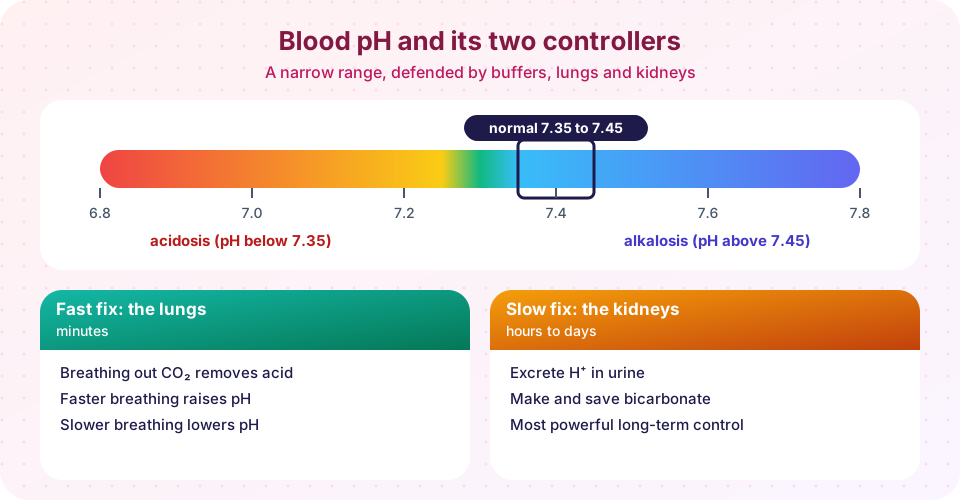
Chemical reactions in cells make acids continuously: about 15,000 mmol of carbon dioxide a day (which forms carbonic acid in water), plus lactic acid, ketone acids and acids from protein breakdown. Yet blood pH holds between 7.35 and 7.45. The pH scale is logarithmic, so a change from 7.4 to 7.1 means a doubling of the hydrogen ion concentration. Blood pH below about 6.8 or above 7.8 is not compatible with life.
First line: chemical buffers
A buffer is a pair of chemicals, a weak acid and its conjugate base, that soak up extra H⁺ or OH⁻. The most important in blood is the bicarbonate buffer system:
CO₂ + H₂O ⇌ H₂CO₃ ⇌ H⁺ + HCO₃⁻
Extra acid is removed by the base (bicarbonate); extra base is neutralized by the acid. This system is powerful because both its parts are controlled by organs: the lungs control CO₂ and the kidneys control HCO₃⁻. The relationship is written by the Henderson-Hasselbalch equation, derived by Lawrence Henderson in 1908 and written in logarithmic form by Karl Hasselbalch in 1916:
pH = 6.1 + log10( [HCO₃⁻] / (0.03 × PCO₂) )
With a bicarbonate of 24 mmol/L and a PCO₂ of 40 mmHg, the ratio is 24 / 1.2 = 20, and log10(20) = 1.30, so pH = 7.40. The pH depends on the ratio of bicarbonate to carbon dioxide, not on either alone. Other buffers include phosphate and proteins such as hemoglobin, which buffers the H⁺ released as carbon dioxide travels in blood.
Second line: the lungs
If the pH falls, the chemoreceptors raise breathing rate and depth, blowing off CO₂, which pushes the buffer equation back toward alkaline. If the pH rises, breathing slows and CO₂ is retained. The respiratory response begins within minutes and can correct about half to two thirds of a disturbance.
Third line: the kidneys
The kidneys can excrete H⁺ in the urine (bound to phosphate and ammonia buffers) and reabsorb or generate new bicarbonate. They are the only organs that can remove the non-volatile acids. The response is slow, taking hours to days, but it is the most powerful.
Disturbances
Disturbances are named by their cause.
| Disorder | pH | Primary change | Example cause | Compensation |
|---|---|---|---|---|
| Respiratory acidosis | Low | High PCO₂ | Slow or obstructed breathing | Kidneys retain bicarbonate |
| Respiratory alkalosis | High | Low PCO₂ | Hyperventilation, altitude | Kidneys excrete bicarbonate |
| Metabolic acidosis | Low | Low bicarbonate | Diabetic ketoacidosis, kidney failure, severe diarrhea | Faster breathing lowers PCO₂ |
| Metabolic alkalosis | High | High bicarbonate | Prolonged vomiting of stomach acid | Slower breathing raises PCO₂ |
Doctors interpret blood gas results by asking three questions: is the pH acid or alkaline, is the primary change in PCO₂ (respiratory) or bicarbonate (metabolic), and is there compensation? This is a skill taught in clinical training; here you learn the logic.
Common misconceptions
"Eating alkaline foods changes your blood pH." Blood pH is tightly controlled by buffers, lungs and kidneys. Diet can change the pH of urine, but not blood in a healthy person.
"Drinking more water is always better." Water in excess of need is excreted, and very large intakes can dilute sodium. Thirst is a good guide for most healthy people.
"Acidosis means the blood is acidic." Blood is always slightly alkaline (pH 7.4 is above 7.0). Acidosis means pH has fallen below the normal range.
Try it
The first TryIt draws pH lines for different carbon dioxide levels and marks typical disturbances using the Henderson-Hasselbalch equation. The example points are textbook-style values, not patient data.
Press Run (or Ctrl + Enter) to see the result here.
Program input · what you'd type while the program runs
Type the answers before you press Run, one per line. Each time the program reads a line (with input()), it gets the next line from this box.
The second TryIt is a small blood gas classifier. Enter a pH, PCO₂ and bicarbonate and see how the logic works. It is an educational exercise, not a diagnostic tool.
Check your understanding
Quick check · 5 questions
of 5 answered You scored / 5 · perfect!
-
1. What fraction of total body water is intracellular?
Roughly two thirds of body water is inside cells and one third is extracellular. -
2. Which signal does a rise in plasma osmolality cause?
Hypothalamic osmoreceptors respond to concentrated plasma by promoting water intake and retention. -
3. A patient has pH 7.28 and a high PCO₂. Which disorder fits best?
Low pH with high PCO₂ means the primary problem is retention of carbon dioxide, a respiratory acidosis. -
4. Using pH = 6.1 + log10(HCO₃⁻ / (0.03 × PCO₂)), what is the approximate pH when HCO₃⁻ = 24 and PCO₂ = 40?
24 / 1.2 = 20 and log10(20) = 1.30, so the pH is 7.40. -
5. Which organs correct acid-base disturbances most slowly but most powerfully?
The kidneys excrete acid and regulate bicarbonate over hours to days.
Summary
- Body water is mainly intracellular (about two thirds) with the rest in interstitial fluid and plasma.
- Sodium, potassium, calcium, chloride and bicarbonate are kept within narrow ranges by pumps, hormones and the kidneys.
- Thirst, ADH, aldosterone and ANP control water and sodium.
- Blood pH 7.35 to 7.45 depends on the bicarbonate to CO₂ ratio; buffers act instantly, the lungs in minutes, the kidneys over days.
- Respiratory disturbances change PCO₂; metabolic disturbances change bicarbonate; the other system compensates.
Track your progress
Create a free account to tick off lessons and pick up where you left off on any device.
of Anatomy and Physiology lessons completed