


















Lesson 18 of 52 · Nervous System and Senses
Chapter 4 overview: the nervous system and senses
See how the nervous system is organized into central and peripheral parts, how it senses, integrates and responds, and what neurons and glia do.
Right now your nervous system is reading these words, keeping you balanced on your chair, controlling your breathing without a thought from you and, if a loud noise suddenly rang out, would make you jump before you knew why. It is the body's fast communication and control network, and it does three jobs: it senses what is happening inside and outside the body, it integrates that information by deciding what matters, and it responds by commanding muscles and glands.
This chapter explores the nervous system in five steps: the cells and electrical signals (neurons), the central nervous system (brain and spinal cord), the peripheral nervous system and its autonomic division, the senses, and a review. This overview gives you the map and the vocabulary, plus a quick demonstration of how fast your own system can respond.
What you will learn
- The structural and functional divisions of the nervous system.
- The two main cell types: neurons and glial cells.
- The sense, integrate, respond sequence.
- What each lesson in the chapter covers.
Key terms
- Central nervous system (CNS): the brain and spinal cord.
- Peripheral nervous system (PNS): all the nerves and ganglia outside the brain and spinal cord.
- Afferent / efferent: carrying signals toward / away from the CNS.
- Neuron: a cell specialized to carry electrical and chemical signals.
- Neuroglia (glial cells): non-conducting cells that support, insulate and protect neurons.
Organization
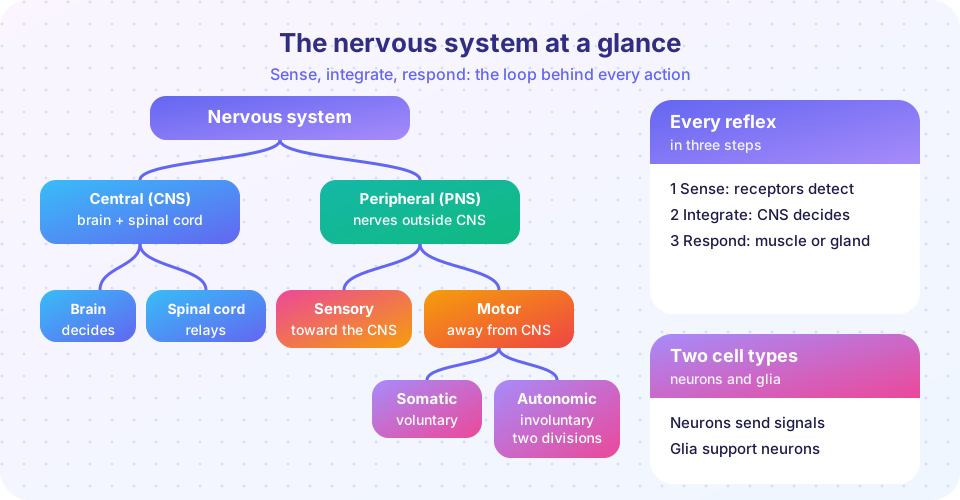
Structurally, the central nervous system is the control center, made up of the brain (inside the skull) and the spinal cord (inside the vertebral column). The peripheral nervous system consists of the nerves that connect the CNS to the rest of the body: 12 pairs of cranial nerves and 31 pairs of spinal nerves.
Functionally, the peripheral system has two directions. The sensory (afferent) division brings information to the CNS from receptors in the skin, muscles, joints, organs and special sense organs. The motor (efferent) division carries commands from the CNS to effectors: muscles and glands. The motor division has two parts. The somatic nervous system controls skeletal muscle and is mostly voluntary. The autonomic nervous system controls smooth muscle, cardiac muscle and glands without conscious effort. It has two opposing branches, sympathetic ("fight or flight") and parasympathetic ("rest and digest"), and the gut also has its own network, the enteric nervous system.
Neurons and neuroglia
The nervous system is built from two cell types. Neurons carry signals. The adult human brain has roughly 86 billion of them, according to a widely cited 2009 count by Suzana Herculano-Houzel and colleagues. Most neurons cannot divide once they mature, although some regions, such as parts of the hippocampus, add new neurons in small numbers. Neuroglia are the supporting cast, and are present in roughly similar numbers to neurons rather than the ten-fold excess older textbooks claimed. The main kinds are:
| Glial cell | Where | Job |
|---|---|---|
| Astrocyte | CNS | supports neurons, regulates the chemical environment, helps form the blood-brain barrier |
| Oligodendrocyte | CNS | wraps axons in myelin |
| Schwann cell | PNS | wraps one axon segment in myelin, and aids repair |
| Microglia | CNS | immune cells that clear debris and pathogens |
| Ependymal cell | CNS | lines the fluid-filled spaces and helps make cerebrospinal fluid |
The brain makes up only about 2% of body weight but uses about 20% of the body's energy at rest, which is why it is so sensitive to a shortage of oxygen or glucose. A few seconds without blood flow causes unconsciousness.
Sense, integrate, respond
Take a sudden pain in your finger from a hot pan. Receptors (sense) send an afferent signal along sensory neurons to the spinal cord, where interneurons (integrate) pass it to motor neurons that command your arm muscles (respond) to pull away, all before the signal reaches the brain's awareness. You become conscious of the pain slightly later. This basic loop, called the reflex arc, is the design behind every neural response, from the simplest reflex to the planning of a chess move.
How fast are signals?
Nerve signals travel at very different speeds. Thin, unmyelinated fibers conduct at about 1 meter per second, and thick, myelinated fibers at close to 100 meters per second. The next demonstration uses typical values to compare how long a signal takes to travel 1.0 meter, roughly the distance from toe to brain in a tall adult.
Press Run (or Ctrl + Enter) to see the result here.
Program input · what you'd type while the program runs
Type the answers before you press Run, one per line. Each time the program reads a line (with input()), it gets the next line from this box.
Try your own reaction time
The tool below measures how long you take to click after a box turns green. A simple visual reaction time involves your eye, brain, spinal cord, motor nerves and finger muscles, plus delays from your device and screen, so results vary from person to person and from device to device, commonly around 200 to 300 milliseconds. It is a classroom demonstration, not a test of health or ability.
What is in this chapter
| Lesson | The big question |
|---|---|
| Neurons and nerve signals | How does a neuron generate and pass on an electrical signal? |
| The brain and spinal cord | What do the parts of the CNS do and how are they protected? |
| Peripheral and autonomic nerves | How do nerves carry commands, and what is a reflex? |
| The special senses | How do the eye, ear, nose and tongue detect the world? |
| Chapter 4 review | Can you connect it all? |
Cells that carry signals
Electrical inside, chemical between.
The control center
Skull and vertebrae protect it.
Messengers to the body
Two-way traffic all day.
Windows on the world
Senses are made in the brain.
Common misconceptions
- "We only use 10% of our brain." Imaging shows activity throughout the brain across a day, and damage to nearly any region has consequences.
- "Glial cells just glue neurons together." Glia does mean glue in Greek, but these cells regulate the chemical environment, insulate axons, clear debris and take part in signaling.
- "Nerve signals are electric currents like in a wire." They are waves of ion movement across membranes, much slower than electricity in a copper wire.
- "The brain feels pain." Brain tissue has no pain receptors, which is why surgeons can operate on it with the patient awake, though the coverings and blood vessels around it do sense pain.
Check your understanding
Quick check · 5 questions
of 5 answered You scored / 5 · perfect!
-
1. Which part of the nervous system belongs to the CNS?
The CNS is the brain and spinal cord; nerves outside them belong to the PNS. -
2. Which division carries signals toward the CNS?
Afferent (sensory) fibers bring information to the CNS; efferent fibers carry commands away. -
3. Which glial cell makes myelin in the CNS?
Oligodendrocytes myelinate CNS axons; Schwann cells do so in the PNS. -
4. The autonomic nervous system controls which effectors?
The autonomic system regulates involuntary targets such as the heart, gut and glands. -
5. About what share of resting body energy does the brain use?
The brain is about 2% of body weight but uses roughly 20% of resting energy.
Summary
- The nervous system senses, integrates and responds; its parts are the CNS (brain and spinal cord) and PNS (cranial and spinal nerves).
- The PNS has sensory (afferent) and motor (efferent) divisions; the motor division splits into somatic and autonomic.
- Neurons carry signals; glial cells support, insulate and protect them.
- Conduction speeds range from about 1 m/s (unmyelinated) to about 100 m/s (thick myelinated fibers).
- The brain is about 2% of body weight but uses about 20% of resting energy.
Track your progress
Create a free account to tick off lessons and pick up where you left off on any device.
of Anatomy and Physiology lessons completed