


















Lesson 29 of 52 · Endocrine and Cardiovascular Systems
Chapter 5 review: Endocrine and Cardiovascular Systems
Review hormones, glands, blood glucose control, the heart, blood vessels and blood pressure with a recap table, flashcards and a 9-question quiz.
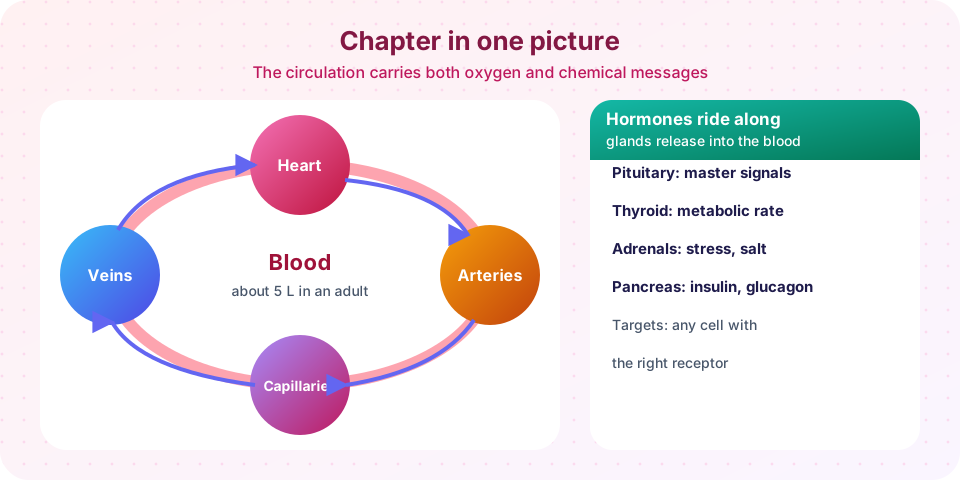
You have now followed a message from a gland, through the blood, to a target cell, and followed blood itself through a double pump and a branching network of vessels. This review pulls the chapter into one picture, one table and one test of what you can recall. Try to answer each quiz question before you read the options, and use the recap table to find the lesson to revisit if you get one wrong.
What you will learn
- Connect hormones, feedback and circulation into one picture.
- Check recall of terms, numbers and mechanisms from the chapter.
- Identify which lesson to revisit for any weak topic.
Recap table
| Topic | Key idea | Numbers and names to remember |
|---|---|---|
| Hormones | Chemical messengers released into blood; target cells need the receptor | Bayliss and Starling (1902); half-lives from minutes to days |
| Hormone families | Peptide (surface receptor), steroid (nuclear receptor), amine | Cyclic AMP as second messenger (Sutherland) |
| Pituitary | Anterior makes tropic hormones; posterior releases ADH and oxytocin | Controlled by the hypothalamus |
| Thyroid, parathyroid, adrenal | Metabolic rate; calcium; stress and salt | T3 and T4; PTH; cortisol, aldosterone, adrenaline |
| Glucose control | Insulin lowers, glucagon raises blood glucose | 70-99 mg/dL fasting; Banting, Best, Macleod and Collip |
| Heart | Double pump, four chambers, four valves | CO = HR x SV, about 5 L/min |
| Heartbeat | SA node, AV node delay, bundle of His, Purkinje fibers | P, QRS and T waves |
| Vessels | Arteries pressure, capillaries exchange, veins return | Resistance proportional to 1/r⁴ |
| Blood pressure | Pressure = output x resistance; baroreceptor reflex | 120/80 mmHg typical; MAP about 93 mmHg |
Three connections worth noticing
Feedback everywhere. The thyroid axis, the pancreas and the baroreceptor reflex all use the same logic: a sensor measures a variable, a control center compares it to a set point, and an effector pushes the variable back. Learn the pattern once and you can read any new diagram.
Structure follows function. The left ventricle is thick because it works against high resistance. Capillary walls are thin because exchange needs a short path. Steroid hormones are fat-soluble so they can enter cells. If you forget a fact, ask what the structure needs to do and the answer is often implied.
Two systems, one network. Hormones act through the vascular system. Adrenaline speeds the heart; aldosterone and ADH raise blood volume; atrial natriuretic hormone from the heart lowers it. When you study the urinary system in the next chapter, you will see the kidneys joining these loops.
A worked scenario
A runner finishes a sprint and stands bent over, breathing hard. Use the chapter to explain what is happening. Adrenaline from the adrenal medulla, a fast amine hormone, raised the heart rate within seconds by acting on the SA node, and cardiac output (heart rate times stroke volume) climbed several-fold. The arterioles in the working muscles widened, which lowered resistance there, while those in the gut narrowed, so blood was redirected. Glucagon and adrenaline made the liver release glucose, which is a feedback response to falling blood sugar. Over the next minutes the baroreceptors and chemoreceptors will return the pressure and the heart rate to their resting values. Notice how many separate loops were involved and how each one could be named with its sensor, control center and effector. If you can tell this story in your own words, you have understood the chapter.
Try it
Use the flashcards to quiz yourself on terms from the chapter. The cards are a study tool: click to flip, then mark whether you knew the answer.
Now a quick calculator for the numbers in the chapter, to practice the formulas.
Press Run (or Ctrl + Enter) to see the console output here.
No output.
Check your understanding
Quick check · 9 questions
of 9 answered You scored / 9 · perfect!
-
1. A hormone binds a receptor on the surface of a cell and triggers cyclic AMP inside. What kind of hormone is it most likely to be?
Peptide hormones cannot cross the membrane, so they use surface receptors and second messengers such as cyclic AMP. -
2. Which gland makes thyroxine?
Thyroxine (T4) and triiodothyronine (T3) come from the thyroid gland, which needs iodine. -
3. After a meal, which sequence is correct?
High glucose stimulates beta cells to release insulin, which lowers blood glucose. -
4. Which structure initiates each normal heartbeat?
The sinoatrial node in the right atrium depolarizes spontaneously and sets the heart rate. -
5. Which vessel carries oxygen-rich blood back to the heart?
The pulmonary veins return oxygenated blood from the lungs to the left atrium. -
6. Stroke volume is 80 mL and heart rate is 75 beats per minute. What is the cardiac output?
75 × 80 mL = 6,000 mL/min = 6 L/min. -
7. What is the main reason a small drop in arteriole radius greatly raises blood pressure?
Because resistance is proportional to 1/r⁴, a modest narrowing multiplies resistance. -
8. Which hormone pair do the posterior pituitary release?
ADH and oxytocin are made in the hypothalamus and released from the posterior pituitary. -
9. What does the T wave of the ECG represent?
P is atrial depolarization, QRS is ventricular depolarization, T is ventricular repolarization.
Summary
- Hormones travel in blood and act on cells with matching receptors; steroids and peptides use different routes.
- Insulin and glucagon keep glucose in a narrow band by negative feedback.
- The heart is a double pump driven by the SA node; cardiac output is rate times stroke volume.
- Vessel structure matches function, and pressure equals output times resistance.
Track your progress
Create a free account to tick off lessons and pick up where you left off on any device.
of Anatomy and Physiology lessons completed