


















Lesson 30 of 52 · Respiratory and Digestive Systems
Chapter 6 overview: Respiratory and Digestive Systems
See how the lungs and the gut bring oxygen and nutrients into the body, and preview each lesson in this chapter on breathing, gas exchange and digestion.
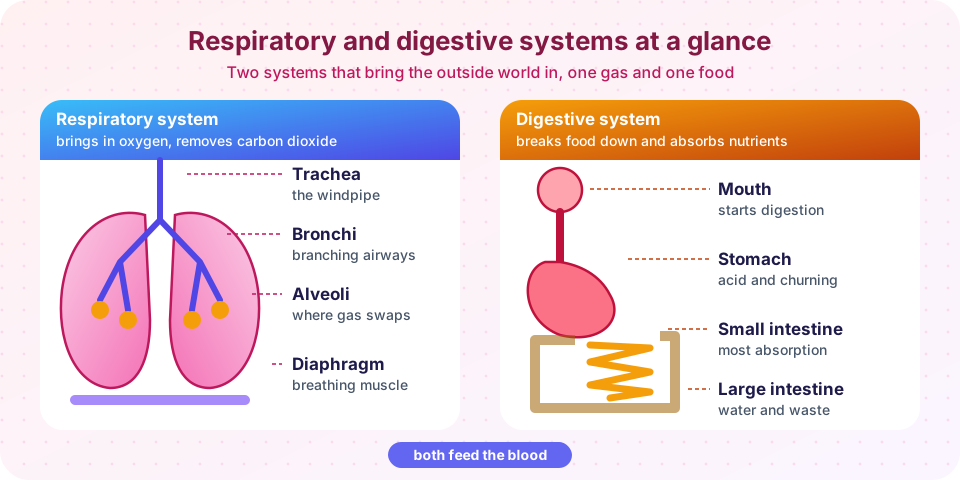
Your body is a closed system of cells, but it cannot be closed to the world. Cells burn fuel and need a steady supply of oxygen and food molecules, and they make waste that must leave. Two organ systems manage most of the traffic across the boundary between the outside world and your blood. The respiratory system takes in oxygen and gets rid of carbon dioxide. The digestive system takes in food, breaks it into particles small enough to absorb, and passes the useful ones into the blood.
It may seem odd that the inside of your lungs and the inside of your gut are "outside" the body. Yet both are tubes that open to the air at one end. The air in your lungs and the food in your intestine have not entered the body until molecules cross a thin layer of cells into the blood. Understanding that single idea makes the anatomy of both systems easy to remember: each is built to give a huge, thin, moist surface for exchange, protected by mucus and guarded by defenses.
What you will learn
- Why both systems are built around large, thin exchange surfaces.
- The overall routes taken by air and by food.
- How the lessons in this chapter fit together.
Key terms
Ventilation: the movement of air in and out of the lungs (breathing).
Gas exchange: diffusion of oxygen and carbon dioxide between air and blood.
Digestion: breaking food into small molecules, mechanically and chemically.
Absorption: movement of nutrients from the gut into blood or lymph.
Peristalsis: waves of muscle contraction that push contents along a tube.
Two doors to the blood
Both end at capillaries
The air route
The food route
Shared design rules
The big picture
The two systems share three design principles.
Large surface area. Diffusion is slow over long distances, so exchange surfaces are folded and branched. Your lungs hold hundreds of millions of tiny air sacs called alveoli, which together present a surface of tens of square meters, roughly the area of a badminton court. The small intestine is lined with folds, finger-like villi and microscopic projections that multiply its absorbing area many hundred times over its simple tube shape.
Thin walls and a rich blood supply. In both places only a single layer of cells, or two, separates the contents from the capillaries. The blood is the receiving system, and the cardiovascular chapter you just finished explains how it carries what arrives to every tissue.
Defense and self-cleaning. Because these surfaces face the outside, they face microbes and particles too. The airways are lined with mucus and cilia that sweep particles upward. The stomach is a bath of acid. The gut wall is full of immune tissue. You will meet these defenses again in the immunity chapter.
The systems also meet in unexpected places. The pharynx at the back of the throat is shared: air and food both pass through it, and a flap of cartilage called the epiglottis closes the airway during swallowing. A mistake sends food "down the wrong way", which is why you cough. And both systems burn effort: breathing uses muscle, digestion uses muscle and glands, and both are regulated by the nervous system and by hormones such as secretin, which you met in the endocrine lesson.
Lessons in this chapter
- Breathing and lung mechanics: airways, the diaphragm, Boyle's law and lung volumes.
- Gas exchange and transport: partial pressures, hemoglobin and carbon dioxide.
- The digestive tract and enzymes: mouth to small intestine, acid, enzymes and hormones.
- Absorption, the liver and the large intestine: villi, bile, water balance and the microbiome.
- Chapter review: a summary picture and a mixed quiz.
Try it
A quick scale check: how much air do you move in a day? The numbers are typical resting values for a healthy adult.
Press Run (or Ctrl + Enter) to see the console output here.
No output.
Second, follow a meal. Pick a nutrient and see where it starts to be digested. This is a simplified map for study.
Check your understanding
Quick check · 4 questions
of 4 answered You scored / 4 · perfect!
-
1. Why are the lungs and small intestine both folded or branched?
Diffusion and absorption depend on surface area, so both organs multiply their surface with branches and folds. -
2. Which structure closes the airway when you swallow?
The epiglottis folds over the larynx to keep food out of the trachea. -
3. Which statement about the gut lumen is correct?
The digestive tract is a tube open to the outside; nutrients enter the body proper only after absorption. -
4. What does peristalsis do?
Peristalsis is the coordinated squeezing that moves swallowed food and other contents through the digestive tract.
Summary
- The respiratory and digestive systems are tubes that bring oxygen and nutrients to the blood.
- Both use large, thin, well-supplied surfaces and have defenses against microbes.
- They share the pharynx, where the epiglottis directs air and food.
- This chapter covers breathing, gas exchange, digestion and absorption.
Track your progress
Create a free account to tick off lessons and pick up where you left off on any device.
of Anatomy and Physiology lessons completed