


















Lesson 48 of 48 · Projects and Practice
Further study: where to go from here
Map your next steps after the fundamentals: statics, strength of materials, fluid mechanics, structural engineering and materials science, plus how to build a portfolio.
You now know how engineers think about water, roads, soil and the environment, and you have run real calculations. The next question is where to go deeper. Civil engineering is a wide field, and almost every specialty rests on a few shared foundations. This lesson maps those foundations, points to the matching tracks on this site, and suggests ways to practice beyond the screen.
What you will learn
- Which subjects form the core of a civil engineering education.
- How each one connects to what you did in this chapter.
- How to build skills through projects, not only reading.
Key terms
Statics: the study of forces on bodies at rest. Strength of materials: how members stretch, bend and break under load. Fluid mechanics: the physics behind all of the hydraulics in this course. Structural engineering: designing beams, frames, bridges and buildings. Portfolio: a collection of your own designs and calculations that shows what you can do.
The core subjects
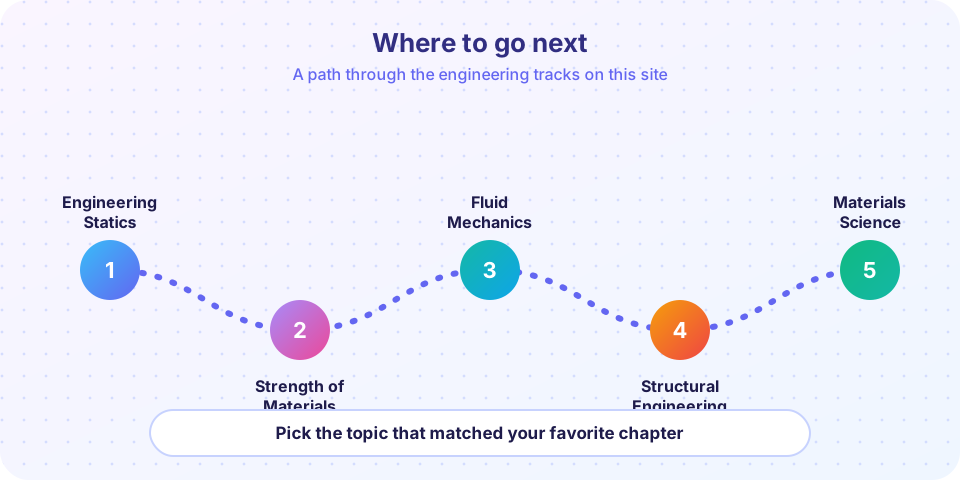
- Statics. Everything about retaining walls and footings in this chapter depends on equilibrium: forces and moments balance. Learn it in Engineering Statics. It also teaches free-body diagrams, the most useful sketch in engineering.
- Strength of materials. Once you know the forces, you ask whether the member survives: stress, strain, bending and deflection. See Strength of Materials.
- Fluid mechanics. The hydraulics chapter used the results; fluid mechanics derives them and goes further into turbulence, pumps and boundary layers. See Fluid Mechanics.
- Structural engineering. Combine statics and materials to design the frames and bridges that carry loads: Structural Engineering.
- Materials science. Why is steel ductile and concrete brittle? How does asphalt age? Materials Science explains what is going on inside.
Other topics worth exploring later include construction management, surveying and GIS, water resources modeling, transportation planning, geotechnical site investigation and environmental impact assessment. The statistics behind rainfall frequencies and traffic counts are covered in Statistics and Probability, a helpful companion for hydrology.
Skills beyond the textbook
- Estimate first. Before any detailed calculation, guess the answer to within a factor of two. This catches unit mistakes.
- Read real specifications. Design codes and agency manuals show how the simple formulas of this course are extended and where they stop being valid.
- Use spreadsheets and code. Every TryIt in this chapter is a small program. Changing the inputs, plotting results and checking limits teaches intuition faster than single numbers.
- Visit sites. Look at a culvert, a retaining wall or a treatment plant. You will notice details, such as weep holes and outlet protection, that a book rarely shows.
- Communicate. Engineers spend a large part of their time writing: reports, drawings and emails. Practice writing a one-page design note like the one in the culvert project.
Careers and professional steps
Most civil engineers work for consultancies, contractors, public agencies or utilities. A bachelor's degree is the typical entry, followed by supervised experience and an exam to become a licensed or chartered engineer, where this is required by the country. Professional societies offer student membership, mentoring and technical papers. The requirements vary widely by country, so check the rules where you plan to work.
Common misconceptions
"Civil engineering is only about concrete and steel." It also covers water, soil, transport, the environment, data and planning.
"Software does the design, so theory is optional." Software needs informed inputs and informed checks. Engineers who understand the theory catch the errors that software hides.
"You must pick one specialty now." Fundamentals are shared, and many engineers move between fields during their careers.
Try it
Build a simple study plan as a chart and then a tiny helper that suggests a next topic from your interests. Both are examples to adapt, not recommendations about your own path.
Press Run (or Ctrl + Enter) to see the result here.
Program input · what you'd type while the program runs
Type the answers before you press Run, one per line. Each time the program reads a line (with input()), it gets the next line from this box.
Press Run (or Ctrl + Enter) to see the console output here.
No output.
Check your understanding
Quick check · 4 questions
of 4 answered You scored / 4 · perfect!
-
1. Which subject teaches how forces balance on bodies at rest?
Statics is the study of equilibrium of forces and moments. -
2. Why do engineers estimate an answer before calculating?
A quick estimate gives a size to compare against the detailed result. -
3. Which track explains why steel is ductile and concrete brittle?
Materials science studies structure and properties of materials. -
4. What is a good habit when using design software?
Software is only as good as the inputs and the engineer's checks.
Summary
- Statics, strength of materials, fluid mechanics, structural engineering and materials science form the core.
- Each connects to calculations you already did in this course.
- Build skills through estimates, specifications, small programs and site visits.
- Professional requirements vary by country; check them early.
Next: Back to the course page
Track your progress
Create a free account to tick off lessons and pick up where you left off on any device.
of Civil Engineering Fundamentals lessons completed