


















Lesson 21 of 48 · Construction Materials
Chapter 4 Review: Construction Materials
Review construction materials: properties, concrete mix and strength, steel behavior, timber, masonry, asphalt, and stress, strain and testing, with a ten-question quiz.
You can now describe the main construction materials in the language engineers use: properties, numbers and tests. This review pulls the chapter into one picture, gives you a recap table with the key formulas, and ends with a longer quiz that mixes all five lessons.
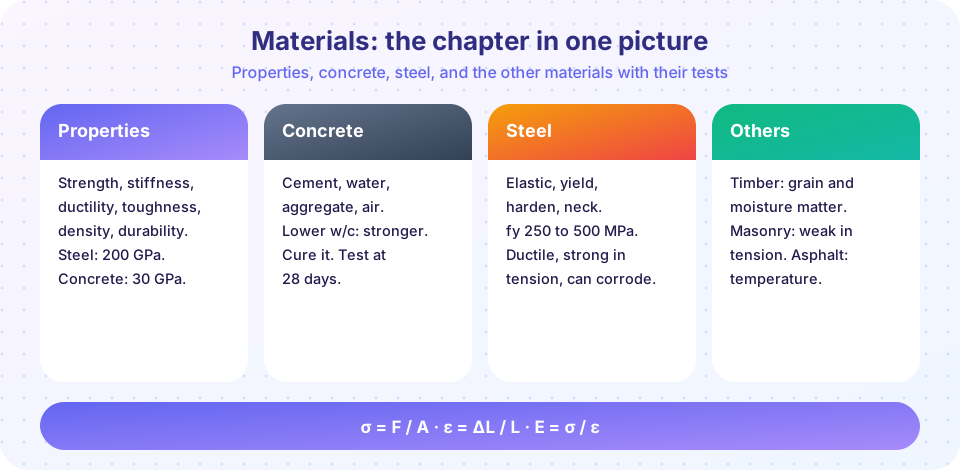
Recap table
| Lesson | Big idea | Remember |
|---|---|---|
| Chapter 4 Overview | Compare materials by strength, stiffness, ductility, density, durability | Steel 200 GPa, concrete about 30 GPa, timber about 11 GPa |
| Concrete Basics | Lower w/c gives higher strength; cure it | f(t) = f28 × t / (4 + 0.85 t); fc = F / A |
| Steel and Metals | Elastic, yield, harden, neck | Py = fy × A; εy = fy / E |
| Timber, Masonry and Asphalt | Grain and moisture; compression-only masonry; temperature-sensitive asphalt | MC = (wet − dry) / dry |
| Stress, Strain and Material Testing | Size-free measures and how tests give them | σ = F/A, ε = ΔL/L, E = σ/ε, δ = FL/(AE) |
Try it
Press Run (or Ctrl + Enter) to see the result here.
Program input · what you'd type while the program runs
Type the answers before you press Run, one per line. Each time the program reads a line (with input()), it gets the next line from this box.
Press Run (or Ctrl + Enter) to see the console output here.
No output.
Check your understanding
Quick check · 10 questions
of 10 answered You scored / 10 · perfect!
-
1. Which property does Young's modulus measure?
E relates stress to strain in the elastic range; it is a measure of stiffness. -
2. A concrete mix has 150 kg of water and 300 kg of cement. What is w/c?
150 ÷ 300 = 0.50. -
3. Which is the correct reason to cure concrete?
Hydration needs water; early drying stops strength gain. -
4. A 12 mm bar (A = 113 mm²) has fy = 500 MPa. Its yield load is about:
500 × 113 = 56,500 N ≈ 56.5 kN. -
5. Timber is weakest in:
Across the grain the fibers are crushed sideways, so strength is much lower. -
6. Masonry walls tend to crack under sideways loading because masonry is:
Bending causes tension on one face, and masonry resists tension poorly. -
7. A 4 m steel bar (E = 200 GPa) carries 100 MPa. How much does it stretch?
ε = 100 ÷ 200,000 = 0.0005; δ = 0.0005 × 4,000 mm = 2 mm. -
8. What do you get by dividing force by area?
σ = F / A. -
9. Why do steel and concrete work well together in reinforced concrete?
They expand by similar amounts and complement each other: concrete takes compression, steel takes tension. -
10. Which statement about asphalt is true?
Asphalt is mostly aggregate with about 5 % bitumen, and it softens when hot and stiffens when cold.
Summary
- Materials are compared by strength, stiffness, ductility, density and durability; strength and stiffness are different.
- Concrete strength falls as w/c rises and grows with age and curing; steel behaves elastically, yields, hardens and necks.
- Timber depends on grain and moisture, masonry on compression and bond, asphalt on temperature.
- Stress, strain and Young's modulus link tests to design numbers.
- Chapters 5 to 9 apply these tools to water, transportation, soil, sustainability and projects.
Track your progress
Create a free account to tick off lessons and pick up where you left off on any device.
of Civil Engineering Fundamentals lessons completed