


















Lesson 19 of 48 · Construction Materials
Timber, Masonry and Asphalt
Learn how timber, brick and block masonry and asphalt behave, why grain and moisture matter, how walls and pavements are built, and how to calculate with them.
Concrete and steel get the headlines, but a huge share of the world's buildings and roads are made of three humbler materials: wood, masonry and asphalt. Each has a distinctive personality. Timber is strong in one direction and weak in another. Masonry is strong when squeezed and weak when pulled. Asphalt behaves like a solid on a cold morning and like a very thick syrup on a hot afternoon. Knowing these personalities is what lets you use each material well.
What you will learn
- Why timber is anisotropic and how moisture changes it.
- How engineered wood products overcome the limits of sawn timber.
- How masonry walls carry load and why bond and mortar matter.
- How a flexible asphalt pavement is layered and why temperature matters.
Key terms
- Anisotropic: having different properties in different directions, like wood.
- Moisture content (MC): mass of water in wood as a percentage of its oven-dry mass.
- Bond: the pattern in which masonry units overlap.
- Bitumen: the black, sticky binder from crude oil used in asphalt.
Timber
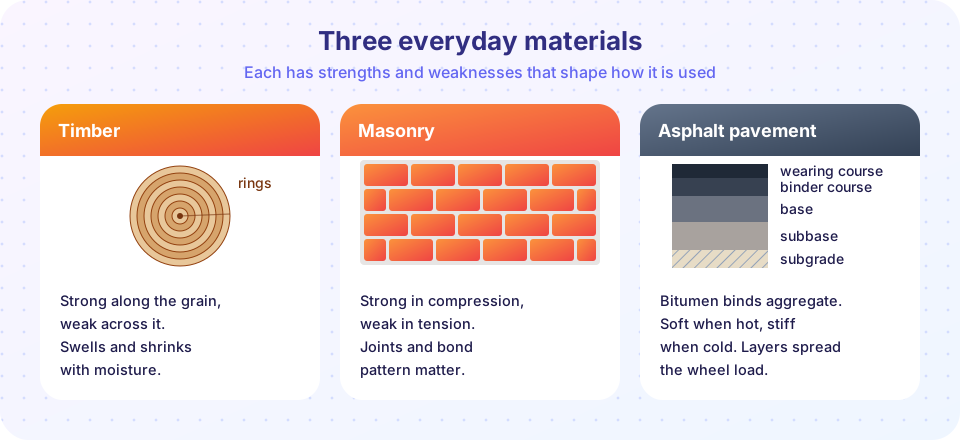
Wood is made of long cellulose fibers glued by lignin, arranged along the tree's trunk. That structure explains everything. Along the grain, the fibers work like bundles of straws and are strong. Across the grain, the fibers are crushed sideways or pulled apart, and the wood is much weaker. For a typical softwood strength class, C24 in the European system, characteristic strengths are about 21 MPa in compression along the grain, 14 MPa in tension along the grain, but only about 2.5 MPa in compression across the grain. Designers therefore pay close attention to bearing at supports, where loads press across the fibers.
Moisture is the second big factor. Living wood is full of water. As timber dries below the fiber saturation point (around 28 to 30 percent moisture content) it shrinks and gains strength. Moisture content is MC = (wet mass − dry mass) ÷ dry mass × 100. A piece that weighs 520 g wet and 450 g after oven drying has MC = 70 ÷ 450 = 15.6 %. Timber in heated buildings settles at about 8 to 12 percent; outdoors under cover, around 15 to 18. Wood kept above roughly 20 percent moisture can rot or attract insects, so good detailing keeps it dry.
Other features: knots and sloping grain lower strength; wood creeps under long-term load; and it burns, but thick sections char at a predictable rate (about 0.6 to 0.7 mm per minute) and the unburned core keeps carrying load. This is why large timber beams can survive fire for a known time.
Engineered wood reduces the variability: plywood glues thin veneers with alternating grain, glulam (glued laminated timber) bonds boards into large beams and curves, LVL (laminated veneer lumber) is stronger and more uniform, and CLT (cross-laminated timber) stacks layers at right angles into big panels that form floors and walls of multi-story buildings. Timber also stores carbon, which is why mass timber attracts interest in low-carbon design.
Masonry
Masonry builds walls from units (clay bricks, concrete blocks, natural stone) joined by mortar, usually cement, lime and sand. A standard UK clay brick is 215 × 102.5 × 65 mm, which with 10 mm joints gives a module of 225 mm long and 75 mm high. So 1 m² of single-skin wall needs about 1 ÷ (0.225 × 0.075) ≈ 59 bricks.
Masonry resembles concrete: strong in compression, weak in tension. A wall carrying a floor load does well; a wall pushed sideways by wind or an earthquake can crack along mortar joints. Reinforcement, grouted cores, tie systems and buttresses address this. Several details matter:
- Bond: units overlap so vertical joints do not line up. In running bond, each course is shifted by half a brick. Overlap spreads loads and avoids long vertical cracks.
- Mortar: it must be weaker than the units or at least compatible, so that cracks happen in the joints (easily repaired) rather than through the units.
- Moisture: damp-proof courses stop water rising from the ground, and cavity walls keep rain from reaching the inside.
- Slenderness: tall, thin walls buckle. Codes limit height-to-thickness ratios.
Asphalt and pavements
Asphalt concrete is aggregate (stones and sand, about 95 percent of the mix by mass) coated and bound by bitumen (about 5 percent). It is mixed hot, around 140 to 160 °C, laid with a paver and compacted by rollers before it cools.
A flexible pavement spreads wheel loads through layers. At the top are the wearing course (smooth, skid-resistant) and the binder course, then a base of granular material or bound mixture, a subbase, and finally the natural subgrade soil. Each layer is stronger and stiffer than the one below, so the pressure under a wheel falls with depth until the soil can carry it. A rigid pavement uses a concrete slab instead, which spreads load over a wide area.
Asphalt is viscoelastic: its stiffness depends strongly on temperature and on how fast it is loaded. In hot weather and under slow heavy traffic it can deform into ruts. In cold weather it becomes stiff and brittle and may crack. Water getting under the surface causes potholes. Engineers choose binder grades for the local climate and design drainage carefully.
Common misconceptions
- "Wood is weaker than concrete." Compare per unit weight: along the grain timber is very strong for its weight. Its weakness is across the grain and in moisture.
- "Mortar is just glue." It also spreads load evenly, seals joints against rain, and accommodates small movements.
- "A thicker asphalt layer always fixes a weak road." If the subgrade is soft or wet, adding asphalt only helps up to a point; drainage and foundation come first.
Try it
Press Run (or Ctrl + Enter) to see the result here.
Program input · what you'd type while the program runs
Type the answers before you press Run, one per line. Each time the program reads a line (with input()), it gets the next line from this box.
Press Run (or Ctrl + Enter) to see the console output here.
No output.
Press Run (or Ctrl + Enter) to see the result here.
Program input · what you'd type while the program runs
Type the answers before you press Run, one per line. Each time the program reads a line (with input()), it gets the next line from this box.
Check your understanding
Quick check · 5 questions
of 5 answered You scored / 5 · perfect!
-
1. A timber sample weighs 560 g wet and 500 g oven-dry. What is its moisture content?
MC = (560 − 500) ÷ 500 × 100 = 12 %. -
2. Why is timber described as anisotropic?
Strength along the fibers is much greater than across them. -
3. Masonry is generally:
Like concrete, masonry carries pushing loads well but cracks when pulled. -
4. Which layer of a flexible pavement is at the very top?
The wearing course is the surface layer; the subgrade is the natural soil at the bottom. -
5. Why is asphalt described as viscoelastic?
It is stiff when cold or loaded quickly and flows when hot or loaded slowly.
Summary
- Timber is strong along the grain and weak across it; moisture content controls shrinkage, strength and rot, and engineered wood evens out the variability.
- Masonry is strong in compression and weak in tension; bond, mortar and detailing govern performance.
- Asphalt is about 95 percent aggregate and 5 percent bitumen; flexible pavements spread load through layers down to the subgrade.
- Temperature and moisture are the main enemies of asphalt and timber respectively.
Track your progress
Create a free account to tick off lessons and pick up where you left off on any device.
of Civil Engineering Fundamentals lessons completed