


















Lesson 35 of 48 · Geotechnical Engineering
Effective stress and consolidation
Master Terzaghi's effective stress principle, compute stresses in layered ground with a water table, and predict how much and how fast clay settles.
In 1925 Karl Terzaghi, an Austrian engineer often called the father of soil mechanics, published a short statement that changed everything: the strength and compression of soil depend not on the total stress, but on the stress carried by the grains, the effective stress. Water in the pores pushes in all directions and gives no resistance to shear. Once you understand this, you can explain why quicksand is dangerous, why a rising water table can undermine a building, and why a new embankment on clay keeps settling for years.
What you will learn
- How to compute total stress, pore pressure and effective stress at any depth.
- How the water table changes effective stress.
- How to estimate the final consolidation settlement of a clay layer.
- How to estimate how long that settlement takes.
Key terms
Total stress (σ): the weight of everything above a point, soil and water, per unit area.
Pore water pressure (u): the pressure of the water in the voids.
Effective stress (σ′): σ − u, the stress carried by the soil skeleton.
Consolidation: the slow squeezing of water out of a loaded saturated clay, causing it to compress.
Coefficient of consolidation (c_v): how quickly a clay drains, in m²/year.
Stresses in layered ground
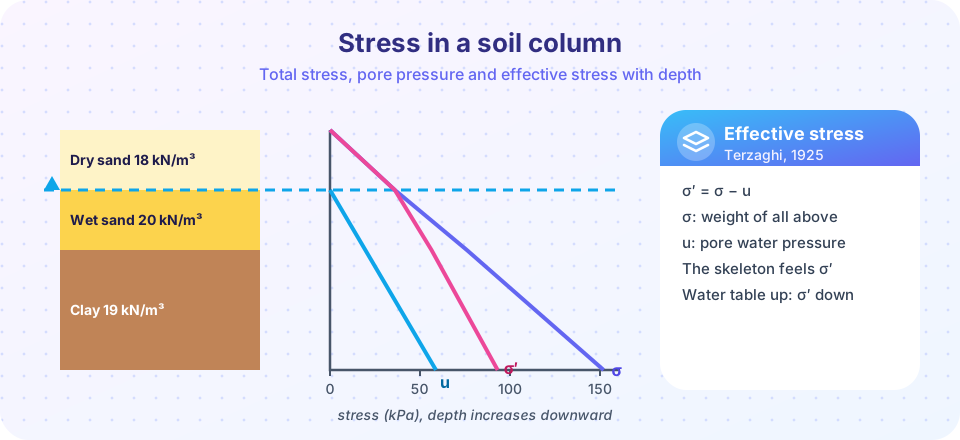
At depth z, total stress is the sum of unit weight times thickness for each layer above. Pore pressure is zero above the water table and γ_w × (depth below the water table) beneath it.
Worked example. The ground has 2 m of dry sand (γ = 18 kN/m³), then saturated sand to 4 m depth (γ_sat = 20 kN/m³), then clay from 4 to 8 m (γ_sat = 19 kN/m³). The water table is 2 m deep.
| Depth | σ (kPa) | u (kPa) | σ′ (kPa) |
|---|---|---|---|
| 2 m | 18 × 2 = 36 | 0 | 36 |
| 4 m | 36 + 20 × 2 = 76 | 9.81 × 2 = 19.6 | 56.4 |
| 8 m | 76 + 19 × 4 = 152 | 9.81 × 6 = 58.9 | 93.1 |
Notice that total stress keeps growing, yet beneath the water table the effective stress grows more slowly: each extra meter adds only γ_sat − γ_w (about 10 kN/m³ for sand), called the submerged or buoyant unit weight. If the water table rises to the surface, σ′ drops everywhere above it. This is why flooding can make slopes fail and why quicksand occurs: upward seepage can raise u until σ′ reaches zero and the grains float.
Stress from a new load
A footing adds stress that spreads with depth. A rough rule is the 2:1 method: the load spreads over an area that grows by one unit horizontally for every two units of depth. For a strip footing of width B with pressure q, Δσ ≈ q B / (B + z) at depth z. A 2 m wide footing at 150 kPa adds about 150 × 2 / (2 + 4) = 50 kPa at 4 m depth. More precise answers come from elastic theory (Boussinesq), but the rule of thumb is useful for checks.
Consolidation settlement
When a load is applied to saturated clay, the water cannot escape at once. Initially the water takes the extra load as excess pore pressure. Over time water drains, the pore pressure falls to its original value, and the soil skeleton takes the load, so effective stress rises and the clay compresses. This delayed process is consolidation.
For a normally consolidated clay layer of thickness H, the final settlement is
S_c = C_c H / (1 + e₀) × log₁₀((σ′₀ + Δσ) / σ′₀)
where C_c is the compression index, e₀ the initial void ratio, σ′₀ the initial effective stress at mid-layer, and Δσ the added stress there.
Worked example. A 4 m clay layer has C_c = 0.30, e₀ = 0.90, σ′₀ = 60 kPa at mid-depth and Δσ = 40 kPa.
S_c = 0.30 × 4 / 1.90 × log₁₀(100 / 60) = 0.632 × 0.222 ≈ 0.140 m = 140 mm
How long does it take?
Terzaghi's theory gives the time for a given degree of consolidation U:
t = T_v H_dr² / c_v
H_dr is the longest drainage path: the layer thickness if water escapes from one side only, or half of it if it drains both top and bottom. T_v is a dimensionless time factor. For U up to 60%, T_v = (π/4) U²; for larger U, T_v = 1.781 − 0.933 log₁₀(100 − U%). At 90% consolidation T_v = 0.848. With H_dr = 2 m (the 4 m clay drains up and down) and c_v = 1.5 m²/year:
t₉₀ = 0.848 × 2² / 1.5 ≈ 2.3 years
Doubling the drainage distance multiplies the time by four. That is why engineers speed up consolidation by driving vertical drains (wicks) through thick clay: they shorten the drainage path from meters to a fraction of a meter. Sand layers, in contrast, consolidate in seconds because they drain freely.
Common misconceptions
"Settlement happens as soon as the building is loaded." In clay, the largest part appears over months or years. In sand it is nearly immediate.
"Pore pressure only matters below the water table." Pore pressure is zero above it in the simplest model, but capillary tension in fine soils above the table can add effective stress.
"Total stress drives soil behavior." Effective stress does. Two soils with the same total stress behave very differently with different pore pressures.
Try it
Compute a stress profile for any layering, then plot how settlement unfolds over time.
Press Run (or Ctrl + Enter) to see the result here.
Program input · what you'd type while the program runs
Type the answers before you press Run, one per line. Each time the program reads a line (with input()), it gets the next line from this box.
Press Run (or Ctrl + Enter) to see the result here.
Program input · what you'd type while the program runs
Type the answers before you press Run, one per line. Each time the program reads a line (with input()), it gets the next line from this box.
Check your understanding
Quick check · 5 questions
of 5 answered You scored / 5 · perfect!
-
1. At 5 m depth below a water table at the ground surface, what is the pore pressure? (γw = 9.81 kN/m³)
u = γw × 5 = 49.05 kPa. -
2. σ = 120 kPa and u = 45 kPa. The effective stress is
σ′ = σ − u = 75 kPa. -
3. If the water table rises, effective stress in the soil below
Pore pressure rises while total stress changes little, so σ′ falls. -
4. A clay layer drains from top and bottom and is 6 m thick. The drainage path H_dr is
With two-way drainage the longest path is half the thickness. -
5. If H_dr doubles, the time for a given consolidation is
t is proportional to H_dr².
Summary
- Effective stress
σ′ = σ − ucontrols soil strength and compression. - Pore pressure below the water table is
γ_wtimes depth below it. - Consolidation settlement:
S_c = C_c H/(1+e₀) log₁₀((σ′₀+Δσ)/σ′₀). - Time follows
t = T_v H_dr² / c_v; shorter drainage paths mean faster settlement.
Track your progress
Create a free account to tick off lessons and pick up where you left off on any device.
of Civil Engineering Fundamentals lessons completed