


















Lesson 2 of 48 · Getting Started
What Is Civil Engineering?
Learn what civil engineers do, how the field began, which problems it solves and how engineers balance safety, cost, time and the environment.
Look out of any window. The road, the building, the water in the tap, the drain under the street and the bridge in the distance were all planned and checked by civil engineers. Civil engineering is the branch of engineering that designs, builds and looks after the physical systems a society needs to live, work and move around.
The word "civil" separates this work from military engineering, which was the older profession. In the 1700s, builders of canals, harbors and roads for ordinary people began to call themselves civil engineers. John Smeaton, who designed the Eddystone Lighthouse in the 1750s, is often named as the first person to use the title. The Institution of Civil Engineers was founded in London in 1818, and similar societies followed worldwide.
What you will learn
- A working definition of civil engineering and where the word "civil" comes from.
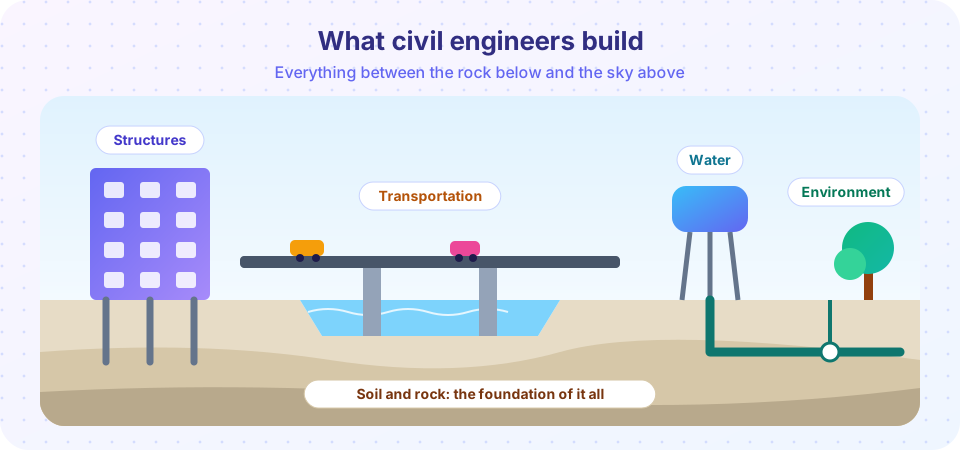
- The four big themes of the work: structures, transportation, water and the environment.
- How an engineer turns a need into a design, and why trade-offs are unavoidable.
- A first back-of-the-envelope estimate you can do in your head.
Key terms
- Constraint: a limit the design must respect, such as budget, site size, schedule or law.
- Trade-off: improving one goal (for example strength) makes another (cost) worse.
- Lifecycle: planning, design, construction, operation, maintenance and eventual renewal.
- Stakeholder: any person or group affected by a project, from owners to neighbors.
The problems civil engineers solve
Civil engineers work on four large families of problems.
Structures. How do you hold something up? Buildings, bridges, towers and dams carry their own weight and everything placed on them, plus wind, snow and sometimes earthquakes.
Transportation. How do people and goods move? Roads, railways, airports and ports need geometry, pavements and traffic analysis.
Water. How do you deliver clean water and remove wastewater and floods? Dams, pipes, pumps, canals, drains and treatment plants all belong here.
Ground and environment. Every structure sits on soil or rock, so engineers must understand how the ground behaves. They also protect air, water and land, and plan infrastructure that lasts without damaging the world around it.
Behind all four themes sits construction: the practical skill of building safely, on time and on budget, and surveying: the science of measuring where things are and where they should go.
How an engineer thinks
Engineers rarely get a neat textbook question. They get a need: "Connect these two towns", "Stop this street from flooding". The usual path looks like this:
- Define the need and the constraints. Who benefits? What is the budget? What laws apply?
- Collect data. Survey the site, test the soil, measure rainfall and count traffic.
- Generate options. There are almost always several ways to solve a problem: a bridge, a tunnel or a ferry.
- Analyze. Use mechanics, hydraulics and materials science to predict how each option behaves.
- Decide and design. Pick the option with the best balance and add safety margins.
- Build, monitor and maintain. A design is only proven once it performs for decades.
Balance is the heart of the job. A bridge that is twice as strong as it needs to be wastes money that could build a second bridge elsewhere. A bridge that is a little too weak endangers lives. The engineer's skill is to find the safe middle with evidence.
An estimate you can do in your head
Engineers love order-of-magnitude estimates: quick calculations that show whether an idea is realistic before any detailed design starts. Suppose a town of 50,000 people needs a new water main. A common planning assumption is about 150 liters per person per day.
- Daily demand: 50,000 × 150 L = 7,500,000 L = 7,500 m³ per day.
- Per second: 7,500 m³ ÷ 86,400 s ≈ 0.087 m³/s, about 87 L/s.
- Water use is not even through the day. If the busiest hour is about twice the average, the pipe must carry roughly 174 L/s.
That is a pipe of modest size, not a giant tunnel, so the idea is realistic. The numbers are rough, but they already guide the next decision. You will refine such estimates in the hydraulics chapter.
Common misconceptions
- "If it is strong enough, it is good enough." A design must also be affordable, buildable, durable and kind to the environment.
- "Engineers work alone with calculators." Most projects involve teams of surveyors, designers, contractors, inspectors, planners and the public.
- "Safety factors mean engineers are unsure." Safety margins cover real uncertainty in loads, materials and workmanship, so they are a sign of good practice.
Try it
Press Run (or Ctrl + Enter) to see the result here.
Program input · what you'd type while the program runs
Type the answers before you press Run, one per line. Each time the program reads a line (with input()), it gets the next line from this box.
Press Run (or Ctrl + Enter) to see the console output here.
No output.
Check your understanding
Quick check · 4 questions
of 4 answered You scored / 4 · perfect!
-
1. Why is it called civil engineering?
The term arose in the 1700s to distinguish engineers working for the public from military engineers. -
2. Which is NOT one of the four big themes described in this lesson?
Microprocessor design belongs to electronic engineering. Civil engineering covers structures, transportation, water and ground and environment. -
3. A town of 20,000 uses 150 L per person per day. What is the average daily demand?
20,000 × 150 L = 3,000,000 L = 3,000 m3 per day. -
4. What is a trade-off?
Stronger usually costs more, faster may be less durable. Engineers balance such competing goals.
Summary
- Civil engineering designs, builds and maintains the systems society depends on.
- The work spans structures, transportation, water and the ground and environment, supported by surveying and construction.
- Engineers define needs and constraints, gather data, compare options, analyze, design and then monitor.
- Quick order-of-magnitude estimates show early on whether an idea is realistic.
Track your progress
Create a free account to tick off lessons and pick up where you left off on any device.
of Civil Engineering Fundamentals lessons completed