


















Lesson 17 of 48 · Construction Materials
Concrete Basics
Understand concrete from the inside: ingredients, hydration, the water-cement ratio, mix design by volume, workability, curing and how compressive strength is tested.
Concrete is the most used construction material on Earth, and the reason is simple: it starts as a liquid you can pour into any shape, then turns into artificial stone. Understanding it well means understanding one chemical reaction, one ratio and one habit. The reaction is hydration of cement, the ratio is water to cement, and the habit is curing.
What you will learn
- What concrete is made of and what each ingredient does.
- How the water-cement ratio controls strength and why workability is a trade-off.
- How to compute a simple mix by absolute volume.
- How curing and age affect strength, and how strength is tested.
Key terms
- Cement: a fine powder that reacts with water to form a hard binder.
- Aggregate: sand (fine) and gravel or crushed stone (coarse) that fill most of the volume.
- Water-cement ratio (w/c): mass of water divided by mass of cement.
- Slump: how far a cone of fresh concrete sinks when the mold is lifted; a measure of workability.
Ingredients and what they do
- Cement (often Portland cement) is made by heating limestone and clay, then grinding the product. It is the binder, not the finished material: "cement" and "concrete" are not synonyms.
- Water starts hydration. Water that is clean enough to drink is generally suitable.
- Aggregates make up about 60 to 75 percent of the volume. They provide bulk, strength and dimensional stability, and they are cheaper than cement. A good mix has aggregate grains of many sizes so small ones fill the gaps between large ones.
- Admixtures are small additions: plasticizers make concrete flow with less water, retarders slow setting in hot weather, and air-entraining agents add tiny bubbles to survive freezing.
When water meets cement, chemical reactions form hardened compounds, mainly calcium silicate hydrate, that grow and interlock. This is hydration, and it releases heat. It continues for weeks and even years, as long as there is water and unreacted cement.
The water-cement ratio
The single most important number in a mix is the water-cement ratio. Cement needs only about 0.25 to 0.30 of its mass in water to hydrate fully, but a mix that dry would be unworkable. Extra water makes the fresh concrete easy to place, but when it later evaporates it leaves tiny pores. More pores mean lower strength and poorer durability. Roughly, strength falls as w/c rises; an empirical relation known as Abrams' law has the form strength = A / B^(w/c). Typical structural concretes use w/c between about 0.40 and 0.60.
The trade-off is workability against strength. A contractor wants a mix that flows around reinforcing bars. A designer wants low w/c. Plasticizing admixtures help reconcile the two by making concrete fluid without extra water. On site, the slump test checks consistency: fill a cone 300 mm tall, lift it and measure how far the concrete slumps. A typical value for ordinary reinforced work is 75 to 100 mm. Adding water on site to make pouring easier quietly weakens the concrete, which is a classic mistake.
Mix design by absolute volume
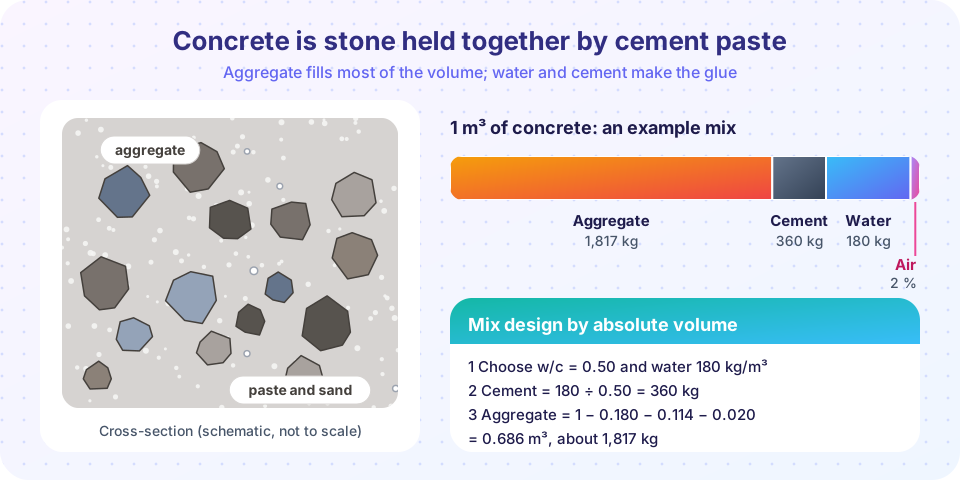
One cubic meter of concrete must add up to 1 m³ of ingredients. Using densities (cement 3,150 kg/m³, aggregate about 2,650 kg/m³, water 1,000 kg/m³) and the example from the figure:
- Choose
w/c = 0.50and water180 kg/m³. - Cement
= 180 ÷ 0.50 = 360 kg. - Volumes: water
0.180 m³, cement360 ÷ 3,150 = 0.114 m³, entrapped air about0.020 m³(2 percent). - Aggregate volume is what is left:
1 − 0.180 − 0.114 − 0.020 = 0.686 m³, so mass0.686 × 2,650 ≈ 1,817 kg. - Fresh density
= 360 + 180 + 1,817 = 2,357 kg/m³, close to the typical 2,400.
Real mix design also adjusts for the moisture already in the aggregate and checks grading, but the volume logic stays the same.
Strength, age and curing
Concrete is strong in compression and weak in tension (its tensile strength is only about a tenth of its compressive strength). Strength is measured by crushing standard specimens: cylinders 150 mm in diameter and 300 mm tall (or 6 × 12 inches in the US) or 150 mm cubes (common in the UK and elsewhere). The stress is fc = failure load ÷ area. The 28-day strength is the standard reference. Concrete classes like C30/37 in Eurocode state cylinder and cube strengths in MPa; in the US you will see "4,000 psi" for about 28 MPa.
Strength rises with age. A widely used empirical model for moist-cured ordinary Portland cement concrete is f(t) = f28 × t / (4 + 0.85 t) with t in days. It predicts about 46 percent of the 28-day strength at 3 days, 70 percent at 7 days, and a little more than 100 percent after months. Stiffness follows strength: a common estimate of Young's modulus is E ≈ 4,700 √fc (both in MPa), so fc = 30 MPa gives E ≈ 25.7 GPa.
Curing keeps the concrete moist and at a moderate temperature while hydration proceeds. Concrete that dries too early stops gaining strength and cracks at the surface. Practical curing means covering with wet burlap or plastic, spraying water or using curing compounds, for several days (seven is a common minimum for ordinary cement). Steel reinforcement is added where tension is expected, so that the steel carries the pull and the concrete carries the push.
Common misconceptions
- "Concrete dries and hardens." It cures by chemical reaction, and it needs water to do so; drying out too fast ruins it.
- "More water makes stronger concrete because it mixes better." The opposite: more water raises w/c and lowers strength.
- "Concrete reaches full strength in a day." Early strength is only a fraction of the 28-day value.
Try it
Press Run (or Ctrl + Enter) to see the result here.
Program input · what you'd type while the program runs
Type the answers before you press Run, one per line. Each time the program reads a line (with input()), it gets the next line from this box.
Press Run (or Ctrl + Enter) to see the result here.
Program input · what you'd type while the program runs
Type the answers before you press Run, one per line. Each time the program reads a line (with input()), it gets the next line from this box.
Press Run (or Ctrl + Enter) to see the console output here.
No output.
Check your understanding
Quick check · 5 questions
of 5 answered You scored / 5 · perfect!
-
1. What is the water-cement ratio of a mix with 200 kg of water and 400 kg of cement?
w/c = 200 ÷ 400 = 0.50. -
2. Adding extra water on site to make concrete easier to pour will usually:
More water raises w/c, leaving more pores after it evaporates. -
3. A cylinder 150 mm in diameter fails at 530 kN. What is fc approximately (area 17,671 mm²)?
530,000 N ÷ 17,671 mm² ≈ 30 N/mm² = 30 MPa. -
4. Why is concrete cured?
Cement needs water to keep reacting; early drying stops strength gain and causes cracks. -
5. Roughly what fraction of 28-day strength does ordinary concrete reach at 7 days?
The empirical model t/(4 + 0.85 t) gives about 70 percent at 7 days.
Summary
- Concrete = cement paste + aggregate + water + a little air; aggregate fills 60 to 75 percent of the volume.
- Lower water-cement ratio means higher strength and durability; workability must come from grading and admixtures, not extra water.
- Mix design by absolute volume makes ingredients add to 1 m³.
- Strength grows with age and needs curing; it is measured by crushing cylinders or cubes, and tensile strength is only about a tenth of compressive.
Next: Steel and Metals
Track your progress
Create a free account to tick off lessons and pick up where you left off on any device.
of Civil Engineering Fundamentals lessons completed