


















Lesson 22 of 48 · Hydraulics and Water Resources
Chapter overview: Hydraulics and water resources
Meet the big ideas of civil hydraulics: still water, moving water in pipes and channels, and rain turning into runoff. A map of the chapter.
Water is the material civil engineers handle more than any other. It fills reservoirs, runs through pipes under every street, drains highways and, when we get it wrong, floods basements and washes out bridges. Hydraulics is the branch of engineering that predicts how water behaves so that we can store it, move it and get rid of it safely.
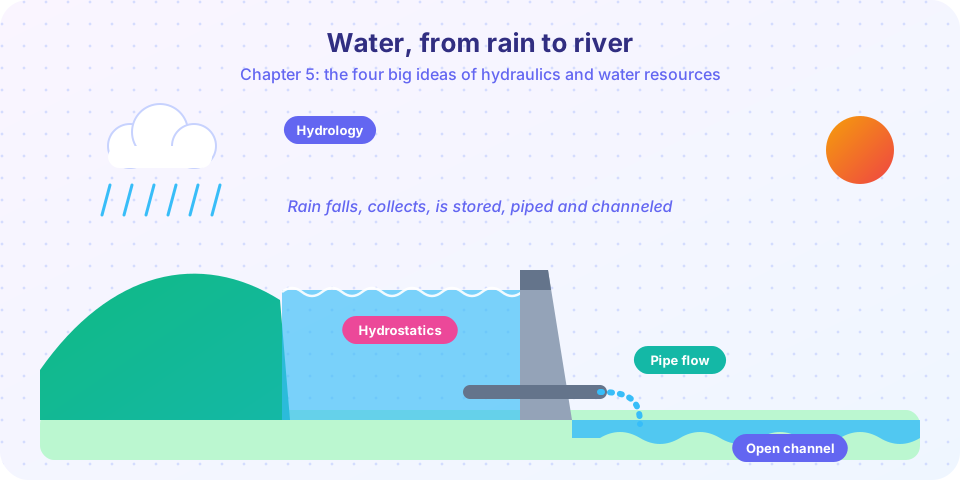
This chapter follows water on its journey: rain falls on a catchment, runs into streams and pipes, pushes on dams and walls, and flows through channels to the sea. Each stop has its own tool, and each tool is a short equation you can use with a calculator.
What you will learn
- Why civil engineers split water problems into four families.
- The key quantities: pressure, head, discharge, velocity and depth.
- How the lessons in this chapter connect.
- Which equation answers which question.
Key terms
Hydraulics: the engineering study of water at rest and in motion. Discharge (Q): the volume of water passing a point each second, in m³/s. Head: energy per unit weight of water, written as a height in meters. Catchment: the land area that drains to a given point. Open channel: any flow with a free surface exposed to the air, such as a river or a ditch.
The four families of water problems
Four questions, four tools
Still water
Moving water
Water from the sky
Sizing every drain starts here.
Every design in this chapter begins by deciding which family the problem belongs to. A reservoir behind a dam is a still water problem: nothing moves, so only pressure matters. A water main is a pipe flow problem. A storm drain ditch is an open channel problem. And the question "how big a pipe do we need?" cannot be answered until hydrology tells you how much water will arrive.
The language of hydraulics
Four quantities appear in nearly every lesson.
| Quantity | Symbol | Unit | Meaning |
|---|---|---|---|
| Pressure | p | pascal (Pa) | Force per unit area |
| Discharge | Q | m³/s | Volume per second |
| Velocity | v | m/s | Speed of the water |
| Head | h or H | m | Energy per unit weight |
Water has a mass density of about 1000 kg/m³, and gravity pulls with g = 9.81 m/s². Multiply them and you get the specific weight γ = ρ g ≈ 9.81 kN/m³, a number you will use again and again.
What each lesson covers
- Hydrostatics: pressure and force shows why dams are thick at the bottom and how to compute the force on a gate.
- Bernoulli and pipe flow follows the energy of water through pipes and measures friction losses.
- Open channels and Manning's equation sizes ditches, culverts and canals.
- Rainfall and runoff estimates the flow a storm sends to your design.
- Chapter review pulls everything into one page and a ten-question quiz.
Common misconceptions
"Deeper water always means stronger flow." Depth sets pressure, not speed. A deep lake can be perfectly still. Flow speed depends on slope, friction and the energy available.
"Water takes the shortest path downhill." It follows the energy gradient, which pipes and channels bend and shape. Engineers design those paths on purpose.
Try it
The first demo shows how pressure at the base of a tank depends only on depth. The second converts a flow in liters per second into the units we use in this chapter.
Press Run (or Ctrl + Enter) to see the result here.
Program input · what you'd type while the program runs
Type the answers before you press Run, one per line. Each time the program reads a line (with input()), it gets the next line from this box.
Press Run (or Ctrl + Enter) to see the console output here.
No output.
Check your understanding
Quick check · 4 questions
of 4 answered You scored / 4 · perfect!
-
1. Which quantity measures volume of water per second?
Discharge Q is volume per unit time, in m³/s. -
2. Which tool would you use first to find how much water a storm sends to a culvert?
Hydrology estimates rainfall and runoff, which gives the design flow. -
3. What is the specific weight of water, approximately?
γ = ρ g = 1000 × 9.81 N/m³ = 9.81 kN/m³. -
4. A river is an example of which kind of flow?
A river has a free surface open to the atmosphere, which defines an open channel.
Summary
- Water problems fall into four families: runoff, still water, pipe flow and open channel flow.
- Pressure, discharge, velocity and head are the core quantities.
- Water has ρ = 1000 kg/m³ and γ ≈ 9.81 kN/m³.
- Hydrology comes first because it tells you how much water to design for.
Track your progress
Create a free account to tick off lessons and pick up where you left off on any device.
of Civil Engineering Fundamentals lessons completed