


















Lesson 5 of 48 · Getting Started
Chapter 1 Review: Getting Started
Review the foundations of civil engineering: what engineers do, SI units, loads and equilibrium, with a recap table, calculators and a ten-question quiz.
You now have the foundations that every later chapter leans on. Civil engineers solve problems for the public, they speak in SI units, they classify loads, and they check that forces balance. This review pulls the chapter into one picture, then lets you test yourself.
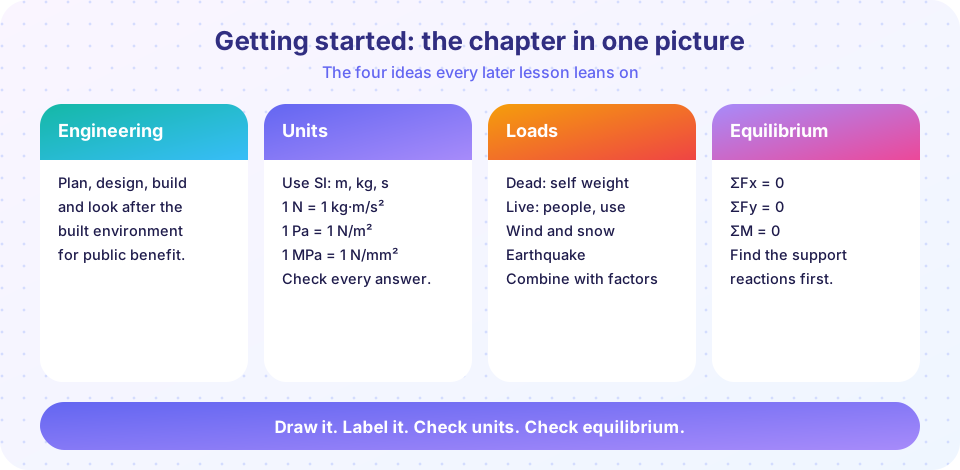
Recap table
| Lesson | Big idea | Key formula or rule |
|---|---|---|
| What Is Civil Engineering? | Plan, design, build and maintain the built world with trade-offs | Order-of-magnitude estimates guide early decisions |
| Units and Significant Figures | SI units and honest rounding | 1 N = 1 kg·m/s², 1 MPa = 1 N/mm², W = m g |
| Forces, Loads and Equilibrium | Loads travel to the ground through supports | ΣFx = 0, ΣFy = 0, ΣM = 0 |
Try it
Press Run (or Ctrl + Enter) to see the result here.
Program input · what you'd type while the program runs
Type the answers before you press Run, one per line. Each time the program reads a line (with input()), it gets the next line from this box.
Press Run (or Ctrl + Enter) to see the console output here.
No output.
Check your understanding
Quick check · 10 questions
of 10 answered You scored / 10 · perfect!
-
1. Which pair describes the four big themes of civil engineering work?
Those four themes organize most civil work, supported by surveying and construction. -
2. What is the SI unit of force written in base units?
A newton gives 1 kg an acceleration of 1 m/s². -
3. 1 MPa equals:
Because 1 m² = 10^6 mm², 10^6 N/m² = 1 N/mm². -
4. A concrete block has mass 2,000 kg. Its weight is closest to:
2,000 × 9.81 ≈ 19,620 N ≈ 19.6 kN. -
5. Which load is a live load?
Live loads vary with use: people, furniture, movable equipment. -
6. A UDL of 12 kN/m acts over 4 m of a simply supported 4 m beam. What is each reaction?
The resultant is 48 kN at the center; by symmetry each support takes 24 kN. -
7. Which pair of equations alone is NOT enough to find the reactions of a simply supported beam?
ΣFx = 0 only tells you about horizontal forces; you need the vertical balance and a moment equation to find the vertical reactions. -
8. Why is reporting 94.176 kN from a density known only as about 2,400 kg/m³ misleading?
Significant figures should reflect the precision of the input data. -
9. What does a roller support prevent?
A roller supplies one reaction, perpendicular to the surface it rolls on. -
10. Why do engineers carry units through every calculation?
Units act as a built-in error check, for example 1 MPa = 1 N/mm².
Summary
- Civil engineering is a balance of safety, cost, time and environment applied to structures, transport, water and ground.
- Work in SI, keep a consistent set of units and round honestly.
- Classify loads, trace the load path and use the three equilibrium equations to find reactions.
- Chapter 2 turns from calculation to the profession itself: who does what and which rules apply.
Track your progress
Create a free account to tick off lessons and pick up where you left off on any device.
of Civil Engineering Fundamentals lessons completed