


















Lesson 16 of 48 · Construction Materials
Chapter 4 Overview: Construction Materials
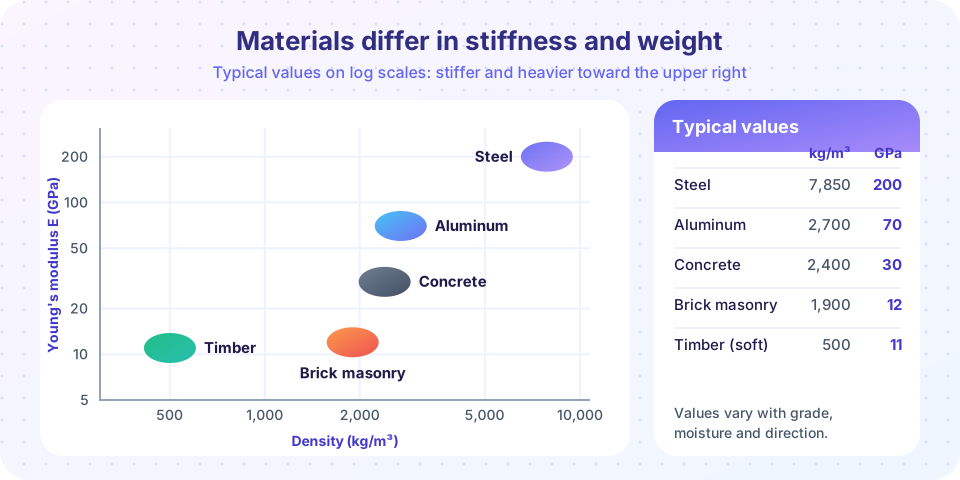
Meet the main construction materials and the properties engineers compare: strength, stiffness, ductility, density and durability, with a stiffness-density chart.
Every structure is only as good as what it is made of. A bridge girder, a road surface and a retaining wall all rely on materials behaving in a predictable way for decades. Civil engineers do not simply ask "is it strong?". They ask which properties matter for the job, how much of each material is needed, what it costs, and how it ages.
What you will learn
- The key mechanical properties and what each one tells you.
- Typical values of density and stiffness for the main construction materials.
- Why reinforced concrete works and why material choice is a trade-off.
- What the next lessons cover.
Key terms
- Strength: the stress a material can carry before it yields or breaks.
- Stiffness: resistance to deformation, measured by Young's modulus
E. - Ductility: the ability to deform a lot before breaking; the opposite is brittleness.
- Durability: how well the material resists weather, chemicals, fatigue and wear over time.
The big picture
Four questions about a material
The materials
How we know
Properties come from tests, not from guesses.
The properties that matter
Strength. For metals, engineers use the yield strength fy, the stress at which permanent deformation begins, and the ultimate strength fu, the highest stress the material reaches. For concrete, the key value is the compressive strength fc, measured on standard cylinders or cubes.
Stiffness. Young's modulus E = stress ÷ strain for a material in its elastic range. A stiffer material deflects less under the same load. Steel is about 200 GPa, concrete about 30 GPa, timber about 11 GPa along the grain.
Ductility and toughness. A ductile material, such as mild steel, stretches visibly before failing, which warns people. A brittle material, such as unreinforced concrete or glass, can fail suddenly. Toughness is the energy a material absorbs before it fractures.
Density. Self weight matters. Concrete and steel structures often carry mostly their own weight, and heavy materials also cost more to lift and transport.
Durability. Steel rusts, timber rots, concrete cracks and its reinforcement can corrode, and asphalt hardens in sunlight. Maintenance planning starts with the material.
Thermal expansion. Materials grow when heated. Steel expands about 12 × 10⁻⁶ per °C and concrete about 10 × 10⁻⁶ per °C. Their similar values are one reason reinforced concrete works: the two materials expand together instead of tearing apart.
Choosing a material
Typical values are in the chart above: steel 7,850 kg/m³ and 200 GPa; aluminum 2,700 and 70; concrete 2,400 and 30; brick masonry 1,900 and 12; softwood timber 500 and 11. A useful comparison is specific stiffness, E / ρ: steel 25.5, aluminum 25.9, softwood timber 22 and concrete 12.5 (in MN·m/kg). Surprisingly, timber stiffens nearly as well as steel per kilogram.
No material wins every contest. Concrete is cheap, fire resistant and moldable but weak in tension and heavy. Steel is strong and fast to erect but needs corrosion and fire protection. Timber is light and renewable but varies and is sensitive to moisture. Engineers also weigh embodied carbon: producing cement is responsible for a significant share of global CO₂ emissions, often estimated at around 7 to 8 percent, which pushes designers to use less cement, recycled steel and engineered timber where they can.
Common misconceptions
- "Stronger material means a stiffer material." Strength and stiffness are different: high-strength steel is no stiffer than ordinary steel (both about 200 GPa).
- "Concrete is a single material." It is a composite of aggregate, cement paste and pores, so its properties depend on the mix and curing.
- "Lighter always means weaker." Timber compares well with concrete and steel in strength per unit weight.
In this chapter
- Concrete Basics: ingredients, water-cement ratio, strength gain, curing and testing.
- Steel and Metals: grades, the stress-strain curve and design strength.
- Timber, Masonry and Asphalt: the other workhorses and their limits.
- Stress, Strain and Material Testing:
σ,ε,Eand how tests find them. - Chapter 4 Review: recap and quiz.
Try it
Press Run (or Ctrl + Enter) to see the result here.
Program input · what you'd type while the program runs
Type the answers before you press Run, one per line. Each time the program reads a line (with input()), it gets the next line from this box.
Press Run (or Ctrl + Enter) to see the console output here.
No output.
Check your understanding
Quick check · 4 questions
of 4 answered You scored / 4 · perfect!
-
1. Which property measures resistance to deformation?
Young's modulus E relates stress to strain in the elastic range: a larger E means less deformation. -
2. Why does reinforced concrete work well in practice?
Their thermal expansion coefficients are close, so they move together; steel also supplies the missing tensile strength. -
3. Which is the most ductile?
Mild steel stretches a lot before it breaks; the others tend to be brittle. -
4. Typical Young's modulus of structural steel is about:
About 200 GPa, roughly the same for all structural steel grades.
Summary
- Compare materials by strength, stiffness, ductility, density, durability and thermal behavior.
- Steel is about 200 GPa and 7,850 kg/m³; concrete about 30 GPa and 2,400 kg/m³; timber about 11 GPa and 500 kg/m³.
- Strength and stiffness are separate properties; ductility gives warning before failure.
- The next lessons cover concrete, steel, other materials and the tests that measure them.
Next: Concrete Basics
Track your progress
Create a free account to tick off lessons and pick up where you left off on any device.
of Civil Engineering Fundamentals lessons completed