


















Lesson 24 of 48 · Hydraulics and Water Resources
Bernoulli and pipe flow
Follow the energy of water through a pipe: continuity, Bernoulli's equation, energy and hydraulic grade lines, and friction losses with Darcy-Weisbach.
When water moves, pressure alone is no longer the whole story. A water main must deliver enough pressure at the far end of town, a pump must lift water over a hill, and a narrow section of pipe changes everything downstream. The key is energy: water carries energy in three forms, and civil engineers track it with a single balance sheet.
What you will learn
- How continuity links area and velocity.
- How to write and use Bernoulli's equation in head form.
- What the energy grade line and hydraulic grade line show.
- How to estimate friction loss in a pipe with Darcy-Weisbach.
Key terms
Continuity: for incompressible flow, the discharge is the same through every cross-section: Q = A v. Pressure head: p/γ, pressure written as a height of water. Velocity head: v²/2g, the height a jet could rise using its speed. Elevation head: z, the height above a chosen datum. Reynolds number: Re = v D / ν, which tells laminar flow from turbulent flow.
Continuity: what goes in must come out
Water is nearly incompressible, so the same volume per second passes every section of a full pipe:
Q = A₁ v₁ = A₂ v₂
If the diameter halves, the area falls to one quarter and the velocity rises fourfold. A garden hose with your thumb over the end works the same way.
Bernoulli: the energy balance
For steady flow without friction, the total head along a streamline is constant:
p₁/γ + v₁²/2g + z₁ = p₂/γ + v₂²/2g + z₂
Each term is a length in meters, which makes the equation easy to picture: pressure head, velocity head and elevation head trade off against each other.
Worked example (a contraction). Water at Q = 0.05 m³/s flows through a horizontal pipe that narrows from 300 mm to 150 mm.
- Areas: A₁ = π(0.15)² ≈ 0.0707 m², A₂ = π(0.075)² ≈ 0.0177 m².
- Velocities: v₁ = 0.05/0.0707 ≈ 0.707 m/s and v₂ = 0.05/0.0177 ≈ 2.83 m/s.
- Same elevation, so
p₁ − p₂ = ½ ρ (v₂² − v₁²) ≈ ½ × 1000 × (8.01 − 0.50) ≈ 3.75 kPa.
The pressure in the throat is lower by about 3.75 kPa. This is the principle behind a Venturi meter: measure the pressure drop and you can calculate the discharge.
Energy and hydraulic grade lines
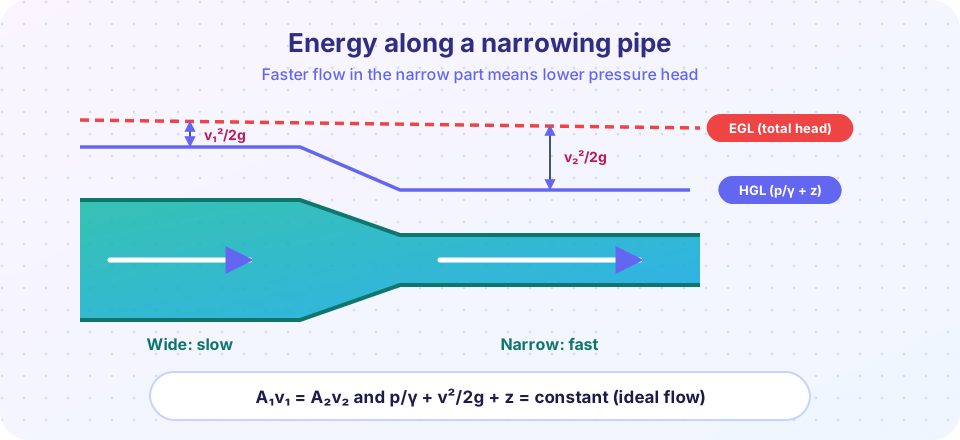
Plot the total head p/γ + v²/2g + z along a pipe and you get the energy grade line (EGL). Subtract the velocity head and you get the hydraulic grade line (HGL), the level water would rise to in a small standpipe tapped into the pipe. For an ideal fluid the EGL is horizontal. In a real pipe it slopes downward because friction turns energy into heat. Two rules help you check designs: if the HGL falls below the pipe, the pressure there is below atmospheric and air or vapor may form, so pipelines are routed to stay under the HGL.
Friction in real pipes
The Darcy-Weisbach equation gives the head lost to friction over a length L:
h_f = f (L/D) v²/2g
The friction factor f depends on the Reynolds number Re = v D / ν (ν ≈ 1.0 × 10⁻⁶ m²/s for water at 20 °C) and the relative roughness ε/D. Flow is laminar below about Re = 2000 and turbulent above about 4000. For turbulent flow, the Swamee-Jain formula gives f directly:
f = 0.25 / [log₁₀(ε/(3.7 D) + 5.74/Re^0.9)]²
Worked example. Q = 0.05 m³/s in a 250 mm pipe, 500 m long, with roughness ε = 0.3 mm.
- Area 0.0491 m², so v ≈ 1.02 m/s.
- Re = 1.02 × 0.25 / 1.0×10⁻⁶ ≈ 2.5×10⁵, clearly turbulent.
- Swamee-Jain gives f ≈ 0.0217.
h_f = 0.0217 × (500/0.25) × (1.02²/19.62) ≈ 2.3 m.
So the pipe wastes about 2.3 m of head, equivalent to roughly 22 kPa. Local fittings such as valves and bends add minor losses h_m = K v²/2g, with K from tables. In practice, water engineers also use the empirical Hazen-Williams equation for clean water: v = 0.849 C R^0.63 S^0.54 in SI units, where C is about 130 for new smooth pipe and R is the hydraulic radius (D/4 for a full circular pipe).
Common misconceptions
"Pressure is highest where the pipe is narrow." In an ideal flow it is lowest there, because speed (and velocity head) is highest.
"Bernoulli's equation includes friction." The basic form does not. Add a head-loss term h_f on the downstream side when losses matter.
"Doubling the flow doubles the loss." Loss grows with v², so doubling the flow roughly quadruples the friction head.
Try it
The first tool solves the friction example and lets you change the diameter to see how strongly it matters. The second computes the Venturi pressure drop.
Press Run (or Ctrl + Enter) to see the result here.
Program input · what you'd type while the program runs
Type the answers before you press Run, one per line. Each time the program reads a line (with input()), it gets the next line from this box.
Press Run (or Ctrl + Enter) to see the console output here.
No output.
Check your understanding
Quick check · 5 questions
of 5 answered You scored / 5 · perfect!
-
1. A pipe's diameter halves while the flow stays the same. By what factor does the velocity change?
Area is proportional to D², so halving D cuts the area to a quarter and Q = A v makes v four times larger. -
2. Which term is the velocity head?
Velocity head is v²/2g, the height equivalent of the kinetic energy. -
3. What does the hydraulic grade line show?
The HGL is the sum of pressure head and elevation head; adding velocity head gives the EGL. -
4. Flow in a pipe has Re = 250,000. It is
Flow above Re of about 4000 is turbulent. -
5. If the flow in a pipe doubles, the friction head loss roughly
h_f is proportional to v², and v is proportional to Q.
Summary
- Continuity:
Q = A vis the same at every section. - Bernoulli: pressure head + velocity head + elevation head stays constant without friction.
- The EGL shows total head; the HGL lies a velocity head below it.
- Friction loss follows
h_f = f (L/D) v²/2g, with f from the Reynolds number and roughness.
Track your progress
Create a free account to tick off lessons and pick up where you left off on any device.
of Civil Engineering Fundamentals lessons completed