


















Lesson 27 of 48 · Hydraulics and Water Resources
Chapter review: Hydraulics and water resources
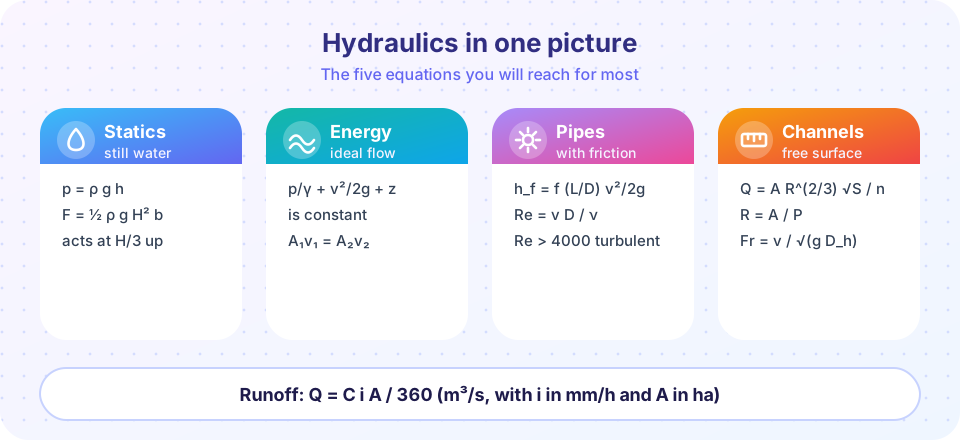
Review pressure, force, Bernoulli, pipe friction, Manning's equation and the rational method on one page, then test yourself with a ten-question quiz.
You have followed water from cloud to channel. This review ties the chapter together: one picture, one table, a worked chain that links the lessons, and a ten-question quiz mixing everything.
What you will learn
- Which equation to reach for in each situation.
- How hydrology, pipe flow and channel flow chain into one design.
- Where your understanding is solid and where to revisit.
Key terms
Gauge pressure: pressure above atmospheric. Head loss: energy per unit weight converted to heat by friction. Normal depth: the steady uniform depth in a channel. Froude number: v / √(g D_h), sorting flow into subcritical and supercritical. Return period: the average interval between storms of a given size.
Recap table
| Question | Tool | Equation |
|---|---|---|
| Pressure at depth h | Hydrostatics | p = ρ g h |
| Force on a wall | Hydrostatics | F = ½ ρ g H² b, at H/3 above the base |
| Speed after a change of area | Continuity | A₁ v₁ = A₂ v₂ |
| Pressure change along a pipe | Bernoulli | p/γ + v²/2g + z = constant |
| Friction loss | Darcy-Weisbach | h_f = f (L/D) v²/2g |
| Flow in a ditch | Manning | Q = (1/n) A R^(2/3) S^(1/2) |
| Flow regime | Froude number | Fr = v / √(g D_h) |
| Design flow from a storm | Rational method | Q = C i A / 360 |
| Runoff depth | SCS curve number | Q = (P − 0.2S)² / (P + 0.8S) |
A worked chain
A new road crosses a 12 ha catchment (C = 0.6) with a 10-year intensity of 80 mm/h. The runoff arrives in a clean earth ditch (n = 0.022, b = 2 m, side slopes 1.5:1, slope 0.001) next to the road.
- Hydrology:
Q = 0.6 × 80 × 12 / 360 = 1.60 m³/s. - Channel: from the Manning lesson, a depth of 1.0 m carries about 3.7 m³/s, so the ditch has plenty of capacity. Solving for the normal depth at 1.6 m³/s gives roughly 0.65 m (the TryIt below finds it).
- Check velocity: v = Q/A is around 0.8 m/s, enough to avoid silting and low enough to avoid erosion in most soils.
- Check regime: Fr stays well below 1, so the flow is calm and subcritical.
One chain, three lessons.
Common misconceptions
"Every water problem needs Bernoulli." Open channel flow driven by gravity and friction is usually handled with Manning, and still water needs only p = ρ g h.
"A higher return period means a bigger storm every time." It means a rarer storm, with a larger depth or intensity, but it still occurs randomly.
"Units sort themselves out." Manning's SI and US forms differ, the rational formula needs i in mm/h and A in ha, and pressure must be in the same units as γ. Always write units.
Try it
A chained calculator takes you from rainfall to ditch depth. A second tool gives you a quick self-check on unit conversions.
Press Run (or Ctrl + Enter) to see the result here.
Program input · what you'd type while the program runs
Type the answers before you press Run, one per line. Each time the program reads a line (with input()), it gets the next line from this box.
Press Run (or Ctrl + Enter) to see the console output here.
No output.
Check your understanding
Quick check · 10 questions
of 10 answered You scored / 10 · perfect!
-
1. What is the gauge pressure at the base of a 6 m deep water tank?
p = 1000 × 9.81 × 6 = 58,860 Pa ≈ 58.9 kPa. -
2. Water depth behind a wall rises from 2 m to 4 m. The force on the wall
F is proportional to H², so doubling H quadruples F. -
3. In a pipe contraction, the pressure in the narrow section is lower because
Higher speed means higher velocity head, so pressure head drops (Bernoulli). -
4. Which quantity is the same at every cross-section of a full pipe at steady flow?
Continuity: Q = A v is constant for incompressible flow. -
5. What do the energy grade line and hydraulic grade line differ by?
EGL = HGL + v²/2g. -
6. In Manning's equation, increasing which variable decreases the discharge?
n is in the denominator: rougher channels carry less flow. -
7. A channel has Fr = 0.4. The flow is
Fr below 1 is subcritical. -
8. A 10 ha catchment with C = 0.7 receives 72 mm/h. The rational method gives
Q = 0.7 × 72 × 10 / 360 = 1.4 m³/s. -
9. Why does urbanization increase flood peaks?
Less infiltration and storage mean higher runoff coefficients and shorter times of concentration. -
10. The resultant hydrostatic force on a vertical wall of height H acts at
The pressure triangle's centroid is H/3 above the base.
Summary
- Five equations cover most day-to-day hydraulic design.
- Hydrology feeds the pipe and channel calculations: find Q first, then size the conveyance.
- Check velocity and Froude number after you size anything.
- Always carry units.
Track your progress
Create a free account to tick off lessons and pick up where you left off on any device.
of Civil Engineering Fundamentals lessons completed