


















Lesson 4 of 48 · Getting Started
Forces, Loads and Equilibrium
Learn what forces and loads are, how supports react, and how the three equilibrium equations let you find unknown reactions on a simple beam.
A structure stands because every push on it is met by an equal and opposite push from somewhere else. The roof pushes down on the walls, the walls push down on the foundations, and the ground pushes back up. If those pushes ever fail to balance, something moves: a floor sags, a wall tips, a bridge falls. This lesson gives you the two tools engineers use to describe and check that balance: forces and equilibrium.
What you will learn
- How to describe a force with magnitude, direction and a point of action, and split it into components.
- The main kinds of load a structure carries.
- What pin, roller and fixed supports do.
- How to use
ΣFx = 0,ΣFy = 0andΣM = 0to find support reactions.
Key terms
- Force: a push or pull, measured in newtons (N) or kilonewtons (kN).
- Moment: the turning effect of a force, equal to force × perpendicular distance (kN·m).
- Reaction: the force a support supplies to hold a structure still.
- Equilibrium: the state where all forces and moments balance, so nothing accelerates.
Forces are vectors
A force has a size, a direction and a line of action. Engineers draw it as an arrow. To calculate with it, you split it into perpendicular components. For a force F at an angle θ above the horizontal:
Fx = F cos θ and Fy = F sin θ.
Example: a cable pulls with 10 kN at 30° above the horizontal. Then Fx = 10 × cos 30° = 8.66 kN and Fy = 10 × sin 30° = 5.00 kN. The cable pulls the connection sideways more than it lifts it.
A moment measures how strongly a force tries to rotate something about a point: M = F × d, where d is the perpendicular distance from the point to the line of the force. A 20 kN force acting 2 m from a support produces a moment of 40 kN·m about that support. Take counterclockwise as positive and keep that convention for the whole problem.
The loads a structure carries
Loads are the forces that act on a structure. Codes group them as:
- Dead loads (permanent): the self weight of the structure and fixed items such as floors, roofs and cladding. They are well known because you can compute them from volumes and densities.
- Live loads (variable): people, furniture, vehicles and stored goods. They change with time and use, so codes give minimum design values per square metre.
- Environmental loads: wind, snow, earthquake, temperature change, flood and soil or water pressure.
Loads also differ in how they act. A point load acts over a tiny area, like a column sitting on a beam. A distributed load spreads along a length, like the weight of a wall, and is given in kN/m. A uniformly distributed load (UDL) w over a length L can be replaced for equilibrium by one resultant W = w × L acting at the center of the load.
Following loads from the point where they act down to the ground is called the load path. A good engineer can trace it for any building: slab to beam, beam to column, column to foundation, foundation to soil.
Supports and reactions
A support provides reactions, the forces that stop movement. The three idealized types are:
| Support | Prevents | Reactions |
|---|---|---|
| Roller | Movement perpendicular to the surface | 1 (vertical) |
| Pin | Movement in any direction, but allows rotation | 2 (horizontal and vertical) |
| Fixed | All movement and rotation | 3 (two forces and a moment) |
A beam with a pin at one end and a roller at the other is simply supported. It is the most common model for a floor beam or a small bridge girder.
The three equations of equilibrium
For a body in a plane to stay still, three conditions must hold:
ΣFx = 0: horizontal forces add up to zero.ΣFy = 0: vertical forces add up to zero.ΣM = 0: moments about any point add up to zero.
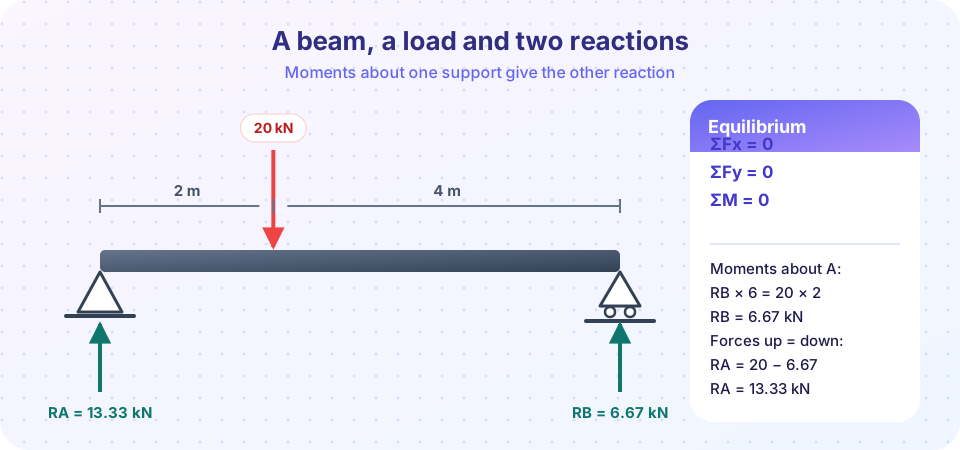
Worked example 1: a point load. A 6 m beam sits on a pin at A and a roller at B. A 20 kN load acts 2 m from A.
- Take moments about A, which removes the unknown
RAfrom the equation:RB × 6 − 20 × 2 = 0, soRB = 40 ÷ 6 = 6.67 kN. - Balance vertical forces:
RA + RB − 20 = 0, soRA = 20 − 6.67 = 13.33 kN. - Check by taking moments about B:
RA × 6 − 20 × 4 = 80 − 80 = 0. It works.
The support nearer the load carries more, which matches intuition. The check in step 3 uses a different point, so it would catch an arithmetic error in steps 1 or 2.
Worked example 2: a UDL. The same beam carries 10 kN/m over its whole length. The resultant is W = 10 × 6 = 60 kN at the center (3 m from A). Moments about A: RB × 6 = 60 × 3, so RB = 30 kN. Then RA = 30 kN. Symmetry gave the answer: each support takes half.
Any problem follows the same recipe: sketch the beam, replace distributed loads by resultants, write the three equations, solve, then check with a different moment point.
Common misconceptions
- "A support only pushes up." Pins can also push sideways, and a fixed support can supply a moment as well.
- "A heavier load always means a bigger reaction at both supports." The total of the reactions equals the load, but the share depends on where the load sits.
- "Equilibrium means nothing is happening." It means the net force and moment are zero; large internal forces can still exist.
Try it
Press Run (or Ctrl + Enter) to see the result here.
Program input · what you'd type while the program runs
Type the answers before you press Run, one per line. Each time the program reads a line (with input()), it gets the next line from this box.
Check your understanding
Quick check · 5 questions
of 5 answered You scored / 5 · perfect!
-
1. A 6 m beam is simply supported. A 30 kN load acts at its center. What is each reaction?
By symmetry the load splits equally: 30 ÷ 2 = 15 kN at each support. -
2. Which is a dead load?
Dead loads are permanent and include the structure's own weight. -
3. How many reaction components does a pin support provide in a plane?
A pin resists horizontal and vertical movement but allows rotation. -
4. A UDL of 8 kN/m acts over 5 m. What is its resultant?
W = w × L = 8 × 5 = 40 kN, acting at the center of the loaded length. -
5. Why take moments about a support when solving for reactions?
A force acting through the chosen point has zero moment about it, leaving fewer unknowns.
Summary
- Forces are vectors: split them with
F cos θandF sin θ. A moment is force × perpendicular distance. - Loads are dead, live or environmental, and they act as point, line or distributed loads.
- Pins, rollers and fixed supports give 2, 1 and 3 reaction components.
- Use
ΣFx = 0,ΣFy = 0andΣM = 0to find reactions, and check with a second moment point.
Next: Chapter 1 Review
Track your progress
Create a free account to tick off lessons and pick up where you left off on any device.
of Civil Engineering Fundamentals lessons completed