


















Lesson 10 of 48 · The Civil Engineering Profession
Chapter 2 Review: The Civil Engineering Profession
Review roles, branches, design codes, load factors, risk and ethics in civil engineering with a recap table, quick calculators and a ten-question quiz.
This chapter moved from calculation to the people and rules around it. You learned who works on a project, which branch handles which question, how codes and load factors create safety margins, and how risk and ethics shape daily choices. Use this page to pull it together.
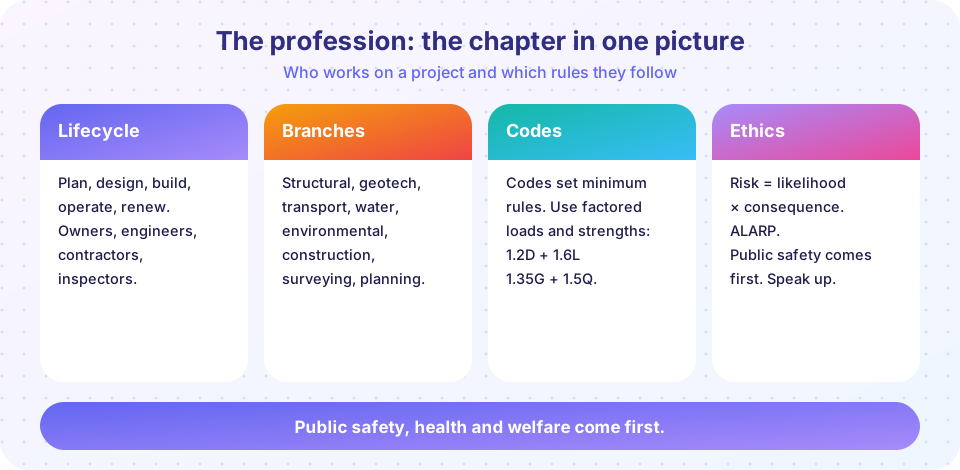
Recap table
| Lesson | Big idea | Remember |
|---|---|---|
| Chapter 2 Overview | Projects follow a lifecycle with many roles | Plan, design, build, operate, renew |
| Branches of Civil Engineering | Eight specialties share one foundation | Real projects mix branches |
| The Design Process and Codes | Codes, limit states, factored loads | 1.2D + 1.6L, 1.35G + 1.5Q, β = (μR − μS) / √(σR² + σS²) |
| Safety, Ethics and Risk | Risk matrices, hierarchy of controls, ethics | Risk = likelihood × consequence; ALARP |
Try it
Press Run (or Ctrl + Enter) to see the result here.
Program input · what you'd type while the program runs
Type the answers before you press Run, one per line. Each time the program reads a line (with input()), it gets the next line from this box.
Press Run (or Ctrl + Enter) to see the console output here.
No output.
Check your understanding
Quick check · 10 questions
of 10 answered You scored / 10 · perfect!
-
1. In the project lifecycle used in this chapter, which stage follows 'Design'?
The order is plan, design, build, operate, renew. -
2. Which branch would investigate boreholes and design pile foundations?
Geotechnical engineers study soil and rock and design foundations. -
3. Which describes a design-build contract?
Design-build puts both under a single responsible team. -
4. Which limit state concerns collapse?
ULS covers collapse, overturning and rupture; SLS covers deflection, vibration and cracking. -
5. US factored load for D = 20 kN/m and L = 10 kN/m is:
1.2 × 20 + 1.6 × 10 = 24 + 16 = 40 kN/m. -
6. A larger reliability index β means:
pf = Φ(−β), which becomes smaller as β grows. -
7. Why are design codes treated as minimum requirements?
The engineer stays responsible for hazards the code does not cover. -
8. Which control is the weakest in the hierarchy?
PPE depends on people using it correctly every time, so it is the last line of defense. -
9. A hazard has likelihood 2 and consequence 5. What is the score and band?
2 × 5 = 10, which falls in the high band of 10 to 14. -
10. What is the first duty in engineering ethics codes such as ASCE's?
Public safety, health and welfare come before client or employer interests.
Summary
- Civil projects have a lifecycle and many cooperating roles, protected by licensing and accreditation.
- Eight branches share foundations, and real projects combine them.
- Codes, limit states and load and resistance factors provide measurable safety margins.
- Risk matrices and the hierarchy of controls guide safety work; ethics puts the public first.
- Chapter 3 returns to measurement: how surveyors locate every point on a site.
Track your progress
Create a free account to tick off lessons and pick up where you left off on any device.
of Civil Engineering Fundamentals lessons completed