


















Lesson 1 of 48 · Getting Started
Course Map: Civil Engineering Fundamentals
Start here: who this civil engineering course is for, what you need to know first, how the nine chapters fit together and how to study them.
Every day you cross bridges, drink water that travelled through pipes you never see, and walk on floors that hold up because someone did a calculation. Civil engineering is the profession behind all of that. This course teaches you how civil engineers think: how they measure the ground, choose materials, move water and traffic, and keep people safe while spending money wisely.
You do not need any engineering background. If you can do algebra, work with a few formulas and read a graph, you can follow every lesson. Each lesson explains the idea in words, shows a picture, works an example with real numbers, and then lets you run the numbers yourself in your browser.
What you will learn
- What civil engineers do, and which branch of the profession matches your interests.
- How to use SI units, forces and equilibrium to check any simple structure.
- How surveyors measure distances, heights and land areas.
- How concrete, steel, timber, masonry and asphalt behave, and how they are tested.
- How the later chapters on water, roads, soil and sustainability build on these foundations.
Who this course is for
The course follows an international curriculum. Its content matches what first-year engineering students, A Level and IB physics students, and curious adults meet in an introduction to civil engineering. It also suits technicians, architects, project managers and builders who want to understand the engineer's side of the table.
Key terms
- Civil engineering: the design, construction and maintenance of the built environment, such as buildings, bridges, roads, water systems and dams.
- Infrastructure: the networks society relies on, for example roads, rail, pipes, power lines and flood defenses.
- Structure: anything built to carry loads safely, from a footbridge to a stadium roof.
- Specification: a written requirement for a material or a piece of work.
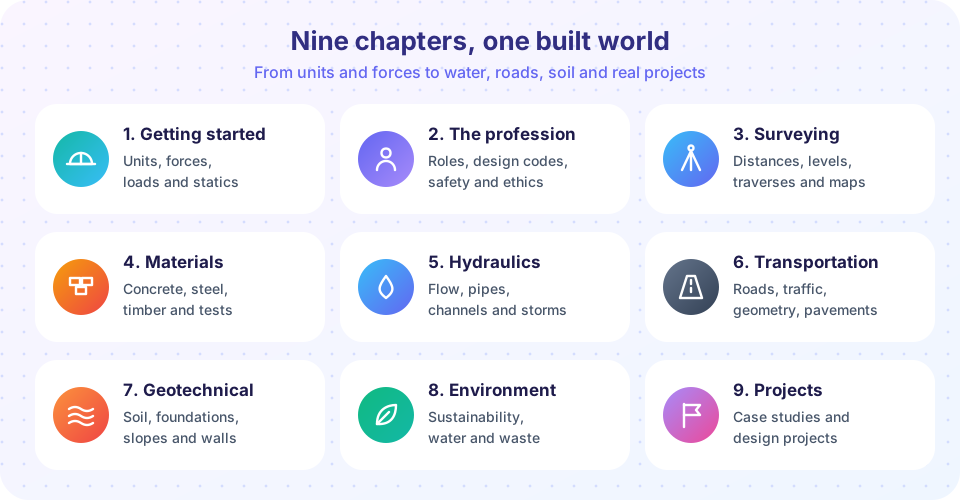
The nine chapters at a glance
Foundations
- Getting started
- The profession
- Surveying
Materials and water
- Materials
- Hydraulics
Moving and holding
- Transportation
- Geotechnical
Sustainable and applied
- Environment
- Projects
Each chapter opens with an overview and closes with a review.
This part of the course covers chapters 1 to 4. You first learn the language of engineering (units, forces, loads), then the profession itself, then how a site is measured, and finally how the materials behave. Chapters 5 to 9 apply these tools to water, transport, ground, sustainability and projects.
How to study
- Read with a pencil. When an example gives numbers, work it by hand before you run the code.
- Always draw the picture. Experienced engineers sketch the problem first. A free-body sketch finds more mistakes than any calculator.
- Carry the units. Write the unit after every number. A wrong unit is the fastest way to spot a wrong answer.
- Use the Try it blocks. Change one input at a time and predict what happens before you press Run.
- Finish the review. Each chapter ends with a review lesson and a longer quiz. Do it a few days after reading the chapter, not the same hour.
Common misconceptions
- "Civil engineering is only about concrete and bridges." It also covers water, soil, transport planning, the environment and project management.
- "Engineers just apply formulas." Formulas are the easy part. Engineers decide which problem to solve, which assumptions are safe and what could go wrong.
Try it
Press Run (or Ctrl + Enter) to see the console output here.
No output.
Check your understanding
Quick check · 3 questions
of 3 answered You scored / 3 · perfect!
-
1. Which description fits civil engineering best?
Civil engineering covers structures, transport, water, ground and the environment, not just one material or one drawing task. -
2. Why should you carry units through every calculation?
If your answer for a force comes out in metres, something went wrong. Units act as a built-in check. -
3. In which chapter do you first meet concrete and steel in detail?
Chapter 4 is dedicated to the behavior and testing of construction materials.
Summary
- Civil engineering shapes the built environment: structures, transport, water, ground and the environment.
- The course moves from foundations (units, forces, the profession, surveying, materials) to applied chapters.
- Study actively: sketch, carry units, run the examples and take the reviews.
Track your progress
Create a free account to tick off lessons and pick up where you left off on any device.
of Civil Engineering Fundamentals lessons completed