


















Lesson 7 of 48 · The Civil Engineering Profession
Branches of Civil Engineering
Meet the eight main branches of civil engineering, what each one designs, the questions they answer and how they combine on real projects.
"Civil engineer" is a family name, like "doctor". A heart surgeon and a family physician share medical training but do very different work. In the same way, a structural engineer who designs a stadium roof and a water engineer who plans a flood channel share the same foundations in mechanics and mathematics, yet spend their days on different problems.
What you will learn
- The eight main branches and the core question each one answers.
- Typical tasks and tools of each branch.
- How several branches combine on one project, such as a dam or a new city district.
- How to start thinking about which branch suits your interests.
Key terms
- Specialty: a branch of the profession with its own methods and standards.
- Multidisciplinary: involving several branches working together.
- Geomatics: the modern name for surveying and spatial data science.
- Consultant: an engineering firm hired by an owner to plan and design.
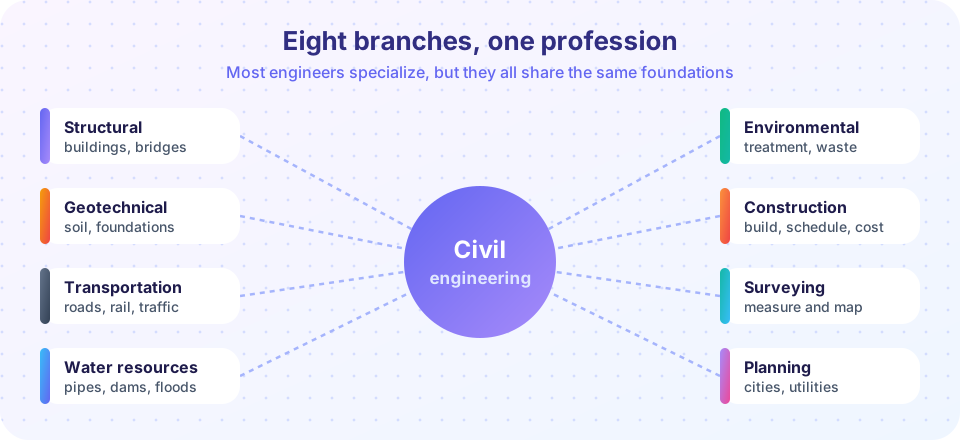
The eight branches
1. Structural engineering. Will it stand up? Structural engineers design frames, bridges, towers and dams so they carry loads safely. They compute forces in members, choose sizes and materials, and check deflection and vibration. Software helps, but the thinking starts with the equilibrium you met in Chapter 1.
2. Geotechnical engineering. What will the ground do? Everything rests on soil or rock. Geotechnical engineers investigate it by drilling and testing, then design foundations, retaining walls, slopes and tunnels. Soil is far less predictable than steel, so judgment and site investigation matter a lot.
3. Transportation engineering. How do people and goods move safely? This branch designs highways, railways, airports and urban streets, including road geometry, pavement thickness, traffic signals and public transit.
4. Water resources and hydraulics. Where does the water go? Engineers here design dams, canals, pipelines, pumping stations, stormwater drains and flood defenses, using the physics of flowing water.
5. Environmental engineering. How do we protect people and nature? They design water and wastewater treatment, manage solid and hazardous waste, control pollution and assess environmental impact.
6. Construction engineering and management. How do we build it safely, on time and on budget? Specialists plan the sequence of work, temporary structures, equipment, schedules and costs, and manage risk on site.
7. Surveying and geomatics. Where exactly is it? Surveyors measure positions and heights, set out buildings and roads, and produce maps. Modern tools include satellite positioning, laser scanning and drones.
8. Urban and municipal planning. How should a community be arranged? Planners and municipal engineers shape land use, streets, utilities and public space so that growth is orderly and fair.
Other specialties exist too: coastal and port engineering, earthquake engineering, materials engineering and tunneling. Many of them are sub-fields of the eight above.
One project, many branches
Consider a new bridge over a river. The surveyor maps the banks and river bed. The geotechnical engineer drills boreholes and recommends pile foundations. The water engineer predicts flood levels so the deck sits above them. The structural engineer designs the girders and piers. The transportation engineer fixes the lane layout and approach roads. The environmental engineer protects fish and limits pollution during building. The construction engineer plans cranes and temporary works. The planner checks that the bridge fits the area's long-term growth.
Because every discipline affects the others, a small decision, such as moving a pier, may change flood levels, foundation depth and cost at the same time. Good engineers learn enough about neighboring branches to ask the right questions.
Common misconceptions
- "Structural engineers design everything that is built." They design the load-carrying frame. Many other branches shape the site, the water, the ground and the use.
- "You must pick a branch on day one." Most programs teach all branches in the early years, and many engineers change focus during their career.
- "Surveying is just pointing a telescope." Modern surveying is data science: coordinates, error analysis, satellites and laser point clouds.
Try it
Press Run (or Ctrl + Enter) to see the result here.
Program input · what you'd type while the program runs
Type the answers before you press Run, one per line. Each time the program reads a line (with input()), it gets the next line from this box.
Press Run (or Ctrl + Enter) to see the console output here.
No output.
Check your understanding
Quick check · 4 questions
of 4 answered You scored / 4 · perfect!
-
1. Which branch mainly answers the question 'What will the ground do?'
Geotechnical engineers investigate soil and rock and design foundations, slopes and retaining walls. -
2. A flood-level prediction for a new bridge comes mainly from:
Hydraulic analysis tells the team how high water can rise, so the deck can be set above it. -
3. Why is a bridge project multidisciplinary?
Foundations, flood levels, loads, traffic and environment interact, so many specialties work together. -
4. Which branch plans cranes, schedules and temporary works?
Construction engineers focus on how to build safely, on time and on budget.
Summary
- Civil engineering has eight main branches: structural, geotechnical, transportation, water, environmental, construction, surveying and planning.
- Each branch answers a core question, from "will it stand?" to "where exactly is it?".
- Real projects combine branches, so decisions in one affect all the others.
- You can learn the foundations first and specialize later.
Track your progress
Create a free account to tick off lessons and pick up where you left off on any device.
of Civil Engineering Fundamentals lessons completed