


















Lesson 42 of 48 · Environmental and Sustainable Design
Chapter review: Environmental and sustainable design
Review water treatment, BOD, settling, stormwater detention and embodied carbon on one page, then test yourself with a ten-question mixed quiz.
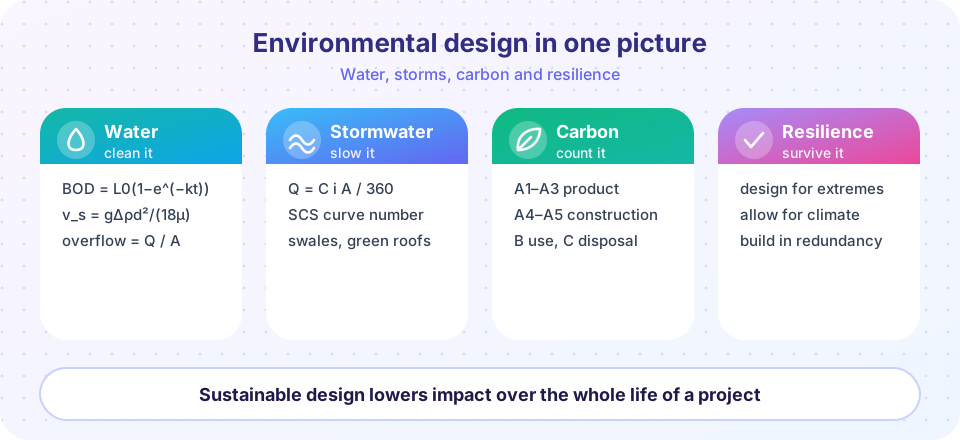
This chapter widened the engineer's question from "will it stand up?" to "what will it do to the world?" Here are the main tools side by side, a worked example that touches three of them, and a ten-question quiz.
What you will learn
- Which equation or idea answers each environmental question.
- How the lessons combine in one site design.
- How to spot weak claims about "green" design.
Key terms
BOD: oxygen demand of pollution in water, BOD_t = L₀ (1 − e^(−kt)).
Overflow rate: Q / A, which decides which particles settle.
Detention: temporary storage that flattens the peak flow leaving a site.
Embodied carbon: product-stage and construction emissions, mass × factor.
Whole-life carbon: embodied plus operational emissions over the lifetime.
Recap table
| Question | Tool | Key relation |
|---|---|---|
| How polluting is the water? | BOD | BOD_t = L₀ (1 − e^(−kt)) |
| Will a particle settle? | Stokes and overflow rate | v_s = gΔρd²/(18μ) ≥ Q/A |
| How big is the flood peak? | Rational method | Q = C i A / 360 |
| How much to store? | Detention | V = ½ T_b (Q_p − Q_o)² / Q_p |
| How much carbon in the build? | LCA modules A1 to A3 | Σ mass × factor |
| Which option is greener? | Whole-life comparison | upfront + yearly × years |
A site design in four steps
A developer plans to pave a 12 ha meadow site next to a small stream.
- Hydrology: the paved site raises the 10-year peak from 0.80 to 2.13 m³/s.
- Stormwater: a detention pond of about 1500 m³ and a swale line hold the peak to the old value, and permeable paving in the car parks reduces the volume.
- Water quality: the pond and the swales settle sediment, and the overflow rate gives the size of particle caught.
- Carbon: the car parks and pond lining use concrete and steel, so the team compares options by embodied carbon and picks a slag-blend concrete and reuses excavated soil on site.
Each step used a different tool, and each decision affected the next one.
Common misconceptions
"Treatment plants create energy for free." Biogas can supply a large share of a plant's energy, but the plant remains a net energy user in most cases.
"A green label guarantees low impact." Check the data. An EPD or a transparent calculation is evidence; an adjective is not.
"Detention solves water quality." Detention helps with flood peaks. Quality needs settling, filtering and plants, and often source control.
Try it
A mini planner chains the stormwater and carbon calculations, then a demonstration checker flags weak "green" claims.
Press Run (or Ctrl + Enter) to see the result here.
Program input · what you'd type while the program runs
Type the answers before you press Run, one per line. Each time the program reads a line (with input()), it gets the next line from this box.
Press Run (or Ctrl + Enter) to see the console output here.
No output.
Check your understanding
Quick check · 10 questions
of 10 answered You scored / 10 · perfect!
-
1. A sample has BOD₅ = 150 mg/L and k = 0.23 d⁻¹. 1 − e^(−1.15) ≈ 0.683. The ultimate BOD is about
L₀ = 150 / 0.683 ≈ 220 mg/L. -
2. Doubling the surface area of an ideal settling tank at the same flow
Overflow rate is Q / A, so doubling A halves it and more particles settle. -
3. Which particle settles fastest? (same material)
Stokes settling velocity grows with d². -
4. A 5 ha site with C = 0.7 and i = 72 mm/h has a peak of
Q = 0.7 × 72 × 5 / 360 = 0.7 m³/s. -
5. Which feature mainly stores water under a surface and lets it soak in?
Permeable paving has a stone reservoir below it. -
6. Which module covers demolition and waste processing?
C modules cover end of life. -
7. 2000 kg of rebar at 1.4 kg CO₂e per kg contributes
2000 × 1.4 = 2800 kg CO₂e. -
8. Why does embodied carbon often dominate for bridges and walls?
Operational energy is small, so the material emissions are most of the total. -
9. A detention pond mainly reduces
It stores water and releases it slowly. -
10. First priority in carbon reduction is to
Avoiding new construction removes the emissions at the source.
Summary
- Water quality uses BOD and settling; flood control uses runoff and detention; carbon uses mass × factor.
- Green infrastructure complements pipes; it does not replace them in extreme storms.
- Compare options over the whole life, with transparent numbers.
- Avoid and reduce first; offset last.
Track your progress
Create a free account to tick off lessons and pick up where you left off on any device.
of Civil Engineering Fundamentals lessons completed