


















Lesson 6 of 48 · The Civil Engineering Profession
Chapter 2 Overview: The Civil Engineering Profession
See who plans, designs, builds and inspects a civil project, how licensing works, and what this chapter covers: branches, design codes and ethics.
A bridge is never built by one person. An owner decides it is needed, planners test the idea, engineers design it, a contractor builds it, inspectors check it and the public uses it for sixty years or more. This chapter looks at the profession: the people, the specialties, the rules and the ethical duties that make safe infrastructure possible.
The big picture
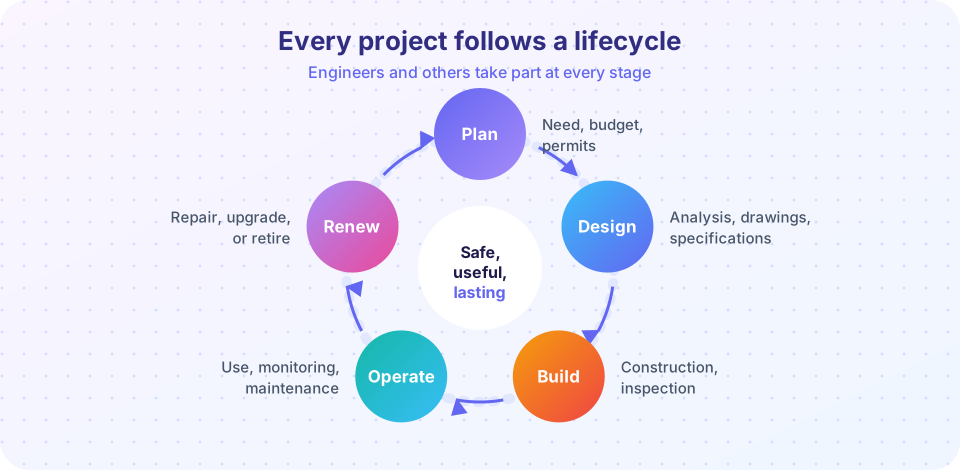
Civil engineering projects share a pattern called the project lifecycle. Different people lead each stage, but the stages overlap, and information must flow in both directions. A designer who does not hear from the people who will maintain a bridge may specify details that are impossible to inspect.
Who is on a project?
The rules
The duty
Ethics are part of the job, not an extra.
Roles you will meet
- Owner or client: a government agency, a company or a family who needs the facility and pays for it.
- Planner: studies need, location, cost and impact before design starts.
- Design engineer (consultant): analyzes, sizes members, produces drawings and specifications.
- Contractor and subcontractors: manage labor, equipment and materials and build to the drawings.
- Resident engineer or inspector: watches construction on the owner's behalf and checks quality.
- Regulator: a public body that approves permits and enforces codes.
Contracts organize these roles. In design-bid-build, the owner has the design finished first, then asks contractors to bid on building it. In design-build, one team does both under one contract, which can be faster but needs careful oversight. Both models share the same technical duties.
Becoming a professional engineer
Engineers earn trust through education, experience and an exam. In the United States, a path leads from an accredited degree through the Fundamentals of Engineering exam and supervised experience to the Professional Engineer (PE) license. In the United Kingdom, graduates work toward Chartered Engineer status through the Institution of Civil Engineers. Other countries have their own bodies. The Washington Accord, signed in 1989, recognizes that accredited engineering degrees in member countries are broadly equivalent, which helps engineers work internationally.
A license matters because certain documents, such as structural drawings for public buildings, must be signed by a person who is legally responsible for them.
What the chapter covers
- Branches of Civil Engineering: the eight main specialties and how they depend on one another.
- The Design Process and Codes: limit states, load and resistance factors, and why codes exist.
- Safety, Ethics and Risk: risk matrices, ALARP, and lessons from past failures.
- Chapter 2 Review: a recap and a ten-question quiz.
Common misconceptions
- "The contractor is responsible for safety, the engineer is not." Both have duties. A designer must create something that can be built and used safely.
- "A license guarantees a perfect design." It guarantees accountability and minimum competence, which is why checking and review still matter.
Try it
Press Run (or Ctrl + Enter) to see the result here.
Program input · what you'd type while the program runs
Type the answers before you press Run, one per line. Each time the program reads a line (with input()), it gets the next line from this box.
Press Run (or Ctrl + Enter) to see the console output here.
No output.
Check your understanding
Quick check · 4 questions
of 4 answered You scored / 4 · perfect!
-
1. In design-bid-build, who builds the project?
In design-bid-build the owner completes the design first, then contractors bid to build it. -
2. What does the Washington Accord do?
It recognizes the substantial equivalence of accredited engineering programs across signatory countries. -
3. Which stage comes right after Build in the lifecycle used here?
After construction, the facility is operated and maintained; renewal comes later. -
4. Why must designers talk to those who will maintain a structure?
Design choices affect inspection and maintenance for decades, so feedback improves safety and cost.
Summary
- Projects pass through plan, design, build, operate and renew, with many roles involved.
- Owners, designers, contractors, inspectors and regulators each carry specific duties.
- Licensing and accreditation (PE, Chartered Engineer, Washington Accord) build public trust.
- This chapter adds the branches, design codes and ethics that guide professional work.
Track your progress
Create a free account to tick off lessons and pick up where you left off on any device.
of Civil Engineering Fundamentals lessons completed