


















Lesson 9 of 48 · The Civil Engineering Profession
Safety, Ethics and Risk
Learn how engineers rank hazards with a risk matrix, apply the hierarchy of controls, and follow the ethical duty to protect the public, with famous case studies.
When a software app fails, you restart it. When a bridge, a dam or a trench wall fails, people can die. That is why civil engineering has a stronger ethical backbone than many professions. Engineers are asked to put public safety, health and welfare first, even above the wishes of an employer or client. This lesson shows how that duty becomes everyday practice: how hazards are ranked, how risks are reduced, and what the profession has learned from past failures.
What you will learn
- How risk is defined and how a risk matrix ranks hazards.
- The hierarchy of controls and the ALARP principle.
- What famous failures teach about design, communication and checking.
- The core ethical duties in engineering codes.
Key terms
- Hazard: something that could cause harm, such as an unsupported trench wall.
- Risk: the combination of how likely harm is and how severe it would be.
- ALARP: reducing risk "as low as reasonably practicable".
- Code of ethics: a profession's published rules of conduct.
Risk = likelihood × consequence
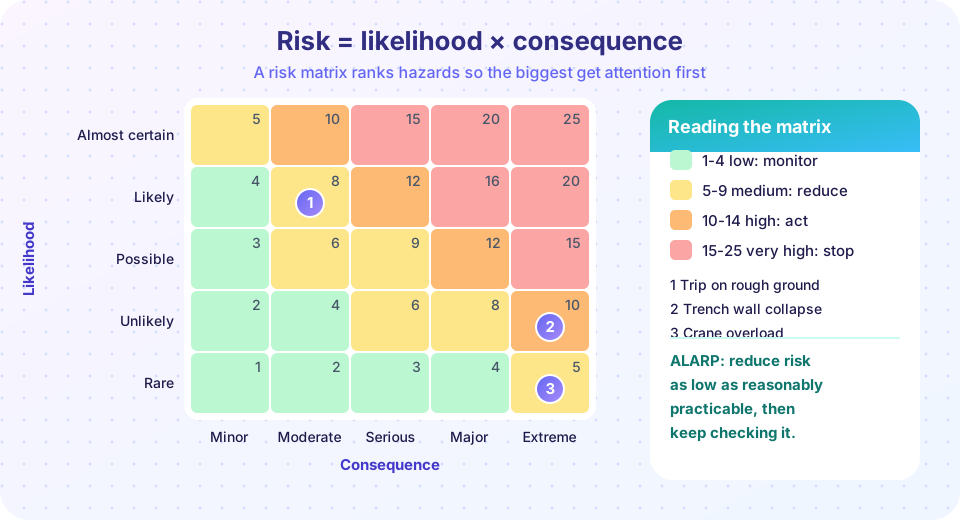
A hazard is a source of possible harm. Risk measures how serious it is in practice. A simple scoring scheme rates likelihood and consequence each from 1 to 5 and multiplies them. The risk matrix above colors the scores: 1 to 4 low, 5 to 9 medium, 10 to 14 high and 15 to 25 very high.
Three examples from the figure:
- Tripping on rough ground: likelihood 4, consequence 2, score 8. It is common but rarely severe, a medium risk that tidy housekeeping reduces.
- Trench wall collapse: likelihood 2, consequence 5, score 10. It is unlikely when trenches are supported, but fatal when it happens, so it lands in the high band. Shoring is mandatory.
- Crane overload: likelihood 1, consequence 5, score 5. Rare because lifts are planned and checked, yet the consequence demands strict controls.
The matrix is a thinking aid, not a law of nature. Scores involve judgment, so teams discuss them and write down their reasons.
The hierarchy of controls
Once a hazard is found, engineers choose controls in order of effectiveness:
- Eliminate the hazard, for example by prefabricating off-site so nobody works at height.
- Substitute something safer, such as a less toxic material.
- Engineering controls: guardrails, shoring, ventilation or interlocks that protect everyone automatically.
- Administrative controls: procedures, training, signs and permits.
- Personal protective equipment (PPE): hard hats, harnesses, gloves. It is the last line of defense, because it relies on every person using it correctly every time.
ALARP says to keep reducing risk until the cost, time or difficulty of going further is grossly out of proportion to the benefit. Residual risk is then monitored and reviewed.
Construction has its own typical killers. In the United States, falls, being struck by objects, electrocution and being caught in or between equipment are often called the "fatal four" of construction fatalities. A good plan targets those first.
Lessons from failures
Failures are painful teachers. A few well-documented cases:
- Quebec Bridge, 1907. During construction the bridge collapsed and killed 75 workers. An inquiry found design errors and warnings about deformed members that were not acted on. It reshaped engineering responsibility in Canada.
- Tacoma Narrows Bridge, 1940. A slender suspension bridge twisted itself apart in a moderate wind. The designers had not considered wind-induced dynamic behavior. Since then aerodynamic testing is standard for long bridges.
- Hyatt Regency walkways, Kansas City, 1981. Two suspended walkways fell during a dance, killing 114 people. A late change to how the hanger rods connected doubled the force on one connection, and the change was not properly checked. The case is a standard lesson on checking changes and on who is responsible for what.
The pattern is the same: assumptions that were not tested, changes that were not reviewed, and warnings that were not heard.
Ethical duties
Professional codes, such as those of ASCE and NSPE, begin with the same first duty: to hold paramount the safety, health and welfare of the public. Other duties include:
- Work only within your competence.
- Be honest in reports, calculations and advertising.
- Avoid conflicts of interest and reject bribery.
- Speak up if a project endangers people, first inside the organization and, if that fails, to the proper authorities.
- Support sustainable use of resources and care for the environment.
- Keep learning, and credit others' work.
Ethics is not a poster on the wall. It is the moment when a deadline is near, a number looks wrong, and you decide to say so.
Common misconceptions
- "If it is legal, it is ethical." Codes of conduct often demand more than the law requires.
- "PPE is the main way to make work safe." It is the weakest control; removing or engineering out the hazard is far better.
- "A low-probability risk can be ignored." If the consequence is catastrophic, even a rare hazard needs strong controls.
Try it
Press Run (or Ctrl + Enter) to see the result here.
Program input · what you'd type while the program runs
Type the answers before you press Run, one per line. Each time the program reads a line (with input()), it gets the next line from this box.
Press Run (or Ctrl + Enter) to see the console output here.
No output.
Check your understanding
Quick check · 5 questions
of 5 answered You scored / 5 · perfect!
-
1. Risk is best described as:
A rare event with catastrophic outcome can be as serious as a common event with minor outcome. -
2. Which control is highest in the hierarchy of controls?
Eliminating the hazard removes the danger altogether, so it is the most effective control. -
3. Which first duty do engineering ethics codes share?
Protecting the public comes before employer or client preferences. -
4. What is a key lesson of the Hyatt Regency walkway collapse?
A late connection change doubled the load on a critical connection without proper checking. -
5. A hazard scores likelihood 3 and consequence 4. Which band is it in?
3 × 4 = 12, which is in the high band of 10 to 14.
Summary
- Risk combines likelihood and consequence; matrices rank hazards for action.
- Controls follow a hierarchy: eliminate, substitute, engineer, administer, then PPE; ALARP guides how far to go.
- Past failures such as Quebec, Tacoma Narrows and the Hyatt Regency show the cost of untested assumptions and unchecked changes.
- Ethics codes put public safety first and require honesty, competence and the courage to speak up.
Next: Chapter 2 Review
Track your progress
Create a free account to tick off lessons and pick up where you left off on any device.
of Civil Engineering Fundamentals lessons completed