


















Lesson 28 of 48 · Transportation Engineering
Chapter overview: Transportation engineering
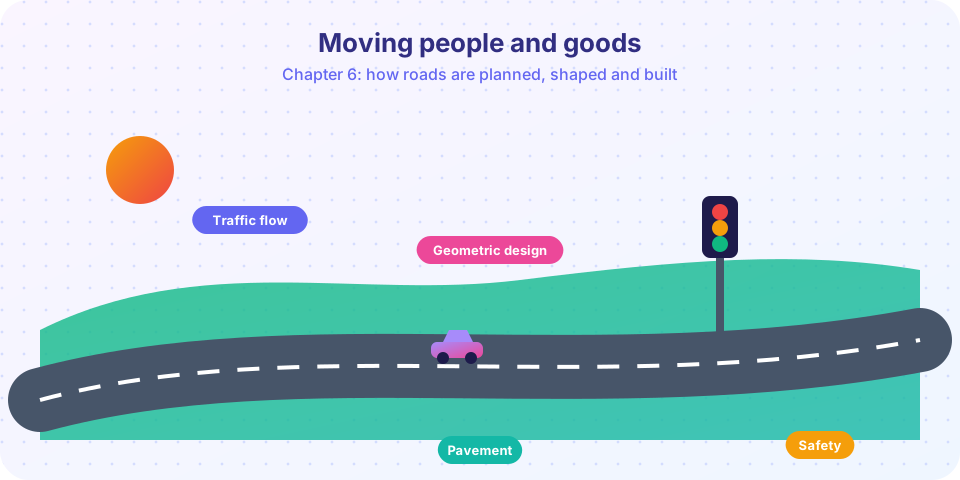
A map of transportation engineering: how traffic flows, how roads are shaped for safety, and how pavements carry the load. Start here before the lessons.
Every morning millions of people join a system that nobody sees whole: roads, junctions, bridges, signals and the pavement under the tires. Transportation engineering plans, designs and operates that system so that people and goods move safely, quickly and at reasonable cost. It combines mathematics (flow models), physics (braking and curves), materials (pavement layers) and human behavior (drivers react slowly and unpredictably).
What you will learn
- The main parts of the transportation system.
- Why flow, geometry and pavement are three separate design problems.
- The vocabulary used in the next lessons.
- How the lessons link together.
Key terms
Flow (q): the number of vehicles passing a point per hour. Density (k): the number of vehicles per kilometer of road. Design speed: the speed used to choose curve radii and sight distances. Level of service (LOS): a grade from A (free flow) to F (breakdown) describing how a road feels to drivers. Pavement: the structure of layers that carries wheel loads to the soil.
Three design problems
Three jobs, one road
Traffic flow
Geometric design
Pavement
Loads repeat millions of times.
Traffic engineering asks how many vehicles a road can carry and how to keep them moving. Geometric design chooses the horizontal and vertical shape of the road so that a driver traveling at the design speed can see hazards in time and stay on the road. Pavement engineering designs the layers under the surface so they last decades under repeated loading.
These problems interact. A wider road increases capacity, but a higher design speed needs larger curve radii, which need more land. Heavy traffic raises pavement cost. The engineer balances them with the available budget.
Why speed matters so much
Three things grow with speed: the distance needed to stop, the radius needed for curves, and the severity of crashes (kinetic energy is proportional to v²). That is why speed limits and design speeds appear in almost every formula in this chapter.
What each lesson covers
- Traffic flow fundamentals introduces flow, density, speed and the capacity of a lane.
- Geometric design works out sight distance and horizontal curves.
- Pavement design basics explains layers, axle loads and how stress spreads.
- Chapter review summarizes the chapter and quizzes you.
Common misconceptions
"A wider road solves congestion." More lanes help only if the bottleneck is lane capacity. Junctions, merges and incidents often limit flow instead.
"Roads fail because of age." They fail because of repeated heavy loads and water entering the layers. Weather speeds this up, but traffic does most of the damage.
Try it
First, how lane capacity depends on the gap between vehicles. Then a quick conversion tool for speed and spacing.
Press Run (or Ctrl + Enter) to see the result here.
Program input · what you'd type while the program runs
Type the answers before you press Run, one per line. Each time the program reads a line (with input()), it gets the next line from this box.
Press Run (or Ctrl + Enter) to see the console output here.
No output.
Check your understanding
Quick check · 4 questions
of 4 answered You scored / 4 · perfect!
-
1. Which grade describes free-flowing traffic in level of service?
LOS A is free flow and LOS F is breakdown. -
2. Which design problem decides the radius of a curve?
Curve radius follows from the design speed, banking and friction, which are geometric design choices. -
3. If drivers keep a 2-second gap, the lane flow is
q = 3600 / 2 = 1800 vehicles per hour. -
4. What mostly damages pavements?
Fatigue from repeated loading and moisture in the layers are the main causes.
Summary
- Transportation engineering joins traffic flow, geometric design and pavement design.
- Speed drives stopping distance, curve size and crash severity.
- Capacity depends on how closely vehicles can follow each other safely.
- Pavements fail from repeated loads and water.
Track your progress
Create a free account to tick off lessons and pick up where you left off on any device.
of Civil Engineering Fundamentals lessons completed