


















Lesson 31 of 48 · Transportation Engineering
Pavement design basics
Understand flexible and rigid pavements, why layers spread load, how the fourth-power law makes trucks destructive, and how stress falls with depth.
Look at a road surface and you see a thin dark skin. Underneath is a carefully designed stack of layers whose job is to take the pressure of a tire, which can be 700 kPa or more, and reduce it to a level the natural soil can survive. A pavement that does this well lasts decades. One that does not turns into ruts, cracks and potholes within a few years.
What you will learn
- The difference between flexible and rigid pavements.
- What each layer does.
- How axle load is converted into equivalent standard axles (ESALs).
- How stress under a wheel falls with depth.
Key terms
Flexible pavement: asphalt-surfaced layers that deflect under load and spread it through the granular layers. Rigid pavement: a concrete slab that spreads load by its own stiffness. Subgrade: the natural soil under the pavement; usually the weakest layer. ESAL: an equivalent single axle load, a measure of damage in units of one 80 kN (18,000 lb) standard axle. Rutting and fatigue: permanent grooves in wheel paths, and cracks from repeated bending.
Flexible and rigid pavements
A flexible pavement has a surface of asphalt concrete over a granular base and subbase, all sitting on the subgrade. It bends under a wheel and distributes the load through the layers. A rigid pavement is a concrete slab (often with steel dowels at joints), stiff enough to spread the load over a wide area so the subgrade sees low stress. Rigid slabs cost more at first and last long; flexible pavements are cheaper to build and easy to resurface. Many roads combine them, for example by overlaying old concrete with asphalt.
Why layers?
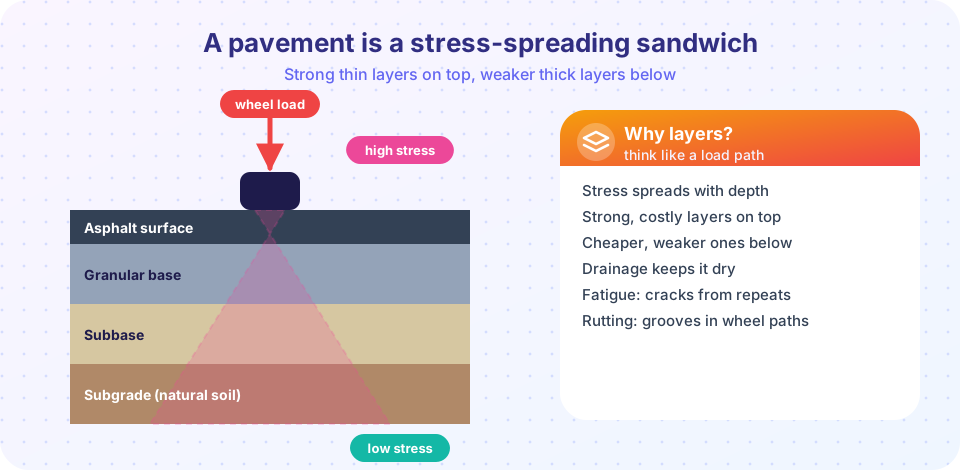
Strong materials are expensive and the soil below is cheap. So engineers put the best material where stress is highest, at the top, and cheaper, weaker material lower down. A typical flexible pavement has:
- Surface course: asphalt, resists tire wear and keeps water out.
- Base course: crushed stone, carries most of the load spreading.
- Subbase: cheaper granular material, adds thickness and drainage.
- Subgrade: the natural soil, often compacted or stabilized.
Water is the enemy of all of them. Water in the base and subgrade lowers their strength, so drainage details (crossfall, side ditches, edge drains) are part of pavement design.
Axle loads and the fourth-power law
A single heavy truck axle does far more damage than a car. Road tests in the United States (the AASHO Road Test of the late 1950s) found that damage grows roughly with the fourth power of axle load. Relative to the 80 kN standard axle:
ESAL factor ≈ (axle load / 80 kN)⁴
| Axle load | Factor |
|---|---|
| 10 kN (a car axle) | about 0.0002 |
| 40 kN | about 0.06 |
| 80 kN | 1.00 |
| 100 kN | about 2.4 |
| 120 kN | about 5.1 |
So one overloaded 120 kN axle does the damage of five standard axles, and thousands of cars together cause less damage than a handful of trucks. A design adds up the ESALs expected over the design life (for example 20 years) and picks layer thicknesses for that total. This is why roads near quarries and ports are built much thicker than residential streets, and why axle load limits are strictly enforced.
Stress under a wheel
A tire presses on the road with a contact pressure close to its inflation pressure, perhaps 700 kPa. The stress at depth z under the center of a uniformly loaded circular area of radius a, in an elastic half-space, is (Boussinesq):
σz = q [1 − (1 / (1 + (a/z)²))^1.5]
With a 40 kN wheel and q = 700 kPa the contact radius is a = √(P / (π q)) = √(40,000 / (π × 700,000)) ≈ 0.135 m. At a depth of one radius (0.135 m) the stress has fallen to about 65% of q; at a depth of four radii it is under 10%. This is the physical basis for layers: strong thin layers above, cheaper thicker ones below.
Common misconceptions
"A thicker asphalt layer is always the best fix." If the base or subgrade is wet or weak, the extra asphalt will crack from below. Drainage and foundation come first.
"Cars wear out roads." Passenger cars contribute very little damage compared with heavy trucks, because of the fourth-power law.
"Rigid pavements never need maintenance." Joints, cracks and slab settlement still need regular attention.
Try it
Plot how stress decays with depth under a wheel, then compute ESALs for a traffic mix.
Press Run (or Ctrl + Enter) to see the result here.
Program input · what you'd type while the program runs
Type the answers before you press Run, one per line. Each time the program reads a line (with input()), it gets the next line from this box.
Press Run (or Ctrl + Enter) to see the console output here.
No output.
Check your understanding
Quick check · 5 questions
of 5 answered You scored / 5 · perfect!
-
1. Which layer of a flexible pavement is usually the weakest?
The natural soil carries the lowest stress but is also the weakest, which is why stress must be spread out. -
2. By the fourth-power law, a 120 kN axle is about how many standard 80 kN axles?
(120/80)⁴ = 1.5⁴ ≈ 5.06. -
3. What mainly justifies using several layers?
Spreading the load lets engineers put expensive material only where stress is high. -
4. Rutting is
Repeated loading compacts or shoves the layers, forming ruts. -
5. Why is drainage part of pavement design?
Moisture reduces strength and speeds damage.
Summary
- Flexible pavements spread load through layers; rigid pavements use a stiff concrete slab.
- Strong, thin layers go on top; weaker, thicker ones go below.
- Damage grows with the fourth power of axle load, so heavy trucks dominate design.
- Stress under a wheel falls quickly with depth; drainage protects every layer.
Track your progress
Create a free account to tick off lessons and pick up where you left off on any device.
of Civil Engineering Fundamentals lessons completed