


















Lesson 13 of 48 · Surveying and Mapping
Leveling and Elevations
Learn how a level and staff measure height differences, how to book backsights and foresights, check the arithmetic and judge misclosure in leveling.
Water runs downhill, roads must not be too steep, and the pipe in a trench has to fall toward the sewer. All of these depend on elevations, the heights of points above a datum. The standard way to find them is leveling: a level instrument creates a horizontal line of sight, a graduated staff held on a point is read through the telescope, and the difference between two staff readings is the difference in height between the two points.
What you will learn
- The terms backsight, foresight, intermediate sight, turning point and height of instrument.
- How to reduce a leveling book with the height-of-instrument method and run the arithmetic check.
- How to judge the closing error against a tolerance.
- Why curvature, refraction and unequal sight lengths matter.
Key terms
- Reduced level (RL): the height of a point above the datum.
- Backsight (BS): a staff reading on a point of known height.
- Foresight (FS): a staff reading on a point whose height is wanted, the last reading before the instrument moves.
- Turning point (TP): a stable point that carries the height forward when the instrument is moved.
The principle
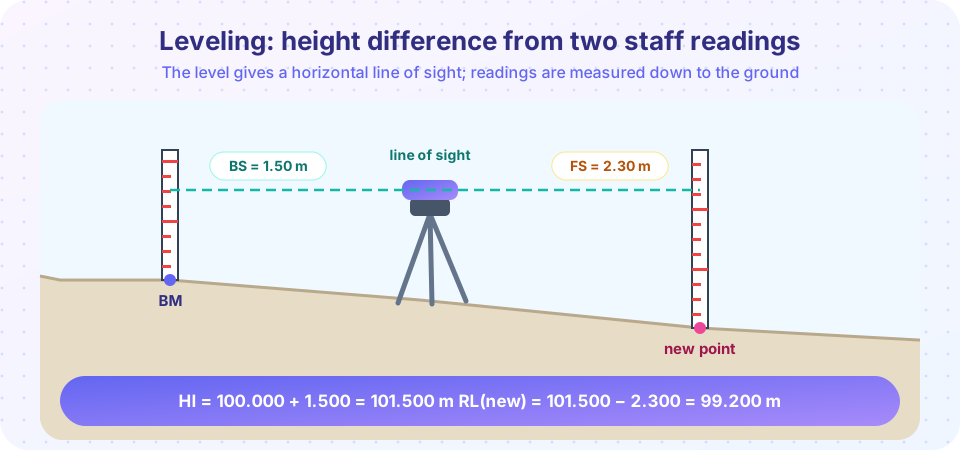
The level's line of sight is horizontal. If you read the staff at 1.500 m on a point at 100.000 m, the line of sight is 101.500 m above the datum: HI = RL + BS. The staff is read down from that line, so a reading of 2.300 m on a new point puts it at RL = HI − FS = 101.500 − 2.300 = 99.200 m. A bigger staff reading means a lower point.
A route is rarely visible from one setup, so the surveyor moves along in steps. At each setup there is one backsight to a known point and one foresight to the next point. The foresight point becomes the next backsight point, and is called a turning point. Points that are only wanted for their height, such as ground along a road line, get intermediate sights (IS) from the same setup.
Booking and reducing
The height of instrument method uses columns for BS, IS, FS, HI and RL. For each setup: add the BS to the RL of that point to get the new HI; subtract any IS or FS from the HI to get that point's RL.
Worked example. BM1 = 100.000 m. The route ends on BM2, whose published level is 100.890 m.
| Station | BS | IS | FS | HI | RL |
|---|---|---|---|---|---|
| BM1 | 1.500 | 101.500 | 100.000 | ||
| TP1 | 1.850 | 2.300 | 101.050 | 99.200 | |
| TP2 | 2.110 | 0.940 | 102.220 | 100.110 | |
| P | 1.760 | 100.460 | |||
| BM2 | 1.325 | 100.895 |
Work through it: at TP1 the foresight gives 101.500 − 2.300 = 99.200; the new setup's BS of 1.850 gives HI = 99.200 + 1.850 = 101.050. Repeat.
Arithmetic check. Intermediate sights are left out. The sum of backsights minus the sum of foresights must equal the last RL minus the first RL: ΣBS = 5.460, ΣFS = 4.565, difference 0.895 m, and 100.895 − 100.000 = 0.895 m. The books agree, so the arithmetic is right.
Closing error. The computed BM2 is 100.895 m but its published value is 100.890 m, so the misclosure is +5 mm. Allowable misclosure is usually written c √K with K the route length in km. A commonly used value for ordinary work is c = 12 mm; for a 0.36 km route the tolerance is 12 × √0.36 = 7.2 mm. The 5 mm is acceptable, and the error is spread over the turning points in proportion to distance or setups.
The rise and fall method compares successive readings instead (a rise if the next reading is smaller) and gives the same levels. It checks every intermediate point as well, which makes it better for long profiles.
Sources of error
- Collimation error: if the line of sight is not truly horizontal, readings are off by an amount proportional to distance. Keeping BS and FS distances equal cancels it. The "two-peg test" measures it.
- Curvature and refraction: the Earth curves away from a horizontal line, and light bends slightly in air. Combined, a sight over
Kkm misreads by about0.0675 K²meters. That is 0.7 mm at 100 m, 17 mm at 500 m and 67 mm at 1 km. Short, equal sights make the error cancel. - Staff errors: a staff not held vertical reads too large (rock it slowly and take the smallest reading), and a staff with mud or a worn base gives wrong heights.
- Reading errors: misreading a decimal place. Booking the readings immediately and checking sums catches most of these.
Common misconceptions
- "A higher staff reading means a higher point." It means a lower point, because the reading is measured down from the line of sight.
- "The arithmetic check proves the readings are right." It proves only that the reductions were done correctly; a misread staff still passes it.
- "Intermediate sights are included in the check." They are excluded, because they do not affect the carried height.
Try it
Press Run (or Ctrl + Enter) to see the result here.
Program input · what you'd type while the program runs
Type the answers before you press Run, one per line. Each time the program reads a line (with input()), it gets the next line from this box.
Press Run (or Ctrl + Enter) to see the console output here.
No output.
Check your understanding
Quick check · 4 questions
of 4 answered You scored / 4 · perfect!
-
1. A benchmark is at 50.000 m and the backsight reading is 1.250 m. What is the height of instrument?
HI = RL + BS = 50.000 + 1.250 = 51.250 m. -
2. With HI = 51.250 m, a foresight of 2.100 m gives which RL?
RL = HI − FS = 51.250 − 2.100 = 49.150 m. -
3. ΣBS = 8.420 and ΣFS = 7.915. The first RL is 120.000 m. What should the last RL be?
Last RL − first RL = ΣBS − ΣFS = 0.505, so the last RL is 120.505 m. -
4. Why keep backsight and foresight distances equal?
Errors that grow with distance affect both sights equally and cancel in the difference.
Summary
- Leveling finds height differences with a horizontal line of sight:
HI = RL + BSandRL = HI − FS. - A bigger staff reading means a lower point; turning points carry height between setups.
- Check the arithmetic with
ΣBS − ΣFS = last RL − first RL, and the field work with a closing tolerance such as12 mm √K. - Equal sight lengths cancel collimation, curvature and refraction errors.
Track your progress
Create a free account to tick off lessons and pick up where you left off on any device.
of Civil Engineering Fundamentals lessons completed