


















Lesson 37 of 48 · Geotechnical Engineering
Chapter review: Geotechnical engineering
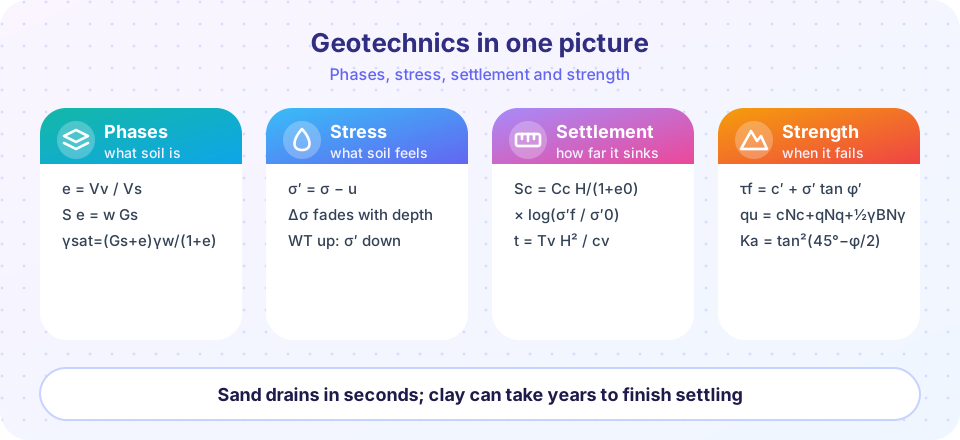
Review phase relations, effective stress, settlement, shear strength, bearing capacity and earth pressure in one picture, then test yourself with ten questions.
Geotechnical engineering turns a handful of simple ideas into foundations that stand for a century. This review collects them: the phase diagram, effective stress, consolidation, Mohr-Coulomb, bearing capacity and Rankine pressure. Then you will run one footing through all of them and answer ten mixed questions.
What you will learn
- Which equation answers which geotechnical question.
- How the four checks combine for one foundation.
- Where the common mistakes lie.
Key terms
Effective stress: σ′ = σ − u.
Void ratio: e = V_v / V_s.
Consolidation: time-dependent compression of saturated clay as water drains.
Bearing capacity: the ultimate pressure the ground can take before shear failure.
Active pressure: the minimum lateral pressure on a wall that moves outward.
Recap table
| Question | Tool | Equation |
|---|---|---|
| How much of the soil is voids? | Phase relations | e = V_v/V_s, S e = w G_s |
| How heavy is it? | Unit weights | γ_sat = (G_s + e) γ_w/(1 + e) |
| What stress do the grains feel? | Effective stress | σ′ = σ − u |
| How far will clay settle? | Consolidation | S_c = C_c H/(1+e₀) log₁₀((σ′₀+Δσ)/σ′₀) |
| How long does it take? | Terzaghi | t = T_v H_dr² / c_v |
| How strong is it? | Mohr-Coulomb | τ_f = c′ + σ′ tan φ′ |
| Will the footing fail? | Bearing capacity | q_u = c N_c + q N_q + ½ γ B N_γ |
| How hard does it push a wall? | Rankine | P_a = ½ K_a γ H² |
One footing, four checks
A strip footing 2 m wide, 1 m deep, carries a pressure of 200 kPa on sand (φ = 30°, γ = 18 kN/m³). Below the sand lies the 4 m clay layer from the consolidation lesson.
- Classify: the sand is well graded, so it is a good bearing layer.
- Stress: the 2:1 rule puts
Δσ ≈ 200 × 2 / (2 + 4) ≈ 67 kPaat the top of the clay. The real stress at mid-clay is smaller; for a quick check we use the value. - Bearing: from the previous lesson
q_u ≈ 734 kPa, soFS = 734 / 200 ≈ 3.7. Safe. - Settlement: the clay settles. Using Δσ = 40 kPa at mid-depth as before, about 140 mm of consolidation settlement appears over a couple of years. If 140 mm is too much, the engineer reduces the pressure, widens the footing or improves the clay with drains.
Notice that the settlement check, not the bearing check, would control here. This is typical when clay lies under a footing.
Common misconceptions
"If the footing does not fail, the design is fine." Settlement and differential settlement often control. Cracks and sticking doors are settlement symptoms.
"A saturated soil has no air, so w = 100%." Water content is the weight ratio of water to solids and is typically 15% to 50% for saturated soils.
"Wall pressure is the same on any wall." It depends on wall movement (active, at-rest or passive), backfill, drainage and surcharge.
Try it
A combined check for the footing above, and a quick flash of unit conversions between densities and unit weights.
Press Run (or Ctrl + Enter) to see the result here.
Program input · what you'd type while the program runs
Type the answers before you press Run, one per line. Each time the program reads a line (with input()), it gets the next line from this box.
Press Run (or Ctrl + Enter) to see the console output here.
No output.
Check your understanding
Quick check · 10 questions
of 10 answered You scored / 10 · perfect!
-
1. A saturated soil has e = 0.9 and Gs = 2.7. Its water content is
w = e / Gs = 0.9 / 2.7 = 0.333. -
2. At 6 m depth, total stress 120 kPa, water table at 2 m. The effective stress is about
u = 9.81 × 4 = 39.2 kPa, so σ′ = 120 − 39.2 ≈ 80.8 kPa. -
3. A clay layer drains one way and is 5 m thick. H_dr is
With one-way drainage the path equals the thickness. -
4. Which soil settles fastest after loading?
Sand drains in seconds, so its settlement is nearly immediate. -
5. Mohr-Coulomb: c′ = 0, φ′ = 30°, σ′ = 200 kPa. τ_f =
200 × tan 30° = 200 × 0.577 = 115.5 kPa. -
6. Doubling the width B of a strip footing in sand (c = 0) changes q_u mainly through
That term is proportional to B. -
7. A 3 m wall retains sand with K_a γ = 6 kN/m³ per meter of depth. The thrust per meter of wall is
P_a = ½ × 6 × 3² = 27 kN/m. -
8. A water table rise generally causes effective stress to
Pore pressure rises while total stress hardly changes. -
9. FS = q_u / q_applied. If q_u = 600 kPa and the applied pressure is 150 kPa, FS =
600 / 150 = 4. -
10. Which test result drives the Atterberg classification of a clay?
PI = LL − PL, plotted on the plasticity chart.
Summary
- A foundation design combines classification, stress, settlement and strength checks.
- On clay, settlement often controls; on sand, bearing capacity does.
- Drainage and the water table are central: they change effective stress, strength and time.
- Always apply a factor of safety.
Next: Chapter overview: Environmental and sustainable design
Track your progress
Create a free account to tick off lessons and pick up where you left off on any device.
of Civil Engineering Fundamentals lessons completed