


















Lesson 36 of 48 · Geotechnical Engineering
Shear strength, bearing capacity and earth pressure
Use the Mohr-Coulomb criterion, Mohr circles, bearing capacity factors and Rankine earth pressure to check footings and retaining walls, with worked examples.
Soil does not crush the way concrete does. It fails by shearing: one mass slides over another along a surface. A footing failing, a slope slipping and a wall being pushed over are all shear failures. So the question "how strong is soil?" really means "how much shear stress can it carry on a given plane?" This lesson answers it with the Mohr-Coulomb law, then applies it to foundations and walls.
What you will learn
- How friction and cohesion combine in Mohr-Coulomb strength.
- How to draw and use a Mohr circle at failure.
- How to compute the bearing capacity of a strip footing.
- How to compute Rankine active earth pressure on a wall.
Key terms
Cohesion (c′): strength that does not depend on normal stress, from bonding between particles. Friction angle (φ′): the angle that relates shear strength to effective normal stress. Mohr circle: a graph of the normal and shear stresses on all planes through a point. Active earth pressure: the minimum horizontal pressure on a wall that moves away from the soil enough for the soil to reach failure. Factor of safety (FS): capacity divided by demand.
Mohr-Coulomb strength
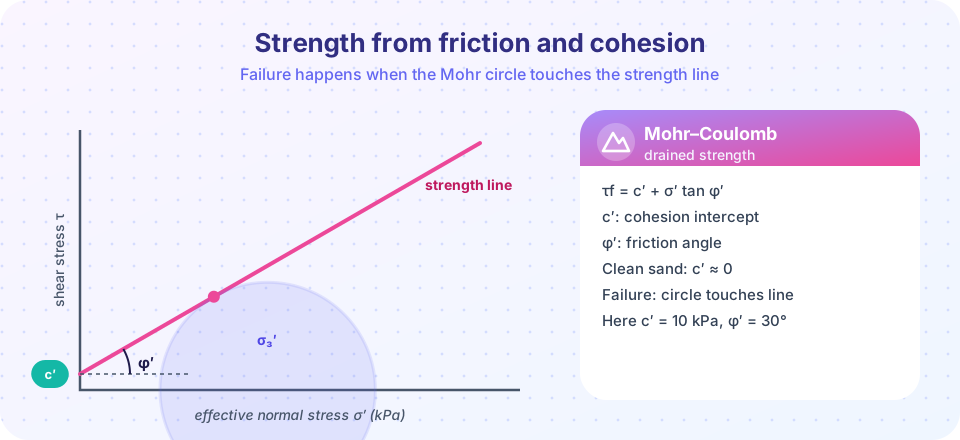
The shear strength on a plane is
τ_f = c′ + σ′ tan φ′
Sand has c′ ≈ 0 and φ′ of roughly 30° to 40°, depending on density. Clay has both c′ and a lower φ′ when drained. Pushing harder on the plane raises the strength, like pressing harder on a block to make it harder to slide. Since σ′ is the effective normal stress, high pore pressure reduces strength directly.
Mohr circle at failure. At failure the major and minor effective principal stresses satisfy
σ₁′ = σ₃′ tan²(45° + φ′/2) + 2 c′ tan(45° + φ′/2)
For c′ = 10 kPa, φ′ = 30° and σ₃′ = 50 kPa: tan²(60°) = 3, tan(60°) = 1.732, so σ₁′ = 150 + 34.6 = 184.6 kPa. The circle has center 117.3 kPa and radius 67.3 kPa, and it touches the strength line exactly. If σ₁′ were larger than 184.6 kPa with the same σ₃′, the soil would already have failed, which is impossible, so the circle can never cross the line.
Bearing capacity
A footing pushes down and the soil beneath pushes back. Beyond a limit the soil shears in the pattern shown in the figure: a wedge under the footing, curved shear zones and passive wedges at the sides. The ultimate bearing capacity of a strip footing of width B and depth D_f follows the Terzaghi form with Vesic's N_γ:
q_u = c N_c + q N_q + ½ γ B N_γ
where q = γ D_f is the soil weight beside the footing, and
N_q = e^(π tan φ) tan²(45° + φ/2)N_c = (N_q − 1) cot φN_γ = 2 (N_q + 1) tan φ
For φ = 30° these give N_q = 18.40, N_c = 30.14 and N_γ = 22.40.
Worked example. A strip footing 2 m wide sits 1 m deep in sand with c = 0, φ = 30°, γ = 18 kN/m³.
q = 18 × 1 = 18 kPa.q_u = 18 × 18.40 + ½ × 18 × 2 × 22.40 = 331 + 403 ≈ 734 kPa.- With FS = 3, the allowable pressure is
734 / 3 ≈ 245 kPa.
Notice that both the width and the depth help: wider and deeper footings carry more pressure. In saturated clay loaded quickly (undrained), φ = 0 and the strength is the undrained shear strength c_u, so q_u ≈ 5.14 c_u + q for a strip. With c_u = 50 kPa, q_u ≈ 257 + 18 ≈ 275 kPa. The allowable pressure also has to satisfy a settlement limit, which often controls on clay.
Earth pressure on walls
A retaining wall holds back soil. The soil pushes sideways with a horizontal stress that is a fraction K of the vertical effective stress. For a smooth vertical wall and level ground, Rankine's theory gives
- Active:
K_a = tan²(45° − φ/2) = (1 − sin φ) / (1 + sin φ) - Passive:
K_p = 1 / K_a
For φ = 30°, K_a = 1/3 and K_p = 3. The horizontal active pressure grows linearly with depth, so the resultant force per meter of wall is
P_a = ½ K_a γ H², acting at H/3 above the base.
A 4 m wall retaining sand with γ = 18 kN/m³ gets P_a = ½ × 0.333 × 18 × 16 = 48 kN/m at 1.33 m above the base. Notice the similarity with hydrostatics: the soil acts like a fluid with an equivalent weight of K_a γ = 6 kN/m³, about 0.6 of water's weight. If the backfill is saturated and undrained, water pressure adds to the load, which is why retaining walls are provided with drainage.
Common misconceptions
"A larger friction angle always means a safer design." Friction angles are measured and uncertain; many designs use a reduced value to be safe.
"Cohesion is a reliable strength for design." Apparent cohesion in sand (from damp capillary suction) disappears when the sand dries or floods, so designers often take c′ = 0.
"Active pressure is the pressure on every wall." It applies only if the wall can move slightly away from the soil. A rigid basement wall that cannot move feels a larger at-rest pressure.
Try it
Draw the Mohr circle for a stress state and see how close it is to failure. Then compute bearing capacity for any friction angle.
Press Run (or Ctrl + Enter) to see the result here.
Program input · what you'd type while the program runs
Type the answers before you press Run, one per line. Each time the program reads a line (with input()), it gets the next line from this box.
Press Run (or Ctrl + Enter) to see the console output here.
No output.
Check your understanding
Quick check · 5 questions
of 5 answered You scored / 5 · perfect!
-
1. Dry clean sand has c′ = 0 and φ′ = 35°. The shear strength at σ′ = 100 kPa is
τ_f = σ′ tan 35° = 100 × 0.700 = 70 kPa. -
2. For φ = 30°, the Rankine active coefficient K_a is
K_a = (1 − sin 30°)/(1 + sin 30°) = 0.5/1.5 = 1/3. -
3. A 5 m high wall retains sand with γ = 18 kN/m³ and K_a = 1/3. The active thrust per meter is
P_a = ½ × (1/3) × 18 × 25 = 75 kN/m. -
4. Making a footing wider (same φ, c = 0) generally
The ½ γ B N_γ term grows with B. -
5. Where does the active thrust act on a vertical wall of height H with triangular pressure?
For a triangular distribution the resultant is at one third of the height from the base.
Summary
- Soil strength follows
τ_f = c′ + σ′ tan φ′. - A Mohr circle touching the strength line means failure.
- Strip footing capacity:
q_u = c N_c + q N_q + ½ γ B N_γ, then divide by FS. - Rankine:
K_a = tan²(45° − φ/2),P_a = ½ K_a γ H²at H/3.
Track your progress
Create a free account to tick off lessons and pick up where you left off on any device.
of Civil Engineering Fundamentals lessons completed