


















Lesson 18 of 48 · Construction Materials
Steel and Metals
Learn what makes structural steel special: stiffness, yield and ultimate strength, ductility, common grades, rebar, corrosion and fire, with a worked tension example.
If concrete is the material of mass, steel is the material of precision. It is strong in both tension and compression, it behaves predictably, and it fails visibly: before it breaks it stretches, bends and gives warning. Those properties made steel the backbone of skyscrapers, long-span bridges and the reinforcing bars hidden inside concrete.
What you will learn
- What steel is and which products and grades civil engineers use.
- How to read the steel stress-strain curve.
- How to compute the yield capacity of a tension member.
- Why corrosion, fire and fatigue need special attention.
Key terms
- Yield strength (fy): the stress where permanent deformation begins.
- Ultimate strength (fu): the maximum stress on the curve.
- Young's modulus (E): the slope of the elastic part; about 200 GPa for all steels.
- Necking: local thinning of the specimen after ultimate strength, before fracture.
What steel is
Steel is iron with a little carbon (typically well under 1 percent for structural grades, around 0.2 percent for mild steel) and small additions of manganese and other elements. More carbon makes steel harder and stronger but less ductile and harder to weld, so structural steels keep the carbon low.
Common products include rolled I-sections and H-sections for beams and columns, angles and channels, hollow sections, plates, reinforcing bars (rebar) for concrete, cold-formed sheet for purlins and decking, and high-strength cables and strands for suspension bridges and prestressing.
Grades are named by yield strength. In Europe, S275 and S355 mean a minimum yield of 275 and 355 MPa. In the United States, ASTM A36 has a yield of about 250 MPa, and A992 (common for wide-flange beams) about 345 MPa. Reinforcing bar is often 500 MPa in Europe (B500) and Grade 60, about 420 MPa, in the US. Whatever the grade, stiffness stays the same: E ≈ 200 GPa, Poisson's ratio about 0.3, density 7,850 kg/m³.
The stress-strain curve
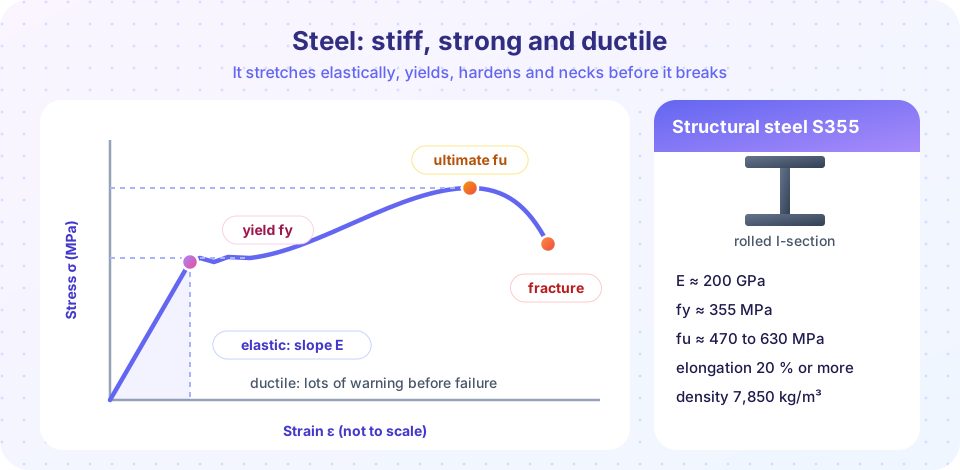
Pull a steel specimen and plot stress against strain. The curve has four stages:
- Elastic range. A straight line whose slope is
E. If you unload, the specimen returns to its original length. Design works in this region. - Yield. At
fythe curve flattens into a plateau; the steel keeps stretching at nearly constant stress as layers of atoms slip. This permanent deformation is what makes it ductile. - Strain hardening. The steel stiffens again and stress rises to the ultimate value
fu. For S355,fuis about 470 to 630 MPa. - Necking and fracture. The specimen thins locally, the load drops and it finally fractures. Elongation at fracture is typically 20 percent or more.
The strain at which yield begins is small: for S355, εy = fy / E = 355 / 200,000 = 0.001775, or 0.18 percent. A 10 m member yields after stretching only 17.8 mm. High-strength steels without a clear plateau use the 0.2 percent offset method to define the yield point.
Design strength of a tension member
A member in tension yields when P = fy × A. Codes reduce this with a safety factor. Example: a round S355 bar with a diameter of 20 mm has an area A = π × 20² / 4 = 314.2 mm².
- Yield load:
P_y = 355 × 314.2 = 111,540 N ≈ 111.5 kN. - With a US-style resistance factor
φ = 0.90, the design strength is0.90 × 111.5 ≈ 100.4 kN.
If the factored demand on this bar is 95 kN, it passes (utilization 0.95); if it is 110 kN, you must choose a larger bar. Real tension members also need checks at the net section through bolt holes and at connections.
Weaknesses to design around
- Corrosion. Steel rusts when it meets oxygen and moisture. Protection includes paint, galvanizing (a zinc coating), weathering steel that forms a stable rust layer, and for rebar, enough concrete cover.
- Fire. Steel does not burn, but it softens. At around 600 °C it keeps only about half of its yield strength, so structural steel is protected with intumescent paint, boards or sprays.
- Fatigue. Repeated load cycles can grow cracks at welds and holes even when stresses are far below yield, which matters for bridges and cranes.
- Brittle fracture. At low temperatures, or with poor welds, steel can crack suddenly. The Charpy impact test measures toughness, and grades are specified with a minimum energy at a stated temperature.
- Buckling. Slender steel members in compression fail by bending sideways long before the material crushes. You will study it in later structural courses.
Common misconceptions
- "Stronger steel is stiffer." High-strength steel yields at a higher stress but has the same
E, so it deflects equally. - "Steel does not burn, so it is fire safe." It loses strength with heat and needs protection.
- "The yield point is where the steel breaks." It is where permanent stretching begins; the steel can carry more load after yield.
Try it
Press Run (or Ctrl + Enter) to see the result here.
Program input · what you'd type while the program runs
Type the answers before you press Run, one per line. Each time the program reads a line (with input()), it gets the next line from this box.
Press Run (or Ctrl + Enter) to see the result here.
Program input · what you'd type while the program runs
Type the answers before you press Run, one per line. Each time the program reads a line (with input()), it gets the next line from this box.
Press Run (or Ctrl + Enter) to see the console output here.
No output.
Check your understanding
Quick check · 5 questions
of 5 answered You scored / 5 · perfect!
-
1. Which property is about the same for all structural steel grades?
E is about 200 GPa whatever the grade; stronger grades yield later but are no stiffer. -
2. What does S355 mean?
The number is the minimum yield strength in MPa. -
3. A 16 mm bar (A = 201 mm²) with fy = 500 MPa yields at about:
500 × 201 = 100,500 N ≈ 100 kN. -
4. Why does structural steel need fire protection?
Around 600 °C steel keeps about half its yield strength. -
5. Which part of the curve describes permanent stretching at nearly constant stress?
At yield the steel flows plastically at about constant stress before hardening starts.
Summary
- Structural steel is iron with low carbon; grades are named by yield strength, with
E ≈ 200 GPaand density 7,850 kg/m³. - The stress-strain curve has elastic, yield, hardening and necking stages; ductility gives warning before failure.
- Tension yield capacity is
fy × A, reduced by a safety factor in design. - Protect steel against corrosion and fire, and watch for fatigue, brittle fracture and buckling.
Track your progress
Create a free account to tick off lessons and pick up where you left off on any device.
of Civil Engineering Fundamentals lessons completed