


















Lesson 46 of 48 · Projects and Practice
Glossary of civil engineering terms
A plain-language glossary of the key terms from the hydraulics, transportation, geotechnical and sustainability chapters, with a searchable list and flashcards.
Every field has its own vocabulary, and civil engineering has plenty of words that sound like everyday English but mean something exact. Here is a glossary of the terms from chapters 5 to 8, written for quick lookup. Use it as a reference, then try the searchable list and the flashcards below.
What you will learn
- The exact meaning of the main terms in this course.
- Which chapter each term belongs to.
- How to test yourself with flashcards.
Key terms
Glossary: an alphabetical list of terms with short definitions. Symbol: a letter standing for a quantity, such as Q for discharge. Unit: the standard measure of a quantity, such as m³/s. Formula: an equation relating symbols. Cross-reference: a pointer from one term to a related one.
Hydraulics and water resources
- Bernoulli's equation: for ideal flow,
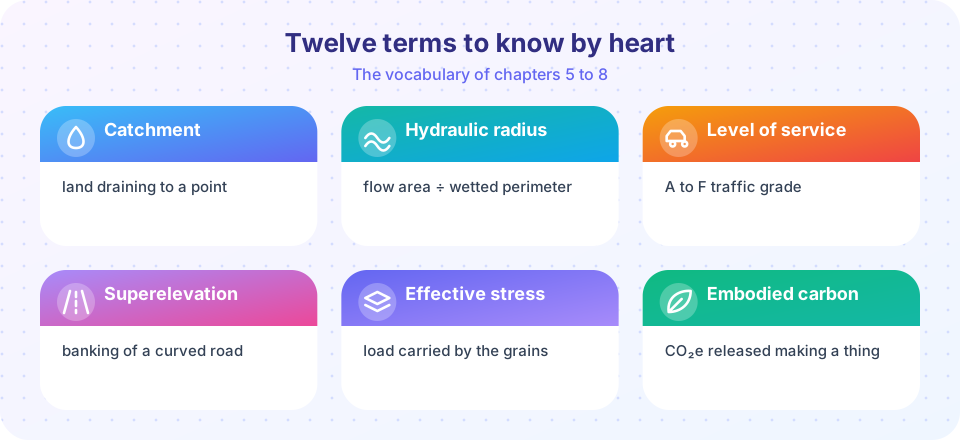
p/γ + v²/2g + zis constant along a streamline. - Catchment: the land area that drains to a given point.
- Continuity: the same discharge passes every section:
Q = A v. - Discharge (Q): volume of water per unit time, in m³/s.
- Energy grade line (EGL): a line showing total head along a flow.
- Froude number:
v / √(g D_h); below 1 is subcritical flow, above 1 is supercritical. - Head: energy per unit weight, expressed as a height of water.
- Hydraulic radius (R): flow area divided by wetted perimeter.
- Hydraulic jump: an abrupt change from supercritical to subcritical flow.
- Manning's n: roughness coefficient in Manning's equation.
- Rational method:
Q = C i A / 360for peak flow from small catchments. - Return period: the average interval between storms of a given size.
Transportation
- Capacity: the maximum sustainable flow of a road.
- Density (k): vehicles per kilometer.
- ESAL: equivalent single axle load, a measure of pavement damage.
- Headway: the time between successive vehicles passing a point.
- Level of service (LOS): a grade from A (free flow) to F (breakdown).
- Perception-reaction time: the time between seeing a hazard and starting to brake.
- Rutting: permanent grooves in wheel paths.
- Stopping sight distance (SSD): reaction plus braking distance.
- Subgrade: the natural soil beneath a pavement.
- Superelevation (e): the banking of a curved road.
Geotechnical engineering
- Atterberg limits: the liquid and plastic limits of a fine soil.
- Bearing capacity: the largest pressure the ground can carry before it fails in shear.
- Cohesion (c′): shear strength independent of normal stress.
- Consolidation: slow compression of saturated clay as water drains.
- Effective stress:
σ′ = σ − u, the stress carried by the soil grains. - Friction angle (φ′): the angle relating shear strength to effective normal stress.
- Pore water pressure (u): pressure of the water in soil voids.
- Rankine pressure: earth pressure for a smooth vertical wall and level ground.
- Void ratio (e): volume of voids divided by volume of solids.
- Water content (w): weight of water divided by weight of solids.
Environmental and sustainable design
- BOD: biochemical oxygen demand, a measure of organic pollution.
- Detention: temporary storage that slows runoff.
- Embodied carbon: emissions from making and building materials.
- EPD: environmental product declaration.
- Green infrastructure: swales, rain gardens and similar features that manage water naturally.
- Life-cycle assessment (LCA): a method that counts impacts over every stage.
- Overflow rate: flow divided by tank surface area.
- Resilience: the ability to absorb shocks and recover.
- Whole-life carbon: embodied plus operational emissions.
Common misconceptions
"Capacity, discharge and flow are interchangeable." Discharge is a volume rate of water; flow in traffic is a vehicle rate; capacity is a maximum.
"Stress and pressure are different things." Both are force per area. Engineers say pressure for fluids and stress for solids and soils, but the units are the same.
"Head means the top of the pipe." Head is energy per unit weight, measured as a height.
Try it
A searchable glossary and a flashcard drill. Type part of a word to filter the list.
Press Run (or Ctrl + Enter) to see the console output here.
No output.
Check your understanding
Quick check · 4 questions
of 4 answered You scored / 4 · perfect!
-
1. Which term means flow area divided by wetted perimeter?
R = A / P. -
2. Superelevation refers to
It tilts the road surface toward the inside of the curve. -
3. Effective stress equals
σ′ = σ − u. -
4. What does BOD measure?
Biochemical oxygen demand shows how much oxygen microbes will use.
Summary
- The glossary covers terms from water, transportation, soil and sustainability.
- Many terms have exact meanings: head, capacity, effective stress.
- Practice with flashcards and by explaining each term in your own words.
Track your progress
Create a free account to tick off lessons and pick up where you left off on any device.
of Civil Engineering Fundamentals lessons completed