


















Lesson 25 of 48 · Hydraulics and Water Resources
Open channels and Manning's equation
Size ditches, canals and culverts: learn hydraulic radius, Manning's equation, roughness values, the Froude number and how to find normal depth.
Rivers, roadside ditches, irrigation canals and half-full storm sewers all share one feature: the top of the water touches the air. There is no pressure pushing water through them. Gravity does the work, and the slope of the bed decides how fast the water runs. In 1889 the Irish engineer Robert Manning proposed an equation that is still the everyday tool for these flows.
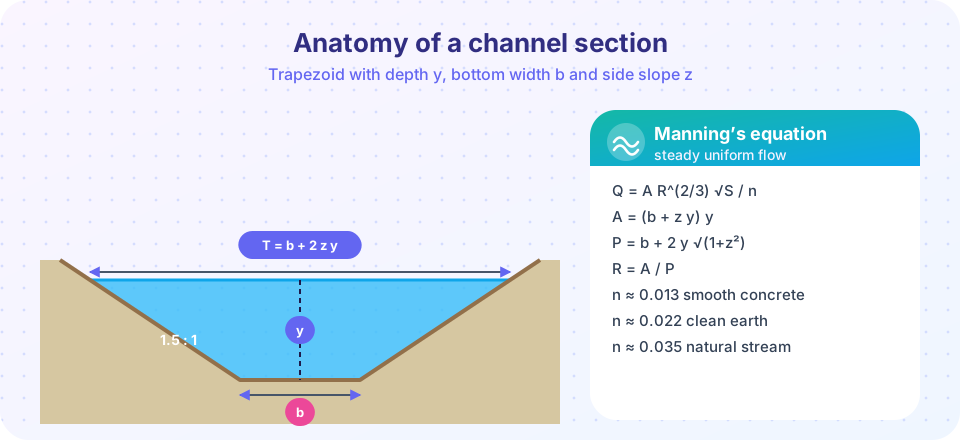
What you will learn
- How to compute area, wetted perimeter and hydraulic radius.
- How to use Manning's equation for discharge and velocity.
- How to pick a roughness coefficient n.
- What the Froude number says about the flow regime.
Key terms
Wetted perimeter (P): the length of channel boundary touched by water. Hydraulic radius (R): flow area divided by wetted perimeter, R = A/P. Normal depth: the depth at which gravity and friction balance in steady uniform flow. Manning's n: a roughness coefficient; larger n means a rougher channel. Froude number (Fr): v / √(g D_h), the ratio of flow speed to wave speed.
Geometry of a trapezoid
For a trapezoidal channel with bottom width b, depth y and side slopes z horizontal to 1 vertical:
- Area:
A = (b + z y) y - Top width:
T = b + 2 z y - Wetted perimeter:
P = b + 2 y √(1 + z²) - Hydraulic radius:
R = A / P
The wetted perimeter matters because friction acts along it. Two channels with the same area but different perimeters carry different flows: the one with less contact (a larger R) moves water more easily.
Manning's equation
In SI units, for steady uniform flow:
Q = (1/n) A R^(2/3) S^(1/2) and v = (1/n) R^(2/3) S^(1/2)
Here S is the bed slope as a decimal (1 m drop per 1000 m gives S = 0.001) and n is Manning's roughness.
| Surface | Typical n |
|---|---|
| Smooth concrete | 0.013 |
| Clean straight earth channel | 0.022 |
| Gravel or grass-lined ditch | 0.025 to 0.030 |
| Natural stream with some vegetation | 0.035 and up |
Worked example. A clean earth channel (n = 0.022) has b = 2 m, side slopes 1.5:1, a depth of 1 m and a slope of 0.001.
A = (2 + 1.5 × 1) × 1 = 3.5 m².P = 2 + 2 × 1 × √(1 + 2.25) = 2 + 2 × 1.803 = 5.606 m.R = 3.5 / 5.606 = 0.624 m.Q = (1/0.022) × 3.5 × 0.624^(2/3) × 0.001^(1/2) ≈ 3.68 m³/s.v = Q/A ≈ 1.05 m/s.
Notice that you usually know Q (from hydrology) and need the depth. Manning's equation cannot be solved for y directly, so engineers iterate or use software. The next TryIt does exactly that.
Subcritical or supercritical?
The Froude number compares flow speed with the speed of a small surface wave:
Fr = v / √(g D_h) where D_h = A / T is the hydraulic depth.
For our channel, T = 2 + 2 × 1.5 × 1 = 5 m, so D_h = 0.7 m and Fr = 1.05 / √(9.81 × 0.7) ≈ 0.40. Fr below 1 is subcritical: slow, deep flow where a disturbance can travel upstream. Fr above 1 is supercritical: fast, shallow flow, and a change downstream cannot be felt upstream. At Fr = 1 the flow is critical. The switch from supercritical to subcritical happens in a hydraulic jump, a turbulent rise in water level that engineers place deliberately in stilling basins below spillways to burn off energy.
Designing a channel
A designer chooses the slope and shape, looks up n, solves for the depth, and checks three things: the capacity covers the design flow with a freeboard (extra wall height) of perhaps 0.3 m, the velocity is high enough to avoid silting (often at least 0.6 m/s) but low enough to avoid erosion (earth channels are damaged by speeds above a meter or two per second, depending on the soil), and the flow is not close to critical, where the surface becomes unstable.
Common misconceptions
"Steeper channels always carry more water, so slope is all that matters." Roughness and cross-section shape matter just as much, and very steep flow can erode the channel.
"Manning's n has no units, so it is universal." In the SI form shown here n has units of s/m^(1/3). The equation is written differently in US customary units (with a 1.49 factor), so never mix the two.
"A full pipe is an open channel." A full pipe flows under pressure. A half-full pipe is an open channel, and Manning applies to it.
Try it
First, a solver that finds the normal depth for a design discharge and shows how depth grows with flow. Then a simple calculator for circular pipes.
Press Run (or Ctrl + Enter) to see the result here.
Program input · what you'd type while the program runs
Type the answers before you press Run, one per line. Each time the program reads a line (with input()), it gets the next line from this box.
Press Run (or Ctrl + Enter) to see the result here.
Program input · what you'd type while the program runs
Type the answers before you press Run, one per line. Each time the program reads a line (with input()), it gets the next line from this box.
Check your understanding
Quick check · 5 questions
of 5 answered You scored / 5 · perfect!
-
1. What is the hydraulic radius of a channel?
R = A / P combines the flow area with the length of boundary the water touches. -
2. In the SI form of Manning's equation, which change increases the discharge?
Q = A R^(2/3) S^(1/2) / n, so a larger S raises Q while a larger n lowers it. -
3. A channel has Fr = 1.8. The flow is
Froude numbers above 1 mean the flow is faster than a surface wave: supercritical. -
4. Which surface has the highest Manning's n?
Vegetation and irregular banks add friction, so n is larger (0.035 and up). -
5. What is a hydraulic jump?
The jump turns fast shallow flow into slow deep flow and dissipates energy.
Summary
- Channel geometry gives A, P and R = A/P.
- Manning:
Q = (1/n) A R^(2/3) S^(1/2)(SI units). - Rougher surfaces have larger n and carry less flow.
- Fr below 1 is subcritical, above 1 is supercritical; a hydraulic jump marks the change.
- Normal depth is found by iteration.
Next: Rainfall and runoff
Track your progress
Create a free account to tick off lessons and pick up where you left off on any device.
of Civil Engineering Fundamentals lessons completed