


















Lesson 3 of 48 · Getting Started
Units and Significant Figures
Master SI units, prefixes, weight versus mass, dimensional checks and significant figures, the habits that keep engineering calculations honest.
An engineering answer is a number and a unit. "The beam carries 40" means nothing; "the beam carries 40 kN" can be checked, compared and built. Civil engineers worldwide use the International System of Units (SI), because a bridge designed in one country is often built with materials and people from several others.
Mistakes with units have real costs. In 1999 NASA's Mars Climate Orbiter was lost because one team supplied thruster data in pound-force seconds while the software expected newton seconds. In 1983 an Air Canada Boeing 767 ran out of fuel and glided to a landing at Gimli, Manitoba, after fuel was calculated with pounds where kilograms were required. A few seconds of unit checking prevents both.
What you will learn
- The SI base and derived units a civil engineer uses every day.
- How to convert with prefixes and why kN, m and MPa work well together.
- The difference between mass and weight, and how to compute unit weight.
- How to check an equation with dimensions and round answers with significant figures.
Key terms
- Base unit: one of the fundamental units of SI, such as the metre, kilogram and second.
- Derived unit: a unit built from base units, for example the newton (N) or pascal (Pa).
- Dimensional analysis: checking that both sides of an equation have the same units.
- Significant figures: the digits of a number that carry real information.
Base and derived units
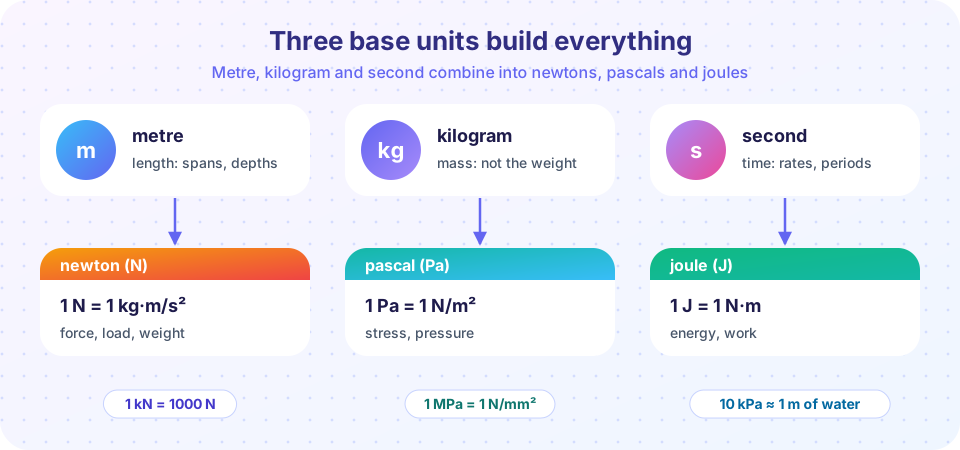
Three base units cover nearly all civil work:
| Quantity | Unit | Symbol |
|---|---|---|
| Length | metre | m |
| Mass | kilogram | kg |
| Time | second | s |
Everything else is built from them. A newton is the force that gives 1 kg an acceleration of 1 m/s², so 1 N = 1 kg·m/s². A pascal is one newton spread over one square metre: 1 Pa = 1 N/m². A joule is one newton acting through one metre: 1 J = 1 N·m.
Because a pascal is tiny (about the pressure of a banknote lying on a table), engineers use prefixes. The common ones are:
| Prefix | Symbol | Factor |
|---|---|---|
| milli | m | 10⁻³ |
| kilo | k | 10³ |
| mega | M | 10⁶ |
| giga | G | 10⁹ |
So 1 kN = 1,000 N, 1 MPa = 1,000,000 Pa, and 1 GPa = 1,000 MPa. A very useful identity: 1 MPa = 1 N/mm², because 1 m² = 1,000,000 mm². That lets you divide a force in newtons by an area in square millimeters and read the result straight in megapascals.
A consistent set. Pick one family and stay inside it. Using kN, m and kPa together is consistent (1 kPa = 1 kN/m²). Using N, mm and MPa is also consistent. Mixing them, such as kN with mm, is where factors of 1,000 sneak in.
Mass is not weight
Mass (kg) measures how much matter an object has. Weight is the force gravity exerts on it, in newtons:
W = m × g, with g ≈ 9.81 m/s² near the Earth's surface.
A 100 kg pile of steel has a weight of 100 × 9.81 = 981 N, about 0.98 kN. In daily speech people say "weight in kilograms", but engineers must convert to force before using the mass in a structural calculation.
Materials are often described by density ρ (kg/m³) or by unit weight γ (kN/m³), where γ = ρ × g. Typical values:
| Material | Density (kg/m³) | Unit weight (kN/m³) |
|---|---|---|
| Water | 1,000 | 9.81 |
| Reinforced concrete | about 2,400 | about 23.5 |
| Structural steel | 7,850 | about 77 |
A worked example: a concrete slab 5 m long, 4 m wide and 0.2 m thick has a volume of 5 × 4 × 0.2 = 4 m³. Its mass is 4 × 2,400 = 9,600 kg. Its weight is 9,600 × 9.81 ≈ 94,176 N ≈ 94.2 kN. Spread over 5 × 4 = 20 m², the pressure it puts on the ground is 94.2 ÷ 20 ≈ 4.71 kPa.
Dimensional analysis: your free error detector
Suppose you remember that the deflection of a cantilever with an end load is δ = P L³ / (3 E I) but are not sure about the exponent. Check the units: load P in N, length L in m, modulus E in N/m², second moment of area I in m⁴. Then N × m³ / (N/m² × m⁴) = N·m³ / (N·m²) = m. The result is a length, which is what a deflection must be, so the equation is dimensionally consistent. If you had written L², the result would have no unit at all, a quick reason to stop.
A dimensional check cannot prove a formula is right (a missing factor of 2 is invisible), but it catches many wrong ones for free.
Significant figures and honest rounding
Measured numbers are never exact. A tape reading of 12.4 m has three significant figures; writing 12.4000 m would claim a precision you do not have. Simple rules:
- Count from the first non-zero digit: 0.00450 has three significant figures.
- In multiplication and division, give the answer the same number of significant figures as the least precise input.
- In addition and subtraction, keep the same number of decimal places as the least precise term.
- Do not round in the middle of a calculation. Keep extra digits and round once at the end.
If a slab is 4.0 m wide (two figures) and 5.25 m long (three figures), its area is 21 m², not 21.000 m². Reporting a result as 94.176 kN when the density was only known as "about 2,400" suggests a certainty that does not exist; "94 kN" is the honest answer.
Common misconceptions
- "A kilogram is a unit of weight." It is a unit of mass. Weight is a force measured in newtons.
- "More decimals means a better answer." Decimals beyond what the inputs justify are noise, not precision.
- "Pounds of force and pounds of mass are the same." They are different quantities even though they share a name.
Try it
Press Run (or Ctrl + Enter) to see the result here.
Program input · what you'd type while the program runs
Type the answers before you press Run, one per line. Each time the program reads a line (with input()), it gets the next line from this box.
Press Run (or Ctrl + Enter) to see the result here.
Program input · what you'd type while the program runs
Type the answers before you press Run, one per line. Each time the program reads a line (with input()), it gets the next line from this box.
Press Run (or Ctrl + Enter) to see the console output here.
No output.
Check your understanding
Quick check · 4 questions
of 4 answered You scored / 4 · perfect!
-
1. What is 1 MPa in N/mm²?
1 MPa = 10^6 N/m² and 1 m² = 10^6 mm², so 1 MPa = 1 N/mm². -
2. A 500 kg block rests on the ground. What is its weight (g = 9.81 m/s²)?
W = 500 × 9.81 = 4,905 N, about 4.9 kN. -
3. Which statement about significant figures is correct?
Do not claim more precision than the inputs justify, and round once at the end. -
4. An equation for deflection should give a length. After dimensional analysis your formula gives a pure number with no unit. What do you conclude?
A result with the wrong dimensions means the formula was written down incorrectly.
Summary
- SI base units (m, kg, s) build the derived units N, Pa and J; use prefixes k, M and G.
- Stay in a consistent set (kN, m, kPa) or (N, mm, MPa); remember 1 MPa = 1 N/mm².
- Weight is a force: W = m g. Unit weight γ = ρ g, for example about 23.5 kN/m³ for reinforced concrete.
- Dimensional analysis catches wrong formulas; significant figures keep answers honest.
Track your progress
Create a free account to tick off lessons and pick up where you left off on any device.
of Civil Engineering Fundamentals lessons completed