


















Lesson 33 of 48 · Geotechnical Engineering
Chapter overview: Geotechnical engineering
See how soil behaves as a material: its phases, the stresses inside it, how it settles and when it fails. A map of the geotechnical chapter.
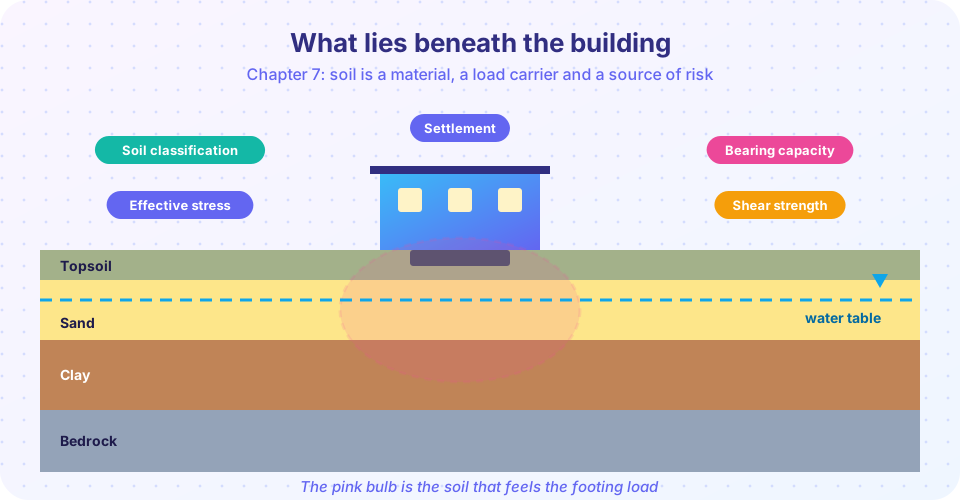
Every structure ends in the ground. A bridge pier, a house, a dam and a pipeline all pass their loads to soil or rock, and the ground is the one material no engineer manufactures or chooses freely. Geotechnical engineering studies how soil and rock behave so that foundations, slopes, tunnels and retaining walls can be designed safely. Soil is a tricky material: it is a mixture of solid grains, water and air; it varies from place to place; and it can sink, slide or flow.
What you will learn
- Why soil is described by three phases.
- The four big questions of geotechnical design.
- How the lessons in this chapter connect.
- Why site investigation comes first.
Key terms
Soil: loose natural material made of mineral grains, water and air. Foundation: the part of a structure that transfers load to the ground. Bearing capacity: the largest pressure the ground can carry before it fails. Settlement: downward movement of a structure as the soil beneath compresses. Site investigation: drilling, sampling and testing the ground before design.
The four questions
Four questions about the ground
Soil is three phases
Stress and strength
The grains carry the load.
Design checks
A good design answers all four. The engineer first classifies the soil from samples. Then she works out the stresses in the ground, including the effect of water. Next she predicts settlement: all soils compress under load, and clay can take years to finish. Finally she checks strength: will the ground shear under the footing, and will a retaining wall be pushed over?
Why soil is different
Steel and concrete are made in factories with known properties. Soil is made by nature, and the properties at one end of a site can differ from those at the other. The ground is also affected by water: a rising water table can lower strength, and permeability decides how fast water drains out of loaded soil. That is why geotechnical engineers rely on investigation, testing and conservative factors of safety (typically 2 to 3 for foundations).
What each lesson covers
- Soil phases and classification builds the three-phase picture, grain size and plasticity.
- Effective stress and consolidation explains the principle that governs all soil behavior and how settlement unfolds over time.
- Shear strength, bearing capacity and earth pressure covers failure and the loads on retaining walls.
- Chapter review summarizes and quizzes.
Common misconceptions
"Soil is solid, so it behaves like concrete." Soil is a particle system that squeezes water out under load. It compresses, creeps and flows in ways concrete does not.
"Good rock under the site means no problem." Fill, weak layers or water above the rock can still cause problems, and the quality of the rock matters.
Try it
First, how quickly different soils drain. Second, a small classifier that sorts a particle by size into the standard groups.
Press Run (or Ctrl + Enter) to see the result here.
Program input · what you'd type while the program runs
Type the answers before you press Run, one per line. Each time the program reads a line (with input()), it gets the next line from this box.
Press Run (or Ctrl + Enter) to see the console output here.
No output.
Check your understanding
Quick check · 4 questions
of 4 answered You scored / 4 · perfect!
-
1. Which are the three phases of soil?
Soil consists of mineral grains, water and air in the voids. -
2. What is bearing capacity?
It is the soil's resistance to shear failure under a foundation. -
3. Which soil drains most slowly?
Clay has tiny pores and very low conductivity, so it can take years to consolidate. -
4. Why do engineers use factors of safety on soil?
Variability and limited testing mean we need margin.
Summary
- Geotechnical design asks four questions: what is the soil, what stresses act, how far will it settle, will it fail.
- Soil is a three-phase material whose behavior depends on water.
- Site investigation and factors of safety deal with uncertainty.
Track your progress
Create a free account to tick off lessons and pick up where you left off on any device.
of Civil Engineering Fundamentals lessons completed