


















Lesson 41 of 48 · Environmental and Sustainable Design
Embodied carbon and life-cycle thinking
Learn how to count the carbon in construction materials, what life-cycle stages A to D mean, and how to compare designs over their whole life with simple sums.
When people talk about green buildings they usually mean low energy bills. That is only half the story. Before a building or a bridge is used at all, its cement has been burned in a kiln, its steel smelted and its materials hauled to site. These emissions are locked in the day construction ends. They are called embodied carbon, and for many civil projects they are the largest part of the climate impact in the first decades. Because they occur now, they cannot be offset by savings years in the future. This lesson teaches the vocabulary and the simple sums behind carbon accounting.
What you will learn
- The life-cycle stages used in carbon accounting.
- How to estimate the embodied carbon of a structure from material quantities.
- Why mass matters as much as carbon intensity.
- How to compare designs over their whole life.
Key terms
kg CO₂e: kilograms of carbon dioxide equivalent, a common unit that counts other greenhouse gases by their warming effect. Embodied carbon: emissions from making, transporting and installing materials, and from end of life. Operational carbon: emissions from energy used while the asset is in service. Environmental product declaration (EPD): a verified document giving a product's impacts per unit. Life-cycle assessment (LCA): a method for adding up impacts over every stage of a product or building.
Life-cycle stages
The European standard EN 15978, widely used across the world, divides a building or infrastructure life cycle into modules:
| Module | Stage | Examples |
|---|---|---|
| A1 to A3 | Product | Raw materials, transport to factory, manufacture |
| A4, A5 | Construction | Transport to site, building works, waste |
| B1 to B7 | Use | Maintenance, repair, replacement, operational energy and water |
| C1 to C4 | End of life | Demolition, transport, waste processing, disposal |
| D | Beyond the system | Credits for reuse, recycling and energy recovery |
Most quick studies count A1 to A3 only, which is a good first estimate of the "upfront carbon". A full assessment adds the rest and often reports whole-life carbon, embodied plus operational.
Counting the carbon: quantity times factor
The core calculation is simple: for each material, multiply its mass by an emission factor from a database or an EPD.
Embodied carbon = Σ (mass_i × factor_i)
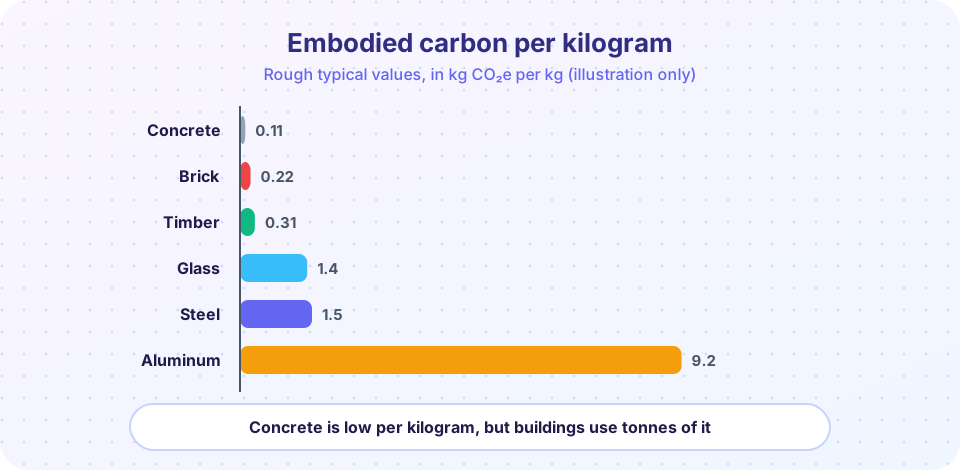
Typical order-of-magnitude factors (kg CO₂e per kg, product stage) are about 0.1 for ready-mixed concrete, 0.2 for brick, 0.3 for sawn timber (excluding the carbon stored in the wood), 1.4 for glass, 1.5 for steel with a typical recycled content and around 9 for aluminum. Real values depend on the supplier, the country, the recycled content and the energy mix, so engineers use EPDs for design work.
Worked example. A floor slab is 10 m × 10 m × 0.2 m thick.
- Concrete:
20 m³ × 2400 kg/m³ = 48,000 kg. At 0.13 kg CO₂e/kg that is 6240 kg, about 6.2 tonnes. - Reinforcement: at 100 kg per m³ of concrete,
2000 kg × 1.4 = 2800 kg, 2.8 tonnes. - Total: about 9 tonnes CO₂e. Steel is only 4% of the mass but about 31% of the carbon.
The example shows both lessons from the chart: per kilogram steel is much worse than concrete, but concrete dominates by sheer mass in many structures, so both matter.
Reducing embodied carbon
A useful order of priorities is: build nothing (reuse an existing structure), build less (smaller, lighter, fewer materials), build clever (optimized shapes, longer spans only where needed), and build efficiently (lower-carbon materials and methods). Examples:
- Replace part of the cement in concrete with industrial by-products such as slag or fly ash; cement is typically responsible for most of the carbon in concrete. Replacing 30% of 300 kg/m³ of cement with slag can cut a concrete's carbon by roughly a fifth.
- Use steel with a high recycled content, or make better use of strength with lighter sections.
- Design for durability so that nothing needs early replacement, and for disassembly so the parts can be reused.
- Choose local materials to cut transport emissions, though for heavy materials like concrete, transport is usually a small share.
Comparing options over the whole life
Suppose option A has higher upfront carbon but needs less energy to operate, and option B is the reverse. Add the embodied carbon to the annual operational carbon times the lifetime. As electricity grids decarbonize, operational carbon falls over time, so embodied carbon becomes a larger share of the total, and a design that "pays back" in 10 years today might never pay back if the grid becomes clean. Good practice is to use a time-dependent grid factor, to test several scenarios and to remember that early emissions matter more in a race against a carbon budget.
Common misconceptions
"Concrete is bad and timber is always good." Concrete has low carbon per kilogram but is used in vast quantities; timber has low upfront carbon but depends on sustainable forestry, durable details and fire design. The choice depends on the project and must be calculated.
"Operational energy is the only impact that matters." In efficient buildings and in infrastructure that uses little energy, such as bridges and retaining walls, embodied carbon dominates.
"Offsets cancel upfront emissions." Carbon emitted now stays in the atmosphere for a long time, so reducing it at the source comes first.
Try it
Compare two floor designs with stacked bars, then run a lifetime comparison for two options with different upfront and operating carbon. The emission factors are assumptions for demonstration.
Press Run (or Ctrl + Enter) to see the result here.
Program input · what you'd type while the program runs
Type the answers before you press Run, one per line. Each time the program reads a line (with input()), it gets the next line from this box.
Press Run (or Ctrl + Enter) to see the console output here.
No output.
Check your understanding
Quick check · 5 questions
of 5 answered You scored / 5 · perfect!
-
1. Which life-cycle modules make up the product stage?
A1 to A3 cover raw materials, transport to the factory and manufacture. -
2. A beam uses 500 kg of steel with factor 1.5 kg CO₂e per kg. Its product-stage carbon is
500 × 1.5 = 750 kg CO₂e. -
3. In the 'build nothing, build less, build clever, build efficiently' order, which comes first?
Avoiding new construction saves all of the embodied carbon. -
4. Why does embodied carbon matter more as grids decarbonize?
Cleaner electricity lowers the operational part, leaving embodied carbon as a larger fraction. -
5. An EPD is
Environmental product declarations give impact data per unit of product.
Summary
- Embodied carbon is emitted before a structure is used; operational carbon accrues over its life.
- Life-cycle modules A to D organize the accounting; A1 to A3 is the common quick estimate.
- Carbon = mass × emission factor, summed over materials; mass matters as much as factor.
- Reduce first by avoiding and optimizing, then by choosing lower-carbon materials.
- Compare designs over the whole life, with scenarios for a changing grid.
Track your progress
Create a free account to tick off lessons and pick up where you left off on any device.
of Civil Engineering Fundamentals lessons completed