


















Lesson 39 of 48 · Environmental and Sustainable Design
Water and wastewater treatment
Follow a treatment train from screening to disinfection, measure pollution with BOD, and size a settling tank using Stokes' law and overflow rate.
Turn on a tap and clean water appears. Flush a toilet and the dirty water disappears. In between is a chain of treatment plants that civil and environmental engineers design, and it is one of the greatest public-health achievements in history: clean water and sanitation prevented more deaths than almost any medicine. This lesson follows the water through the plant and teaches two calculations at its heart: how much oxygen the pollution will consume (BOD) and how big a settling tank must be.
What you will learn
- The stages of drinking-water and wastewater treatment.
- What BOD is and how to use the first-order BOD equation.
- How Stokes' law explains settling.
- How to compute an overflow rate and find the smallest particle a tank removes fully.
Key terms
BOD (biochemical oxygen demand): the oxygen that microbes use to break down organic matter in water, in mg/L; BOD₅ is the five-day test at 20 °C. Coagulation and flocculation: adding chemicals and gentle mixing so tiny particles clump into settleable flocs. Sedimentation: letting solids settle out under gravity. Overflow rate (surface loading): flow divided by tank surface area, in m/h. Disinfection: killing or inactivating disease-causing organisms, usually with chlorine, UV light or ozone.
Drinking-water treatment
Raw river or reservoir water goes through a typical sequence:
- Screening removes leaves and debris.
- Coagulation and flocculation: a coagulant such as aluminum sulfate neutralizes the charge on fine particles, and slow stirring lets them form larger flocs.
- Sedimentation: flocs settle in a large tank.
- Filtration: water passes through sand and other media to remove what remains.
- Disinfection: chlorine, chloramine or UV light inactivates pathogens, and a small chlorine residual keeps the pipes safe.
Wastewater treatment
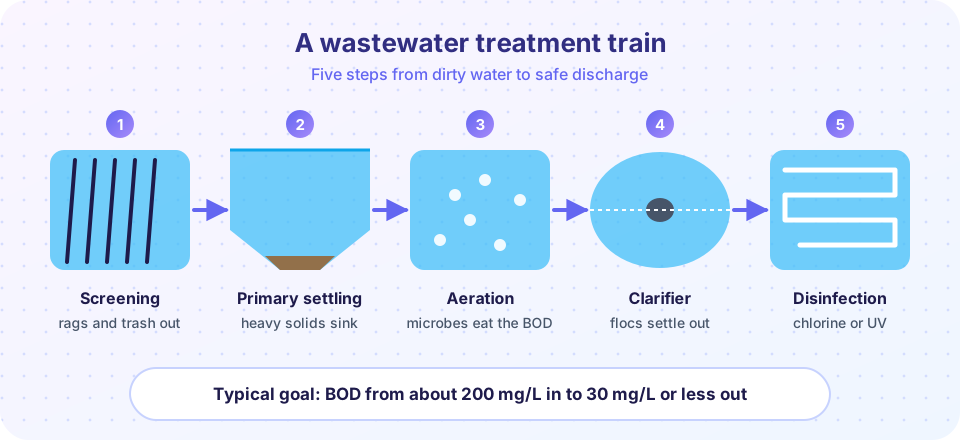
The units in the figure make a treatment train:
- Preliminary: bar screens and grit chambers remove rags and sand.
- Primary: settling removes a large part of the suspended solids as sludge.
- Secondary: an aeration tank feeds air to microbes that digest dissolved organic matter, then a clarifier settles the microbial flocs. Part of the settled sludge is returned to keep enough microbes in the tank.
- Tertiary and disinfection: further polishing (for nutrients such as nitrogen and phosphorus) and finally disinfection before discharge to a river or for reuse.
Sludge is thickened, digested without air (producing biogas, mostly methane, which can run engines) and finally dewatered. Treatment plants are significant energy users but can also produce energy.
Measuring pollution: BOD
Pollution that looks clear can still harm a river, because microbes eating it consume dissolved oxygen, and fish suffocate. BOD measures that oxygen demand. Organic matter decays roughly as a first-order process, so the oxygen consumed after time t is
BOD_t = L₀ (1 − e^(−k t))
L₀ is the ultimate demand and k the rate constant (about 0.23 per day at 20 °C for typical domestic sewage, in base e). Because the lab measures after five days, you may need L₀.
Worked example. A sewage sample has BOD₅ = 200 mg/L, with k = 0.23 d⁻¹.
1 − e^(−0.23 × 5) = 1 − e^(−1.15) = 0.683.L₀ = 200 / 0.683 ≈ 293 mg/L.
So about 293 mg/L of oxygen will eventually be needed, though only 68% has been used by day five. Reactions run faster in warmer water: a common correction is k_T = k₂₀ × 1.047^(T − 20). Treated effluent commonly has to meet limits of a few tens of mg/L of BOD₅ or lower, depending on the country and the receiving river.
Settling and tank sizing
A particle of diameter d and density ρ_p falling in water of viscosity μ reaches a terminal velocity given by Stokes' law (valid for small particles at low Reynolds numbers):
v_s = g (ρ_p − ρ_w) d² / (18 μ)
For a sand grain of 0.1 mm with ρ_p = 2650 kg/m³ and μ = 1.002 × 10⁻³ Pa·s: v_s = 9.81 × 1650 × (10⁻⁴)² / (18 × 1.002×10⁻³) ≈ 0.009 m/s, about 9 mm/s. A fine silt particle of 0.01 mm settles 100 times slower, because v_s depends on d².
In an ideal rectangular tank, a particle is fully removed if its settling velocity is at least the overflow rate v₀ = Q / A, where A is the surface area. Suppose Q = 0.5 m³/s = 1800 m³/h and A = 900 m². Then v₀ = 2.0 m/h = 0.56 mm/s. Solving Stokes' law for d gives the smallest particle fully removed: about 25 µm. Notice what controls the removal: surface area, not depth. A shallow wide tank works as well as a deep narrow one, which is why plate settlers (inclined plates that add surface area) are used to shrink tanks.
Common misconceptions
"Clear water is clean water." Pathogens and dissolved chemicals are invisible. Disinfection and testing are essential.
"A deeper tank removes more solids." In ideal settling, removal depends on surface area (the overflow rate), not depth.
"Chlorine kills everything instantly." It needs contact time and a certain concentration; some organisms resist it, which is why filtration and UV are also used.
Try it
Plot the BOD curve for the sample and see how temperature changes it, then compute Stokes settling for different particles.
Press Run (or Ctrl + Enter) to see the result here.
Program input · what you'd type while the program runs
Type the answers before you press Run, one per line. Each time the program reads a line (with input()), it gets the next line from this box.
Press Run (or Ctrl + Enter) to see the console output here.
No output.
Check your understanding
Quick check · 5 questions
of 5 answered You scored / 5 · perfect!
-
1. What does BOD measure?
BOD is the biochemical oxygen demand, in mg/L. -
2. If a particle's diameter is halved, its Stokes settling velocity becomes
v_s is proportional to d², so halving d divides v_s by 4. -
3. A tank has Q = 3600 m³/h and A = 1800 m². The overflow rate is
v₀ = Q / A = 3600 / 1800 = 2 m/h. -
4. In ideal settling theory, removal of a given particle depends mainly on
A particle is removed if v_s ≥ Q/A, so surface area matters, not depth. -
5. In secondary treatment, microbes mainly
Aeration tanks grow microbes that consume dissolved organics.
Summary
- Water treatment removes debris, solids, dissolved pollution and germs in sequence.
- BOD measures oxygen demand:
BOD_t = L₀ (1 − e^(−kt)). - Stokes' law: settling velocity grows with d².
- A settling tank's performance is set by its overflow rate
Q/A, not its depth.
Track your progress
Create a free account to tick off lessons and pick up where you left off on any device.
of Civil Engineering Fundamentals lessons completed