


















Lesson 30 of 48 · Transportation Engineering
Geometric design: sight distance and curves
Work out stopping sight distance, horizontal curve radius, superelevation and side friction with metric formulas and worked examples for highway design.
A road is a shape in three dimensions, and every feature of that shape is a safety decision. How far ahead must a driver see to stop for a hazard? How tight can a bend be before a car skids? Geometric design answers these questions with a small set of formulas, all driven by the design speed, the speed that sets the rules for a given road.
What you will learn
- How to compute stopping sight distance.
- How banking and side friction balance on a horizontal curve.
- How to find a minimum curve radius.
- How grade and design speed change these results.
Key terms
Stopping sight distance (SSD): the distance a driver needs to perceive a hazard and brake to a stop. Perception-reaction time (t): the time to notice and begin braking; 2.5 s is a common design value. Superelevation (e): the banking of a road toward the inside of a curve, as a fraction (0.06 = 6%). Side friction factor (f): the share of tire grip used to hold the car on the curve. Grade (G): road slope as a decimal, positive uphill.
Stopping sight distance
When a driver sees a hazard, the car first travels during the reaction time and then during braking. In metric units (V in km/h, d in meters):
SSD = 0.278 V t + V² / (254 (a/9.81 + G))
The first term is speed in m/s (V/3.6 = 0.278 V) times the reaction time. The second is the braking distance from physics, v² / (2 a), rewritten in km/h, where a is the deceleration (about 3.4 m/s², a comfortable value roads use) and G adjusts for slope.
Worked example. V = 100 km/h, t = 2.5 s, a = 3.4 m/s², level road.
- Reaction:
0.278 × 100 × 2.5 = 69.5 m. - Braking:
100² / (254 × (3.4/9.81 + 0)) = 10,000 / (254 × 0.3466) ≈ 113.6 m. - SSD ≈ 183 m.
Standard tables round this to about 185 m. On a 3% downgrade (G = −0.03) the braking term grows, giving about 194 m. Because speed appears squared in the braking term, a modest increase in speed lengthens SSD sharply.
Horizontal curves
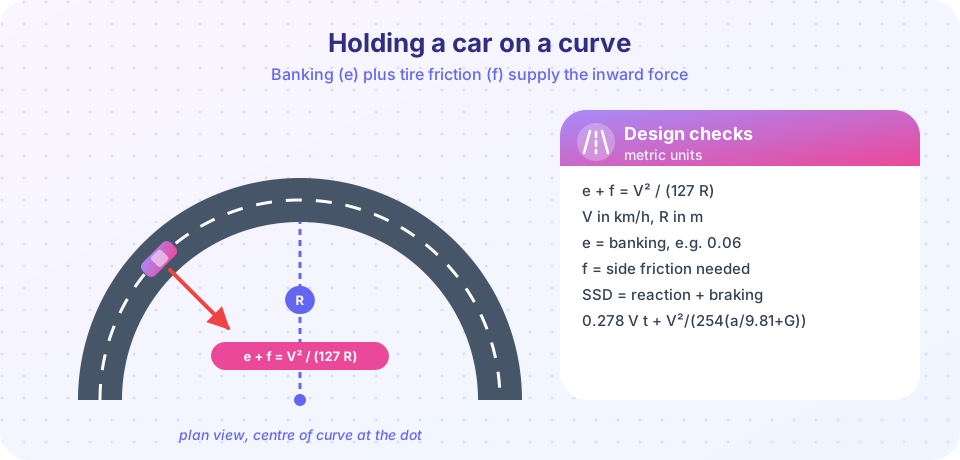
A car on a curve of radius R needs a centripetal acceleration v²/R toward the center. Banking the road contributes part of the inward force and tire friction supplies the rest. The standard design equation in metric units is
e + f = V² / (127 R)
with V in km/h and R in meters (127 = 3.6² × 9.81).
Worked example. V = 80 km/h, R = 300 m, banking e = 0.06.
V² / (127 R) = 6400 / 38,100 = 0.168.f = 0.168 − 0.06 = 0.108.
A friction demand of 0.108 is below the maximum value around 0.14 typically allowed at 80 km/h, so the curve is acceptable. To find the minimum radius use R_min = V² / (127 (e_max + f_max)). With e_max = 0.06 and f_max = 0.14, R_min = 6400 / (127 × 0.20) ≈ 252 m. Design agencies limit e_max (often 4% to 10%, lower where ice or slow trucks are common) because a steeply banked road is uncomfortable and unsafe for slow vehicles.
Putting the shape together
A real alignment strings together straight tangents, circular arcs and gentle transition curves (spirals) that introduce the banking gradually. In the vertical direction, parabolic vertical curves connect grades; on a crest the curve must be long enough that the driver can see over the hill, so the SSD again sets the minimum length. Crossing roads, junctions and clear zones around the pavement add more sight-distance checks, but the idea is always the same: the driver must see in time.
Common misconceptions
"Banking removes the need for friction." Banking removes friction demand only at one design speed. Faster or slower vehicles still use friction, and slow vehicles on icy banked roads can slide inward.
"SSD is the same for every driver." It uses a design value of perception-reaction time and braking, chosen so that most drivers can stop. Distracted drivers need more.
"Doubling the speed doubles the stopping distance." The braking part grows with V², so it roughly quadruples.
Try it
Plot stopping sight distance for different speeds and grades, then use the calculator to test a curve.
Press Run (or Ctrl + Enter) to see the result here.
Program input · what you'd type while the program runs
Type the answers before you press Run, one per line. Each time the program reads a line (with input()), it gets the next line from this box.
Press Run (or Ctrl + Enter) to see the console output here.
No output.
Check your understanding
Quick check · 5 questions
of 5 answered You scored / 5 · perfect!
-
1. In the SSD formula, what does the term 0.278 V t represent?
0.278 V converts km/h to m/s, and multiplying by t gives the reaction distance. -
2. A curve has V = 90 km/h, R = 400 m and e = 0.04. What friction is needed? (V²/(127R) = 8100/50800)
e + f = 0.159, so f = 0.159 − 0.04 ≈ 0.119. -
3. A downgrade makes SSD
Braking is less effective downhill, so the braking distance grows. -
4. Why is the maximum superelevation limited?
At low speeds on a steeply banked road, gravity can pull a car inward, especially on ice. -
5. Speed rises from 60 to 120 km/h. The braking term of SSD becomes about
The braking term is proportional to V², so doubling V quadruples it.
Summary
- SSD adds reaction distance and braking distance:
0.278 V t + V²/(254(a/9.81 + G)). - Curves satisfy
e + f = V² / (127 R). - Minimum radius follows from limits on e and f.
- Speed enters squared, so design speed choices have large effects.
Next: Pavement design basics
Track your progress
Create a free account to tick off lessons and pick up where you left off on any device.
of Civil Engineering Fundamentals lessons completed