


















Lesson 20 of 48 · Construction Materials
Stress, Strain and Material Testing
Learn stress, strain, Hooke's law, Young's modulus and Poisson's ratio, work an elongation example and see how tensile and compression tests find material properties.
How do you compare a steel bar and a concrete column, when they have different sizes and carry different loads? You divide. Dividing force by area gives stress, which says how hard the material is working regardless of size. Dividing the change in length by the original length gives strain, which says how much it deformed regardless of length. Plot one against the other and you get a fingerprint of the material. This lesson turns that idea into numbers and shows how tests produce them.
What you will learn
- How to compute normal stress, strain and elongation.
- What Young's modulus and Poisson's ratio mean and typical values.
- How a tensile test finds yield and ultimate strength.
- How strength results from several specimens are summarized.
Key terms
- Stress (σ): force per unit area,
σ = F / A, in pascals (N/m²) or MPa (N/mm²). - Strain (ε): change in length divided by original length,
ε = ΔL / L0, unitless. - Young's modulus (E): the ratio
σ / εin the elastic range. - Poisson's ratio (ν): the ratio of sideways to lengthwise strain, with the sign flipped.
Stress and strain
If a force F acts along a bar and is spread over a cross-section of area A, the normal stress is σ = F / A. Tension is positive, compression negative. A force parallel to a surface produces shear stress, τ = V / A.
Strain is the relative stretch. A bar of original length L0 that grows by ΔL has ε = ΔL / L0. A strain of 0.001 is "1000 microstrain" and means 1 mm of stretch per meter. Strains in structures are tiny: steel at its yield stress has a strain of only about 0.0018.
Hooke's law and Young's modulus
For many materials, in the elastic range (where they return to their original shape after unloading), stress is proportional to strain: σ = E ε. The constant E is Young's modulus. Typical values: steel 200 GPa, aluminum 70 GPa, concrete 25 to 35 GPa, softwood timber 8 to 14 GPa.
Combining the equations gives the elongation of a bar under axial load:
δ = F L / (A E).
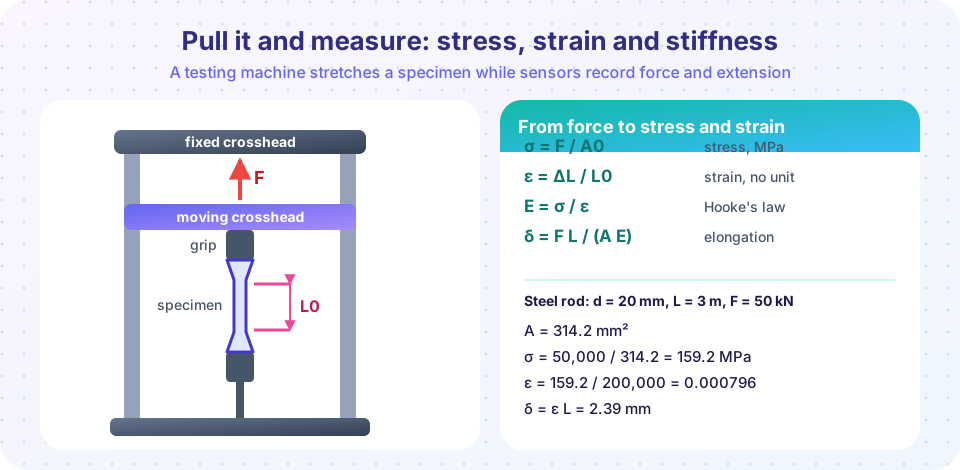
Worked example. A steel rod 20 mm in diameter and 3 m long carries a tensile load of 50 kN. Take E = 200 GPa = 200,000 MPa.
- Area:
A = π × 20² / 4 = 314.2 mm². - Stress:
σ = 50,000 N ÷ 314.2 mm² = 159.2 MPa, well below the 355 MPa yield of S355, so the rod stays elastic. - Strain:
ε = σ / E = 159.2 ÷ 200,000 = 0.000796. - Elongation:
δ = ε L = 0.000796 × 3,000 mm = 2.39 mm.
The rod stretches less than 2.4 mm even though it is 3 m long. Because stiffness EA appears in the denominator, doubling the area halves the elongation.
Poisson's ratio. A bar stretched lengthwise gets thinner. The ratio ν = −ε_lateral / ε_axial is about 0.3 for steel and 0.15 to 0.2 for concrete.
The tensile test
A tensile test (standardized in ISO 6892 and ASTM E8) pulls a machined specimen at a slow, controlled rate in a testing machine. A load cell records force F, and an extensometer clipped to a gauge length L0 records the extension. The software divides by the original area and length to give a stress-strain curve.
From the curve you read:
- Young's modulus: the slope of the initial straight line.
- Yield strength: the stress at the start of the plateau; for metals without a plateau, the 0.2 percent offset method draws a line parallel to the elastic slope, shifted by a strain of 0.002, and takes its intersection with the curve.
- Ultimate tensile strength: the highest stress reached.
- Ductility: the elongation at fracture (percent) and the reduction of area at the neck.
Test results are engineering stress and strain (using original dimensions), so after necking begins the curve falls even though the true stress in the neck keeps rising.
Other common tests
- Compression test on concrete: cylinders or cubes are crushed between plates;
fc = F / A. - Slump test: measures fresh-concrete consistency.
- Bend test and hardness test: check ductility and surface strength of steel.
- Charpy impact test: a swinging hammer breaks a notched bar and the absorbed energy measures toughness.
- Soil tests (covered in the geotechnical chapter) such as triaxial and consolidation tests follow the same logic.
Working with scatter
No two specimens give exactly the same number. If six concrete cubes fail at 31.2, 33.0, 29.8, 34.1, 30.5 and 32.0 MPa, the mean is 31.77 MPa and the sample standard deviation about 1.60 MPa. Codes define the characteristic strength as the value that only about 5 percent of results are expected to fall below, estimated for a normal distribution as mean − 1.645 × standard deviation. Here that gives about 31.77 − 1.645 × 1.60 ≈ 29.1 MPa. Design uses the characteristic value, not the average, so a typical batch is stronger than the number on the drawing.
Common misconceptions
- "Stress and pressure are different things." They have the same units. Pressure acts on a surface from outside; stress is the internal force intensity.
- "A material with high E is strong." E measures stiffness. Glass is stiff and brittle; rubber is flexible and can stretch a lot.
- "The tensile test curve gives the true behavior after necking." It plots engineering stress, so it hides the true stress rise in the neck.
Try it
Press Run (or Ctrl + Enter) to see the result here.
Program input · what you'd type while the program runs
Type the answers before you press Run, one per line. Each time the program reads a line (with input()), it gets the next line from this box.
Press Run (or Ctrl + Enter) to see the result here.
Program input · what you'd type while the program runs
Type the answers before you press Run, one per line. Each time the program reads a line (with input()), it gets the next line from this box.
Check your understanding
Quick check · 5 questions
of 5 answered You scored / 5 · perfect!
-
1. A 10 mm diameter bar carries 15.7 kN (A = 78.5 mm²). What is the stress?
σ = 15,700 ÷ 78.5 = 200 MPa. -
2. Steel (E = 200 GPa) is stressed to 100 MPa. What is the strain?
ε = σ / E = 100 ÷ 200,000 = 0.0005. -
3. A 2 m steel bar has strain 0.001. How much does it stretch?
δ = ε L = 0.001 × 2,000 mm = 2 mm. -
4. What does the 0.2 percent offset method estimate?
A line parallel to the elastic slope, shifted by 0.002 strain, intersects the curve at the offset yield point. -
5. Why is the characteristic strength lower than the mean test strength?
Design uses a cautious fractile (mean minus 1.645 standard deviations) to allow for variability.
Summary
- Stress
σ = F / Aand strainε = ΔL / L0remove size from the comparison of materials. - In the elastic range
σ = E ε, giving elongationδ = F L / (A E). - A tensile test yields E, yield and ultimate strength and ductility; metals without a plateau use the 0.2 percent offset.
- Specimen results scatter, so design relies on characteristic strengths rather than averages.
Next: Chapter 4 Review
Track your progress
Create a free account to tick off lessons and pick up where you left off on any device.
of Civil Engineering Fundamentals lessons completed