


















Lesson 8 of 48 · The Civil Engineering Profession
The Design Process and Codes
Learn how engineers move from concept to detailed design, why design codes exist, and how load factors and limit states give structures a safety margin.
Nobody knows exactly how heavy the crowd on a bridge will be, how strong the concrete in a particular beam turns out, or how hard the wind will blow in year thirty. Engineers cannot remove that uncertainty, so they manage it. They follow a design process, obey design codes that capture generations of experience, and build in safety margins that are sized with statistics instead of guesses.
What you will learn
- The stages of the design process, from concept to documents.
- What a design code is and which well-known codes exist.
- What limit states and load factors are, with a worked beam example.
- How a reliability index describes how safe a design is.
Key terms
- Design code: a document of rules, formulas and minimum values that engineers must follow.
- Limit state: a condition beyond which a structure no longer meets its requirements.
- Load factor: a number greater than 1 that multiplies a load to allow for uncertainty.
- Resistance factor (φ): a number below 1 that reduces the computed strength.
The design process
Design is iterative, not linear. You propose something, analyze it, find a problem and improve it.
- Concept design: sketch several options and compare cost, risk and buildability.
- Preliminary design: estimate sizes with simple hand calculations to choose one option.
- Detailed design: run full analysis, size every member, design connections and foundations.
- Checking: an independent engineer reviews the calculations and drawings.
- Documents: drawings, specifications and bills of quantities tell the contractor exactly what to build.
- Construction support: answer questions, inspect, and update drawings to show what was actually built.
Hand calculations never disappear. Engineers use them to check that computer output is plausible, which prevents a typing error from becoming a collapsed floor.
Why design codes exist
Early builders learned by failure. A code turns those hard lessons into rules everyone can follow. Examples include the Eurocodes (EN 1990 to EN 1999, used across Europe and adapted elsewhere), ASCE 7 for loads in the United States, ACI 318 for concrete, AISC 360 for steel and many national standards. Codes do three things: they set minimum loads (for example, how much live load an office floor must resist), they give design equations with tested safety margins, and they make designs comparable and checkable by regulators.
A code is a minimum. An engineer who finds an unusual hazard must go beyond it. Following the code does not remove responsibility for the result.
Limit states
Modern codes use limit state design. A limit state is a boundary between acceptable and unacceptable behavior. Two families matter:
- Ultimate limit states (ULS): collapse, overturning, rupture or loss of stability. These threaten life, so margins are large.
- Serviceability limit states (SLS): excessive deflection, vibration or cracking. The structure still stands, but it is unpleasant or damaged, so margins are smaller.
For ULS the rule is: factored demand must not exceed factored capacity, that is, γ × (load effect) ≤ φ × (nominal resistance).
Load factors in practice
Dead loads are well known, so their factor is smaller. Live loads vary more, so theirs is larger. Two common combinations for gravity loading are:
- ASCE 7 (US):
1.2 D + 1.6 L - Eurocode (permanent G, variable Q):
1.35 G + 1.5 Q
Worked example. A floor beam carries a dead load of 12 kN/m and a live load of 8 kN/m and spans 6 m (simply supported).
- US combination:
wu = 1.2 × 12 + 1.6 × 8 = 14.4 + 12.8 = 27.2 kN/m. - Eurocode combination:
wEd = 1.35 × 12 + 1.5 × 8 = 16.2 + 12 = 28.2 kN/m. - Maximum bending moment for a simply supported beam with a UDL:
M = w L² / 8, so for the US caseMu = 27.2 × 6² / 8 = 122.4 kN·m.
The beam is then chosen so its design bending resistance φ Mn is at least 122.4 kN·m. For steel beams in bending, the US code uses φ = 0.90, so the nominal moment capacity must be at least 122.4 ÷ 0.90 ≈ 136 kN·m. The two codes use different recipes and give close, not identical, answers. Each should be used with its own resistance rules.
From safety factors to reliability
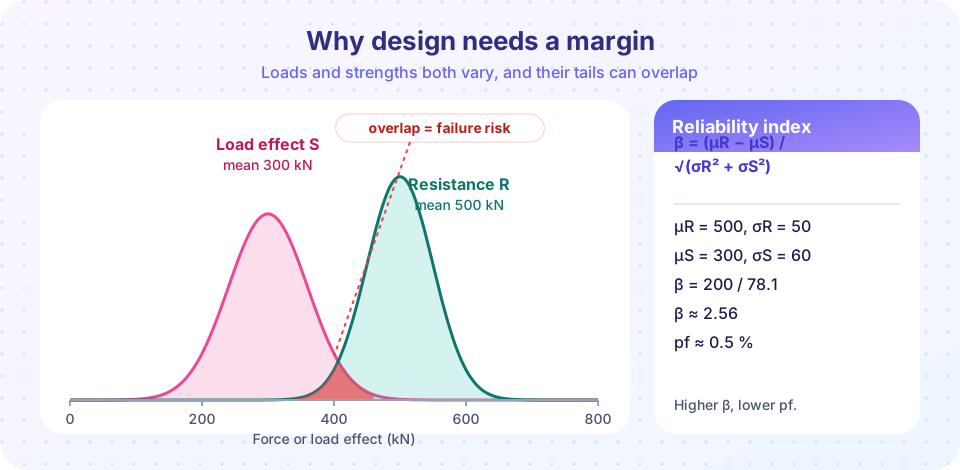
A single safety factor, such as "twice as strong as needed", is a blunt instrument. Statistics let us do better. If load effect S has mean μS and standard deviation σS, and resistance R has mean μR and σR, the reliability index is
β = (μR − μS) / √(σR² + σS²).
With μR = 500 kN, σR = 50, μS = 300 kN and σS = 60, we get β = 200 / 78.1 ≈ 2.56. For normal distributions the probability of failure is pf = Φ(−β), about 0.5 percent here. Real code targets are much stricter, typically a β around 3 to 4 for ordinary buildings, and higher where failure would be catastrophic. A larger β means a lower chance of failure, and that is what load and resistance factors are calibrated to deliver.
Common misconceptions
- "Following the code makes the structure absolutely safe." It makes failure very unlikely under assumed conditions; unusual hazards need extra thought.
- "A bigger safety factor is always better." Over-design wastes material and carbon, and can even move problems elsewhere.
- "Load factors are applied to the final answer." They multiply the loads before analysis, and resistance factors reduce the capacity.
Try it
Press Run (or Ctrl + Enter) to see the result here.
Program input · what you'd type while the program runs
Type the answers before you press Run, one per line. Each time the program reads a line (with input()), it gets the next line from this box.
Press Run (or Ctrl + Enter) to see the result here.
Program input · what you'd type while the program runs
Type the answers before you press Run, one per line. Each time the program reads a line (with input()), it gets the next line from this box.
Press Run (or Ctrl + Enter) to see the console output here.
No output.
Check your understanding
Quick check · 4 questions
of 4 answered You scored / 4 · perfect!
-
1. What does a design code provide?
Codes set minimum loads, tested formulas and margins so designs are safe and checkable. -
2. A beam has D = 10 kN/m and L = 5 kN/m. What is the US factored load 1.2D + 1.6L?
1.2 × 10 + 1.6 × 5 = 12 + 8 = 20 kN/m. -
3. Which is a serviceability limit state?
Serviceability concerns comfort and function, such as deflection, vibration and cracking. -
4. If μR = 400, σR = 30, μS = 250, σS = 40, what is β?
β = 150 / √(30² + 40²) = 150 / 50 = 3.0.
Summary
- Design is an iterative path: concept, preliminary, detailed design, checking, documents and construction support.
- Codes capture experience: minimum loads, equations and margins.
- Limit state design requires factored demand ≤ factored capacity, with load factors above 1 and resistance factors below 1.
- Reliability index β links variability to failure probability; larger β means a safer design.
Next: Safety, Ethics and Risk
Track your progress
Create a free account to tick off lessons and pick up where you left off on any device.
of Civil Engineering Fundamentals lessons completed