


















Lesson 45 of 48 · Projects and Practice
Practice problems: water, roads, soil and carbon
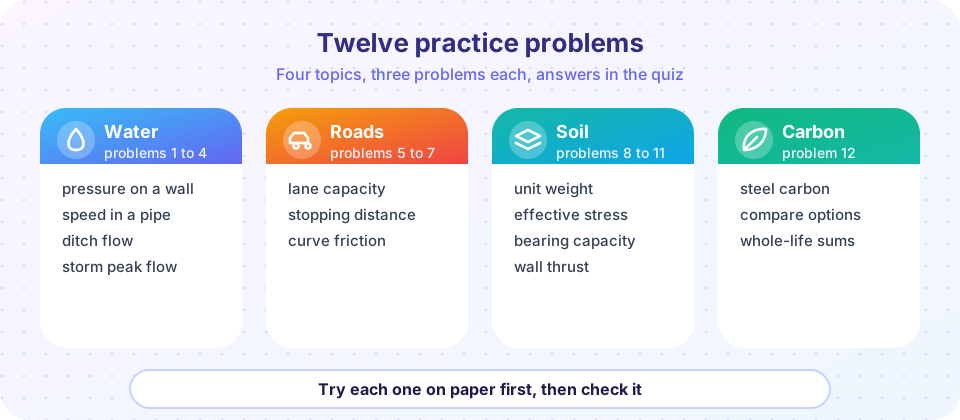
Ten worked-answer practice problems covering pressure, channel flow, runoff, traffic, curves, soil stress and carbon. Solve on paper, then check in the quiz.
Reading about engineering is not the same as doing it. This lesson is a problem set: ten questions that use the main tools of the last four chapters. The advice is simple: solve each one on paper with units written out, then check your answer in the quiz. Each explanation shows the working, so you can find your slip if the numbers differ.
What you will learn
- How to turn a word problem into the right equation.
- How to keep units straight through a calculation.
- How to sanity-check an answer.
Key terms
Given and unknown: the numbers a problem supplies and the quantity it asks for. Sanity check: asking whether an answer has a plausible size and unit. Significant figures: report no more precision than the data justify, usually three figures. Assumption: a simplification you state openly, such as ignoring friction. Units check: confirming that both sides of an equation have the same units.
A method that works
- Draw a sketch and list the givens with units.
- Identify the unknown and name the equation family (hydrostatics, Manning, rational method, ...).
- Convert units before substituting (mm/h, ha, km/h, kPa).
- Compute, then ask: is the size reasonable? A pressure of 78 kPa at 8 m depth is; 78 MPa is not.
- State the answer with units and the assumptions.
The problems
Use g = 9.81 m/s², ρ_w = 1000 kg/m³ and γ_w = 9.81 kN/m³.
Water
- What is the gauge pressure at the base of an 8 m deep tank of fresh water?
- A vertical gate is 2 m high and 3 m wide, with water up to its top edge. What is the hydrostatic force on it?
- A rectangular channel has b = 3 m, y = 1 m, n = 0.015 and S = 0.0009. Find the discharge with Manning's equation.
- A 25 ha catchment has C = 0.45 and a design intensity of 60 mm/h. What is the peak flow?
Roads
- With v_f = 90 km/h and k_j = 120 veh/km, what is the Greenshields capacity?
- A road has a design speed of 60 km/h, t = 2.5 s and a = 3.4 m/s² on level ground. What is the SSD?
- A curve of radius 200 m, V = 70 km/h and e = 0.05: what friction is needed?
Soil and carbon
- A saturated sand has G_s = 2.65 and e = 0.7. What is its saturated unit weight?
- A 5 m clay layer (γ_sat = 18 kN/m³) lies under a water table at the surface. What is the effective stress at its base?
- A beam uses 5 tonnes of steel at 1.5 kg CO₂e per kg. What is the product-stage carbon?
Try it
Check your own answers with a solver, then try the bonus problem: a strip footing 1.5 m wide at 1 m depth on sand with φ = 35°, c = 0 and γ = 19 kN/m³. Predict the ultimate bearing pressure before you run the code.
Press Run (or Ctrl + Enter) to see the result here.
Program input · what you'd type while the program runs
Type the answers before you press Run, one per line. Each time the program reads a line (with input()), it gets the next line from this box.
Press Run (or Ctrl + Enter) to see the console output here.
No output.
Check your understanding
Quick check · 10 questions
of 10 answered You scored / 10 · perfect!
-
1. Problem 1: the gauge pressure at the base of an 8 m deep tank is
p = ρ g h = 1000 × 9.81 × 8 = 78,480 Pa ≈ 78.5 kPa. -
2. Problem 2: the force on a 2 m × 3 m vertical gate with water to its top is
F = ½ γ H² b = ½ × 9.81 × 4 × 3 = 58.9 kN, at 0.67 m above the base. -
3. Problem 3: the rectangular channel carries about
A = 3, P = 5, R = 0.6; Q = (1/0.015) × 3 × 0.6^(2/3) × √0.0009 ≈ 4.27 m³/s. -
4. Problem 4: the peak flow from the 25 ha catchment is
Q = 0.45 × 60 × 25 / 360 = 1.875 m³/s. -
5. Problem 5: the Greenshields capacity is
q_max = v_f k_j / 4 = 90 × 120 / 4 = 2700 veh/h. -
6. Problem 6: the stopping sight distance at 60 km/h is about
Reaction 0.278 × 60 × 2.5 = 41.7 m, braking 3600 / (254 × 0.3466) = 40.9 m; total 82.6 m. -
7. Problem 7: the friction demand on the curve is about
V²/(127R) = 4900/25,400 = 0.193; f = 0.193 − 0.05 ≈ 0.143. -
8. Problem 8: the saturated unit weight is about
γ_sat = (G_s + e) γ_w / (1 + e) = 3.35 × 9.81 / 1.7 ≈ 19.3 kN/m³. -
9. Problem 9: the effective stress at the base of the 5 m clay layer is about
σ = 5 × 18 = 90 kPa, u = 5 × 9.81 = 49.05 kPa, σ′ = 90 − 49.05 ≈ 41 kPa. -
10. Problem 10: the steel's product-stage carbon is
5000 kg × 1.5 kg CO₂e/kg = 7500 kg CO₂e.
Summary
- Sketch, list givens, convert units, solve, then sanity-check.
- The same few equations solve most everyday problems in water, roads, soil and carbon.
- Always state units and assumptions.
- Use the checker to compare, then vary the numbers to build intuition.
Track your progress
Create a free account to tick off lessons and pick up where you left off on any device.
of Civil Engineering Fundamentals lessons completed