


















Lesson 23 of 48 · Hydraulics and Water Resources
Hydrostatics: pressure and force
Learn how water pressure grows with depth, how to find the force on a dam or gate, where it acts, and why buoyancy lifts a boat. Worked examples included.
Stand at the bottom of a swimming pool and your ears tell you something engineers care about deeply: pressure rises with depth. A dam, a basement wall and a canal gate all have to resist that pressure, and the force it produces can be enormous. This lesson gives you the three tools for still water: the pressure equation, the force on a flat wall, and buoyancy.
What you will learn
- How to compute pressure at any depth with p = ρ g h.
- The difference between gauge and absolute pressure.
- How to find the force on a vertical wall and where it acts.
- How buoyancy follows from the same idea.
Key terms
Gauge pressure: pressure measured relative to the atmosphere. Absolute pressure: gauge pressure plus atmospheric pressure (about 101.3 kPa at sea level). Resultant force: the single force that has the same effect as the whole pressure distribution. Center of pressure: the point where the resultant force acts. Buoyancy: the upward force on a submerged body, equal to the weight of the displaced fluid.
Pressure and depth
Imagine a column of water of height h and base area A. Its weight is ρ g h A, and that weight presses on the area A at the bottom. Dividing force by area gives
p = ρ g h
with p in pascals when ρ is in kg/m³, g in m/s² and h in meters. For fresh water at 3 m depth:
p = 1000 × 9.81 × 3 = 29,430 Pa ≈ 29.4 kPa.
Two facts make hydrostatics simple. First, pressure at a point acts equally in all directions: sideways on a wall, up on a ceiling and down on a floor. Second, pressure depends only on vertical depth, not on the shape of the container or how wide the lake is. A thin pipe 3 m high gives the same base pressure as a lake 3 m deep.
Engineers usually work with gauge pressure because a wall has air on its dry side pressing back with atmospheric pressure, which cancels. Use absolute pressure only when something like a vacuum or gas law is involved.
Force on a vertical wall
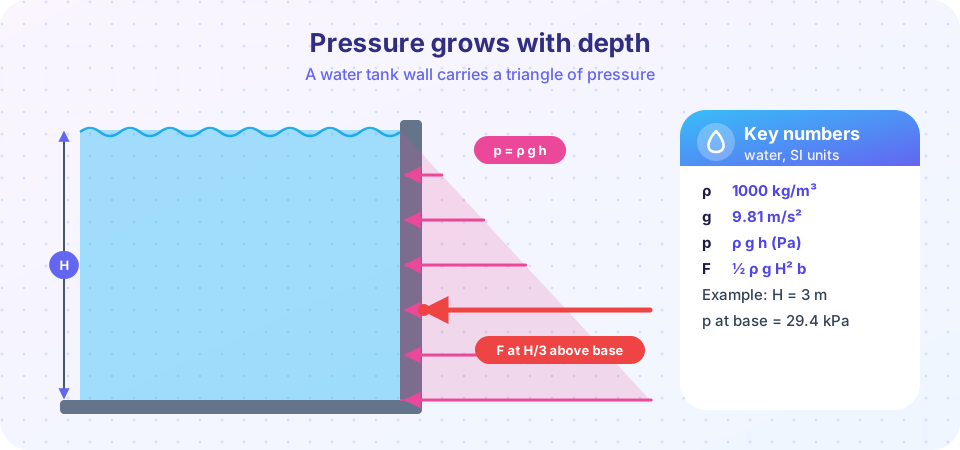
Because pressure grows linearly from zero at the surface to ρ g H at the base of a wall of height H, the pressure diagram is a triangle. The force is the area of that triangle times the wall width b:
F = ½ × (ρ g H) × H × b = ½ ρ g H² b
The force acts through the centroid of the triangle, which is H/3 above the base (or 2H/3 below the surface).
Worked example. A concrete wall holds back 3 m of water and is 5 m long.
- Base pressure:
p = 1000 × 9.81 × 3 = 29,430 Pa. - Force:
F = ½ × 1000 × 9.81 × 3² × 5 = 220,725 N ≈ 220.7 kN. - Location: 1 m above the base.
- Overturning moment about the base:
220.7 kN × 1 m ≈ 220.7 kN·m.
Notice the square. Doubling the water depth quadruples the force, which is why dams are built thick near the bottom and why a flood that rises only a little can suddenly overload a wall.
Buoyancy
Pressure on the underside of a submerged object is larger than on its top, so water pushes up. Archimedes' principle says the net upward force equals the weight of the water the object displaces:
F_b = ρ g V_displaced
A concrete block of 1 m³ weighs about 24 kN in air (2400 kg/m³ × 9.81). Submerged, it displaces 9.81 kN of water, so a lifting crane only has to carry 24 − 9.81 ≈ 14.2 kN. A steel ship floats because its hollow hull displaces far more water than the steel itself would. Buoyancy also matters for buried tanks and basements: when the water table rises, uplift can float an empty tank out of the ground, so civil engineers check it.
Common misconceptions
"A big lake pushes harder than a small pond of the same depth." Pressure depends only on depth, so the pressure at 3 m is identical in both. The total force on a wall differs only because a wider wall has more area.
"Pressure acts only downward." It acts perpendicular to every surface it touches, including vertical walls and ceilings.
"The force on a dam acts at mid-height." Pressure increases with depth, so the resultant is lower, at H/3 above the base.
Try it
First, a plot of the pressure triangle with the resultant force computed for any wall size. Then an interactive tank where you drag the depth slider and watch the force and its location change.
Press Run (or Ctrl + Enter) to see the result here.
Program input · what you'd type while the program runs
Type the answers before you press Run, one per line. Each time the program reads a line (with input()), it gets the next line from this box.
Check your understanding
Quick check · 5 questions
of 5 answered You scored / 5 · perfect!
-
1. What is the gauge pressure at 5 m depth in fresh water (ρ = 1000 kg/m³, g = 9.81 m/s²)?
p = ρ g h = 1000 × 9.81 × 5 = 49,050 Pa = 49.05 kPa. -
2. Where does the resultant hydrostatic force act on a vertical rectangular wall of height H?
The pressure triangle's centroid is one third of the height above its wide base. -
3. If the water depth behind a wall doubles, the total force becomes about
F = ½ ρ g H² b, so force is proportional to H squared. -
4. A 1 m³ concrete block (24 kN in air) is fully submerged in water. About how much does it weigh in water?
Buoyancy equals 9.81 kN, so 24 − 9.81 ≈ 14.2 kN. -
5. Why do engineers usually use gauge pressure for dry-side walls?
The air on the dry side pushes back with the same atmospheric pressure as on the water surface.
Summary
- Hydrostatic pressure is
p = ρ g hand depends only on vertical depth. - On a vertical wall the force is
F = ½ ρ g H² band acts H/3 above the base. - Doubling the depth quadruples the force.
- Buoyancy equals the weight of the displaced water.
Next: Bernoulli and pipe flow
Track your progress
Create a free account to tick off lessons and pick up where you left off on any device.
of Civil Engineering Fundamentals lessons completed