


















Lesson 38 of 48 · Environmental and Sustainable Design
Chapter overview: Environmental and sustainable design
Why modern civil engineers must clean water, manage storms and cut carbon. A map of the chapter on environmental and sustainable design with key terms.
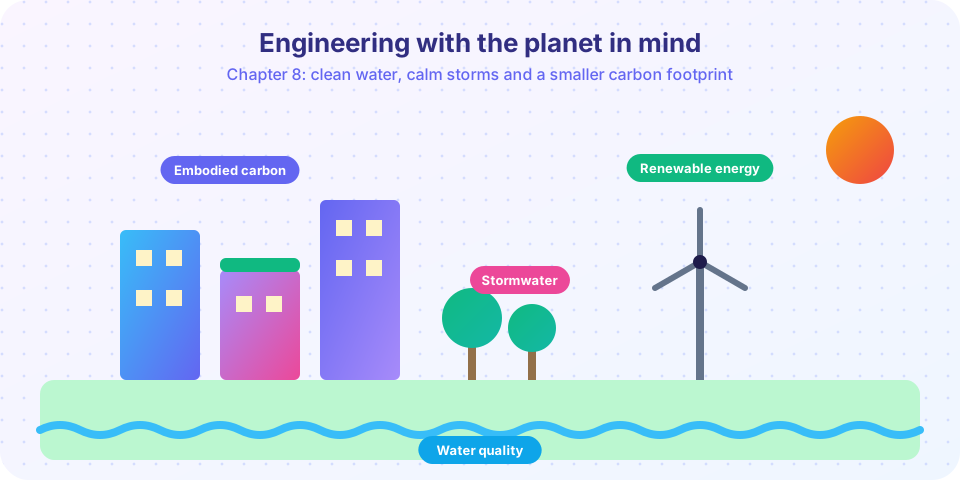
Civil engineering built the modern world, and it also leaves a mark on it. Construction uses a very large share of the world's raw materials, buildings and infrastructure account for a large share of energy use and carbon emissions, and every paved surface changes where rainwater goes. Environmental and sustainable design asks civil engineers to meet today's needs without leaving a worse world for tomorrow's engineers and users.
What you will learn
- What sustainability means for a civil engineer.
- The main environmental problems civil engineering helps solve.
- How the lessons in this chapter are organized.
- How the sustainable development goals connect to engineering work.
Key terms
Sustainability: meeting present needs without compromising the ability of future generations to meet theirs. Triple bottom line: judging a project by people, planet and profit, not cost alone. Embodied carbon: greenhouse gases released making and transporting materials and building the structure. Resilience: the ability of a system to absorb shocks such as floods and recover quickly. Green infrastructure: designs that use soil, plants and natural processes to manage water.
The big picture
Sustainability has three legs
Four problems we solve
Whole-life thinking
Count impacts at every stage.
A sustainable project is judged over its whole life. A cheap pavement that must be rebuilt every five years may cost more in money and carbon than a stronger one that lasts thirty. A building that is easy to insulate saves energy for decades. Engineers use tools such as life-cycle assessment to compare options with numbers instead of slogans.
The United Nations goals
In 2015 the United Nations adopted 17 Sustainable Development Goals. Several are civil engineering at heart: SDG 6 (clean water and sanitation), SDG 9 (industry, innovation and infrastructure), SDG 11 (sustainable cities and communities) and SDG 13 (climate action). The goals matter to engineers because infrastructure decisions last for generations.
What each lesson covers
- Water and wastewater treatment follows a treatment train and measures pollution with BOD.
- Stormwater and green infrastructure shows how to slow runoff with swales, rain gardens and permeable paving.
- Embodied carbon and life-cycle thinking counts the carbon in materials and shows how to compare designs.
- Chapter review summarizes and tests the chapter.
Common misconceptions
"Sustainable design is always more expensive." Some measures cost more up front but save money in operation. Others, such as using less material, cost less at both stages.
"Only renewable energy matters." For many civil projects, the carbon in materials (cement and steel) is as large as the energy used in operation over the first decades.
Try it
First, a water quality fact that drives many treatment decisions: warm water holds less oxygen. Then a quick emissions calculator, labeled as a demonstration with an assumed grid factor.
Press Run (or Ctrl + Enter) to see the result here.
Program input · what you'd type while the program runs
Type the answers before you press Run, one per line. Each time the program reads a line (with input()), it gets the next line from this box.
Press Run (or Ctrl + Enter) to see the console output here.
No output.
Check your understanding
Quick check · 4 questions
of 4 answered You scored / 4 · perfect!
-
1. What does the triple bottom line consider?
It adds social and environmental results to financial ones. -
2. Embodied carbon refers to
It counts emissions from product manufacture, transport and construction. -
3. Which Sustainable Development Goal is about clean water and sanitation?
SDG 6 targets clean water and sanitation for all. -
4. Why is whole-life thinking useful?
A cheap design may cost more over its life in money and carbon.
Summary
- Sustainability balances people, planet and economy.
- Civil engineers tackle dirty water, floods, carbon and resilience.
- Whole-life thinking compares options over decades.
- The UN goals, especially 6, 9, 11 and 13, frame the work.
Track your progress
Create a free account to tick off lessons and pick up where you left off on any device.
of Civil Engineering Fundamentals lessons completed