


















Lesson 49 of 49 · Projects and Practice
Where to go next after strength of materials
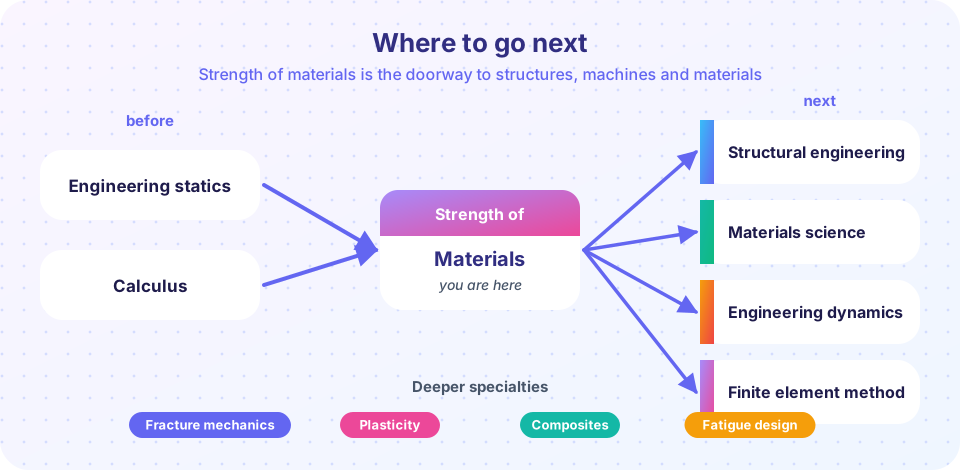
Plan your next steps after strength of materials: structures, materials science, dynamics, finite elements, fracture, plasticity and composites, with site tracks to follow.
You can now take a loaded part, find the stresses and deformations inside it, compare them with the limits of the material, and choose a safe size. That is a real engineering skill, and it is the base for many fields. This last lesson shows where it leads and gives you a few ways to keep the knowledge alive.
What you will learn
- What you can do now, and where the limits of this course are.
- Which topics build on strength of materials and which tracks on this site cover them.
- How to practice so the skill does not fade.
What this course deliberately left out
- Plasticity: behavior beyond yield, residual stresses, plastic design of beams.
- Fracture mechanics: how pre-existing cracks grow and when they become unstable.
- Composites and anisotropic materials: timber, fiber-reinforced plastics, laminates.
- Thin plates and shells, and curved beams.
- Dynamic loading: vibration, impact and resonance.
- Creep and high-temperature behavior.
Natural next steps
| If you like... | Study next | Why it builds on this course |
|---|---|---|
| Buildings, bridges and frames | Structural engineering | Beams, columns and frames are the structures this course analyzed one at a time |
| Choosing and understanding materials | Materials science | Why E, σy, ductility and fatigue behave as they do, from microstructure |
| Machines, vibration and motion | Engineering dynamics | Loads change with time; accelerations add inertia forces to every calculation |
| The foundation under all of this | Engineering statics | Free-body diagrams and equilibrium are the first step of every problem |
| Heat, engines and pressure vessels | Engineering thermodynamics | Thermal stresses and the loads in pressurized systems |
Beyond this site, the usual path is machine design (shafts, gears, bearings, springs, fatigue life), structural analysis (indeterminate frames, influence lines, design codes), the finite element method (the computer version of everything here, which breaks a complicated part into small pieces and solves them all at once), and specialties such as fracture mechanics, plasticity and composite materials.
Computer tools and why you still need the formulas
Finite element software computes stresses in shapes far too complicated for hand formulas. It will gladly give you a colorful picture of a wrong answer if the loads, supports or materials are wrong. The best way to catch those errors is to estimate the answer by hand with the methods of this course: the maximum moment, the section modulus, the deflection of a similar standard beam, the buckling load. If the computer and your estimate differ by a factor of two, one of them is wrong, and it is worth finding out which.
Common misconceptions
- "Software makes hand calculation obsolete." Software multiplies the speed and also the consequences of a wrong input. Hand checks are how experts catch mistakes.
- "Passing the formulas means the design is safe." Real structures involve connections, fabrication, corrosion, inspection and misuse. Codes, standards and experience cover these.
- "Once the course is over, the learning is over." The speed with which you recognize the right method comes from practice with varied problems.
Try it
This planner suggests a next track and a practice habit for the area you pick. Change interest to see the options.
Press Run (or Ctrl + Enter) to see the console output here.
No output.
A habit that works: once a week, take an object around you (a shelf, a chair, a bicycle crank, a ladder), imagine its loads, and estimate which part is most stressed and in which mode (bending, buckling, shear, fatigue). Then check the numbers.
Check your understanding
Quick check · 3 questions
of 3 answered You scored / 3 · perfect!
-
1. Which topic studies the behavior of a material beyond yield and the plastic design of beams?
Plasticity covers behavior after yielding. This course stayed within the elastic range. -
2. Why should you estimate by hand even when using finite element software?
A hand estimate is a sanity check on the model and its inputs. -
3. Where would you study how microstructure sets the yield strength and ductility of a metal?
Materials science links the microstructure of a material to its mechanical properties.
Summary
- You can analyze axial members, shafts, beams and columns, combine loads, check stiffness, stability, yield and fatigue, and make a design decision.
- Natural next steps: structures, materials science, dynamics, machine design, finite elements, fracture mechanics, plasticity and composites.
- Keep hand estimation as the sanity check for any computer result.
- Practice on real objects to keep the skill alive.
Back to the course: Strength of Materials
Track your progress
Create a free account to tick off lessons and pick up where you left off on any device.
of Strength of Materials lessons completed