


















Lesson 31 of 49 · Shear and Combined Loading
Stress transformation and Mohr's circle
Rotate a plane stress state, find principal stresses and maximum shear with formulas and Mohr's circle, and avoid the in-plane versus absolute shear trap.
Imagine pressing a pencil point on a fixed spot of a loaded part. How hard it pushes depends on which way you slice through the material. The same physical state of stress gives different σ and τ values on different planes through the same point. Failure, however, does not care how we drew our axes. Cracks and yielding care about the largest normal stress, the largest shear stress and the angles at which they act. This lesson shows how to find them, first with equations, then with the beautiful graphical method devised by the German engineer Christian Otto Mohr in 1882.
What you will learn
- The plane-stress transformation equations for
σθandτθ. - How to compute the principal stresses, the principal angle and
τmax. - How to draw and read Mohr's circle.
- Why the absolute maximum shear stress can be larger than the in-plane one.
Key terms
- Plane stress: all stress components lie in one plane (the faces normal to the third axis are stress-free).
- Principal stresses
σ1 ≥ σ2: the maximum and minimum normal stresses; shear is zero on these planes. - Principal planes: the two perpendicular planes on which the principal stresses act.
- Maximum in-plane shear
τmax: the largest shear stress for rotations about the third axis.
The transformation equations
Start with a plane stress element with stresses σx, σy, τxy. Rotate the element by an angle θ counterclockwise. By equilibrium of a small wedge, the stress on the new x′ face is
σθ = (σx + σy)/2 + (σx − σy)/2 · cos 2θ + τxy · sin 2θ
τθ = −(σx − σy)/2 · sin 2θ + τxy · cos 2θ
Notice the doubled angle: rotating the element by 90° swaps the faces, and the stresses return to their values with the roles exchanged. The sum σx + σy never changes under rotation; it is an invariant.
Principal stresses and maximum shear
Setting τθ = 0 gives the principal directions, and the extreme values of σθ follow:
tan 2θp = 2·τxy / (σx − σy)
σ1,2 = (σx + σy)/2 ± √( ((σx − σy)/2)² + τxy² )
τmax = √( ((σx − σy)/2)² + τxy² )       (on planes 45° from the principal planes)
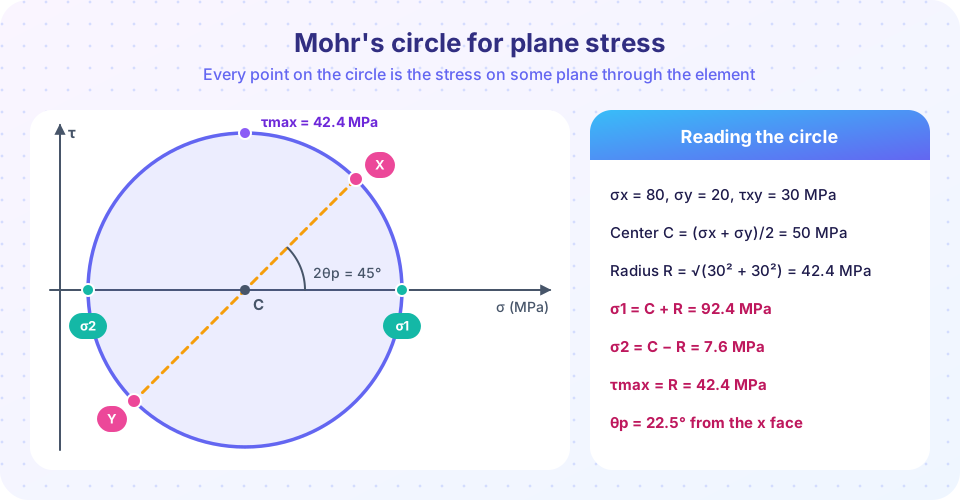
Worked example. Take σx = 80, σy = 20, τxy = 30 MPa, the state in the figure.
- Average:
(80 + 20)/2 = 50 MPa. - Half difference:
(80 − 20)/2 = 30 MPa. R = √(30² + 30²) = 42.43 MPa.σ1 = 50 + 42.43 = 92.43 MPa,σ2 = 50 − 42.43 = 7.57 MPa.tan 2θp = 2 × 30 / 60 = 1, so2θp = 45°andθp = 22.5°.- On the principal planes
τ = 0and on the planes atθp + 45°,τ = ±42.43 MPawith a normal stress of50 MPa.
Mohr's circle
Plot σ on the horizontal axis and τ on the vertical. The two faces of the original element give two points, X = (σx, τxy) and Y = (σy, −τxy). Join them by a straight line; its midpoint is the center C = (σx + σy)/2 on the σ axis. Draw a circle through X and Y.
- The radius is
R = √(((σx − σy)/2)² + τxy²), which equalsτmax. - The circle crosses the σ axis at
σ1 = C + Randσ2 = C − R. - The highest point of the circle gives
τmax, and its σ coordinate isC. - Rotating the element by
θcorresponds to rotating the diameter by2θon the circle, in the same direction.
Using the circle, every answer becomes geometry: the sines and cosines of the equations are just the horizontal and vertical components of a radius.
Sign convention tip: when you draw Mohr's circle by hand, plot shear that tends to rotate the element clockwise with a positive τ if you plot τ downward, or flip the vertical axis. Stay consistent and check the answer by substituting into the formulas.
A trap to avoid: in-plane versus absolute shear
For plane stress, the third principal stress is σ3 = 0 (the free surface). Mohr's circles exist for all three pairs (σ1, σ2), (σ2, σ3), (σ1, σ3). The absolute maximum shear stress is half the difference between the largest and smallest of the three:
τabs = (σmax − σmin)/2
In our example, σ1 = 92.4, σ2 = 7.6, σ3 = 0: both in-plane stresses are positive, so σmin = 0, and τabs = 92.4/2 = 46.2 MPa, which is larger than the in-plane τmax = 42.4 MPa. If σ1 and σ2 have opposite signs, then σmax − σmin = σ1 − σ2 and the in-plane value is the absolute maximum.
Common misconceptions
- "The principal planes are where the shear is greatest." The opposite: on principal planes the shear stress is zero. The maximum shear acts on planes at 45° to them.
- "Rotating by θ rotates the circle point by θ." It is
2θ. A 90° rotation of the element is a half turn around the circle. - "
τmaxfrom the circle is always the largest shear." Only in the plane of the circle. With a zero third principal stress, the absolute maximum may be larger. - "Mohr's circle only works for shafts." It works for any plane stress state: beams, pressure vessels, welds, anywhere.
Try it
First, a calculator and plotter that draws Mohr's circle for any plane stress state.
Press Run (or Ctrl + Enter) to see the result here.
Program input · what you'd type while the program runs
Type the answers before you press Run, one per line. Each time the program reads a line (with input()), it gets the next line from this box.
Second, sweep the element angle θ from 0° to 180° with the transformation equations. The curves show the principal stresses at the peaks and τ = 0 there.
Press Run (or Ctrl + Enter) to see the result here.
Program input · what you'd type while the program runs
Type the answers before you press Run, one per line. Each time the program reads a line (with input()), it gets the next line from this box.
Check your understanding
Quick check · 6 questions
of 6 answered You scored / 6 · perfect!
-
1. For σx = 100, σy = 0, τxy = 0 MPa (a uniaxial state), what is τmax in the plane?
R = √((100/2)² + 0) = 50 MPa, acting on planes at 45°. -
2. For σx = 60, σy = −20, τxy = 0 MPa, what are the principal stresses?
With no shear stress the element already lies on the principal planes; σ1 = 60 and σ2 = −20. -
3. Rotating the element by 30° moves the point on Mohr's circle by...
Points on the circle move twice the angle of rotation of the element. -
4. On the principal planes, the shear stress is...
Principal planes are defined as planes without shear stress. -
5. For the state σx = 80, σy = 20, τxy = 30 MPa, the sum σx + σy after rotating the element by 40° is...
The sum of the normal stresses on perpendicular planes is invariant: σx′ + σy′ = σx + σy = 100 MPa. -
6. A plane stress state has σ1 = 90 MPa and σ2 = 30 MPa (σ3 = 0). What is the absolute maximum shear stress?
Both principal stresses are positive, so σmin = 0 and τabs = (90 − 0)/2 = 45 MPa, larger than the in-plane (90 − 30)/2 = 30 MPa.
Summary
- Stress depends on the plane;
σθandτθfollow from the transformation equations with the doubled angle2θ. - Principal stresses:
σ1,2 = (σx+σy)/2 ± RwithR = √(((σx−σy)/2)² + τxy²);tan 2θp = 2τxy/(σx−σy). - Mohr's circle has center
(σx+σy)/2and radiusR = τmax; rotating the element byθrotates a point by2θ. - Shear is zero on principal planes and maximum on planes 45° from them.
- Include
σ3 = 0when finding the absolute maximum shear stress.
Next: Chapter 6 review
Track your progress
Create a free account to tick off lessons and pick up where you left off on any device.
of Strength of Materials lessons completed