


















Lesson 44 of 49 · Projects and Practice
Project 1: design a floor beam
Size a steel rectangular hollow beam for bending strength and a span over 360 deflection limit, find which check governs and plot V, M and deflection.
A small mezzanine floor is carried by steel beams that span 5 m between two walls. Your job is to choose a section for one of them. This is the most common calculation in structural design, and it uses almost every idea from Chapters 5 to 8: reactions, moment diagram, flexure formula, section properties, deflection, factors of safety and the "weakest check governs" rule.
What you will learn
- How to turn a brief into numerical requirements for
SandI. - How to compute
Mmaxfor combined loads by superposition. - How to search a list of sections and find the governing check.
- How to verify the result with diagrams.
Key terms
- Requirement: a number the design must meet, such as
S ≥ 333 × 10³ mm³. - Utilization: the ratio of the actual stress (or deflection) to its limit; 100% means no margin.
- Governing check: the check with the highest utilization.
- Rectangular hollow section (RHS): a closed box-shaped tube, efficient in bending.
The brief
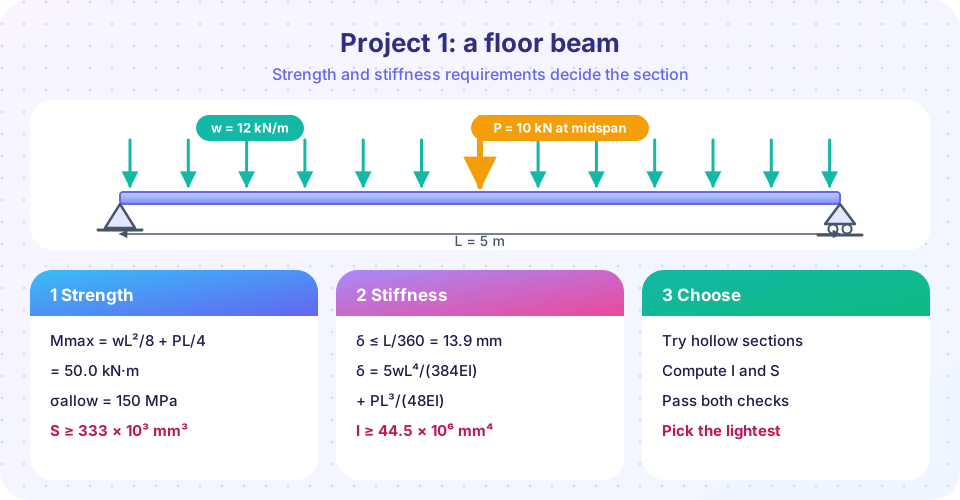
- Simply supported span
L = 5 m. - Uniform load
w = 12 kN/m, which includes an allowance of about 0.5 kN/m for the beam's own weight. - A 10 kN point load at midspan from a piece of equipment.
- Steel:
E = 200 GPa; allowable bending stressσallow = 150 MPa(yield strength divided by a factor of safety). - Deflection limit under this load:
L/360.
Assumptions you should state: the beam is laterally supported along its length (no twisting sideways), the loads are static, the section is symmetric so there is one neutral axis, and shear is checked separately and will not govern for a slender beam.
Step 1: strength requirement
By superposition, the maximum moment is at midspan:
Mmax = wL²/8 + PL/4 = 12 × 5²/8 + 10 × 5/4 = 37.5 + 12.5 = 50 kN·m
The flexure formula σ = M/S ≤ σallow gives
S_required = 50 × 10⁶ N·mm / 150 MPa = 333 × 10³ mm³
Step 2: stiffness requirement
The deflection limit is L/360 = 5000/360 = 13.9 mm. Superposing the two standard cases from Chapter 7:
δ = 5wL⁴/(384EI) + PL³/(48EI) ≤ 13.9 mm
With w = 12 N/mm, L = 5000 mm, P = 10 000 N:
5wL⁴/384 = 9.77 × 10¹³ N·mm³      PL³/48 = 2.60 × 10¹³ N·mm³
I_required = 1.237 × 10¹⁴ / (200 000 × 13.9) = 44.5 × 10⁶ mm⁴
Step 3: look at the two requirements together
The strength requirement says S ≥ 333 × 10³ mm³; the stiffness requirement says I ≥ 44.5 × 10⁶ mm⁴. For a section of depth h, S = I/(h/2). A section 250 mm deep that just meets the I requirement has S = 44.5 × 10⁶ / 125 = 356 × 10³ mm³, which also exceeds the strength requirement: stiffness governs for depths of 250 mm and more. A shallower section would be governed by strength instead. Long spans of moderately loaded beams are very often controlled by deflection.
Step 4: search the sections
Use hollow rectangular sections with outer width B, depth H and wall thickness t. These dimensions are invented for the exercise; real catalogs list standard sizes. For each candidate compute
I = [B·H³ − (B − 2t)(H − 2t)³] / 12 S = I / (H/2) A = B·H − (B − 2t)(H − 2t)
and keep the lightest (smallest area) that satisfies both requirements.
Common misconceptions
- "If the stress check passes, the beam is fine." A beam can pass strength and still sag too much. Check both.
- "A thicker wall is the best way to stiffen a section." Depth does far more per kilogram than thickness, since it enters
Ias a cube. - "The beam's own weight does not matter." For long spans it can be a large share of the load. Include an allowance and recheck after choosing.
- "The cheapest section is the one with the smallest area." Fabrication, availability and connections matter too. The lightest section is only a good starting point.
Try it
First, the search. The program prints the stress and deflection of every candidate and selects the lightest section that passes both checks.
Press Run (or Ctrl + Enter) to see the result here.
Program input · what you'd type while the program runs
Type the answers before you press Run, one per line. Each time the program reads a line (with input()), it gets the next line from this box.
The second TryIt verifies the choice with diagrams: shear force, bending moment, and the deflection curve of the chosen section.
Press Run (or Ctrl + Enter) to see the result here.
Program input · what you'd type while the program runs
Type the answers before you press Run, one per line. Each time the program reads a line (with input()), it gets the next line from this box.
Extensions
- Self weight. The chosen section weighs
48.2 kg/m, about0.47 kN/m: compare with the allowance of 0.5 kN/m in the load. - Shear check. The maximum shear is
V = wL/2 + P/2 = 35 kNat each support. Estimate the average shear stress in the two vertical walls (each 8 mm thick and about 234 mm tall) and compare it with the allowable stress: it comes out at roughly 9 MPa, so shear does not govern. - Move the load. Put the point load at 1.5 m from a support. Which check changes most?
- Change the material. Replace steel by aluminum (
E ≈ 70 GPa). What happens to the governing check?
Check your understanding
Quick check · 4 questions
of 4 answered You scored / 4 · perfect!
-
1. A 4 m simply supported beam carries 10 kN/m. What is the required S for σallow = 150 MPa?
Mmax = wL²/8 = 10 × 16/8 = 20 kN·m; S = 20 × 10⁶/150 = 133 × 10³ mm³. -
2. In the project, the section 150 × 250 × 6 mm has a stress of 155 MPa. Does it pass?
155 MPa is above 150 MPa, so the strength check fails even though the deflection limit is satisfied. -
3. Why do long, lightly loaded beams tend to be governed by deflection rather than strength?
Moment grows with L², deflection with L⁴ for a uniform load, so stiffness becomes critical for long spans. -
4. A section is 80% utilized in stress and 85% in deflection. Which check governs?
The check with the higher utilization (85%) governs.
Summary
- Translate the brief into requirements:
S ≥ Mmax/σallowandI ≥ the deflection requirement. - Superposition gives
Mmax = wL²/8 + PL/4 = 50 kN·mand the deflection as a sum of standard cases. - Search sections, record utilization for each check, and pick the lightest that passes; here the 150 × 250 × 8 section.
- Verify with diagrams, and remember the checks you did not do (shear, lateral stability, connections).
Track your progress
Create a free account to tick off lessons and pick up where you left off on any device.
of Strength of Materials lessons completed