


















Lesson 39 of 49 · Failure Theories and Design
Yield criteria: Tresca and von Mises
Check whether a ductile part yields under combined stresses with the Tresca maximum-shear and von Mises distortion-energy criteria, plus brittle fracture rules.
A tensile test tells you the stress at which a bar of steel starts to yield when pulled in one direction. But the shaft in a gearbox is bent and twisted at once, and a pressurized tank wall is stretched in two directions. At what combination of stresses does that metal yield? Two answers, both useful and both widely used, were proposed in the nineteenth and early twentieth centuries: the maximum shear stress criterion of Henri Tresca (1864) and the distortion energy criterion associated with Richard von Mises (1913) and Heinrich Hencky. Both give the same result for a simple pull, and they differ by at most about 15% in other states.
What you will learn
- The statement of the Tresca and von Mises criteria and where each comes from.
- How to compute an equivalent stress and a factor of safety against yielding.
- How the criteria differ in pure shear.
- The basic rules for brittle materials (maximum normal stress, Coulomb–Mohr).
Key terms
- Equivalent stress
σe: a single stress for a combined state; yielding is predicted whenσe = σy. - Tresca (maximum shear stress) criterion: yielding starts when the maximum shear stress reaches that of a tensile test,
σy/2. - von Mises (distortion energy) criterion: yielding starts when the energy of shape change reaches that of a tensile test.
- Factor of safety against yielding
n = σy / σe.
The Tresca criterion
Ductile metals yield by layers of crystals sliding over one another, which is a shear process. Tresca proposed that yielding begins when the largest shear stress in the material reaches the value it has at yield in a tensile test.
In uniaxial tension the maximum shear stress is σ/2 (Mohr's circle with σ2 = σ3 = 0). So at yield, τmax = σy/2. For a general state with principal stresses σ1 ≥ σ2 ≥ σ3 (include σ3 = 0 for plane stress):
τmax = (σ1 − σ3)/2 ≤ σy/2 ⇔ σ1 − σ3 ≤ σy
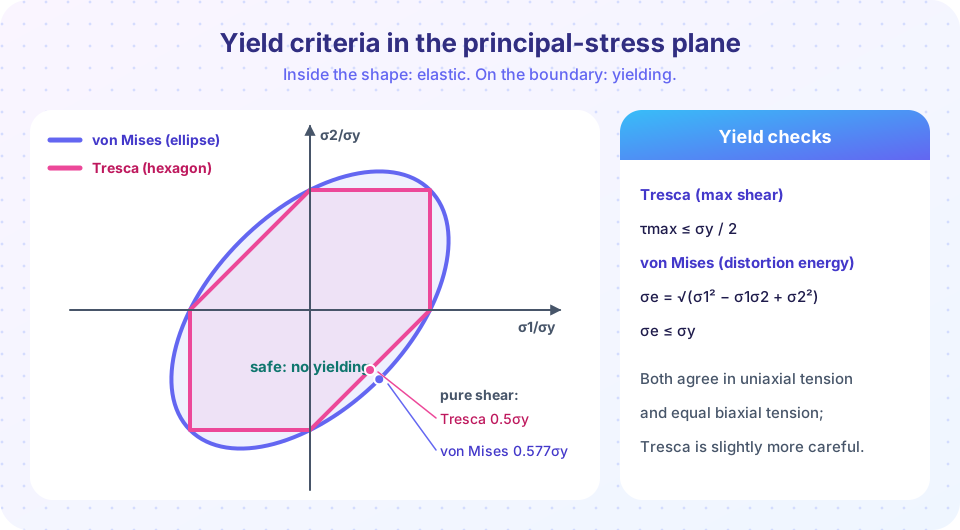
In the principal-stress plane (σ3 = 0), this is the hexagon in the figure. It is simple, slightly conservative, and often used in hand calculations.
The von Mises criterion
Von Mises noticed that adding the same pressure to all three principal stresses (hydrostatic pressure) does not make metals yield, however large. Only the part of the stress that changes shape matters. The energy stored in that shape-changing (distortion) part has a neat form, and equating it to its value at yield in a tensile test gives
σe = √( ½[(σ1 − σ2)² + (σ2 − σ3)² + (σ3 − σ1)²] ) yield when σe = σy
For plane stress (σ3 = 0):
σe = √(σ1² − σ1·σ2 + σ2²) = √(σx² − σx·σy + σy² + 3τxy²)
This is the ellipse in the figure. It matches experiments on ductile metals slightly better than Tresca, so it is the standard for computer analysis, which reports the "von Mises stress" in most finite element results.
Pure shear: where they differ
In pure shear (σ1 = τ, σ2 = −τ):
- Tresca:
σ1 − σ2 = 2τ ≤ σy, so yield atτy = 0.5 σy. - von Mises:
σe = √(τ² + τ² + τ²) = √3 τ ≤ σy, so yield atτy = σy/√3 = 0.577 σy.
Experiments on ductile metals in torsion give a yield shear stress close to 0.577 σy, which is why von Mises is preferred. The difference between the two is 15%, and it is the largest difference the criteria can have.
Worked examples
The shaft. At the critical point of the combined-loading shaft (σ = 63.7 MPa, τ = 23.9 MPa), the principal stresses are σ1 = 71.6 MPa and σ2 = −8.0 MPa. The material has σy = 250 MPa.
- Tresca:
σ1 − σ2 = 79.6 MPa, son = 250/79.6 = 3.14. - von Mises:
σe = √(σ² + 3τ²) = √(63.7² + 3 × 23.9²) = 75.9 MPa, son = 3.29.
A pressurized cylinder. A thin-walled tube with p = 2 MPa, radius 500 mm and wall 10 mm has a hoop stress σh = p·r/t = 100 MPa and an axial stress σa = p·r/(2t) = 50 MPa; the radial stress is small and taken as zero. Then σ1 = 100, σ2 = 50, σ3 = 0:
- Tresca:
σ1 − σ3 = 100 MPa,n = 2.5. - von Mises:
σe = √(100² − 100 × 50 + 50²) = 86.6 MPa,n = 2.89.
Note how the biaxial tension makes Tresca conservative here: it says the tube has less margin than von Mises does.
Brittle materials
Brittle failure is not about shear sliding. It starts as a crack opened by the largest tensile normal stress. The simplest rule is the maximum normal stress criterion: the part fractures when σ1 reaches the ultimate tensile strength σut, or when σ3 reaches the (negative) ultimate compressive strength −σuc. Many brittle materials, such as cast iron and concrete, are much stronger in compression than in tension. For such materials, the Coulomb–Mohr criterion interpolates between the two strengths: with σ1 ≥ σ3 and signs included, the safe region is
σ1/σut − σ3/σuc ≤ 1
For gray cast iron with illustrative strengths σut = 200 MPa and σuc = 600 MPa, a state σ1 = 100, σ3 = −150 gives 0.5 + 0.25 = 0.75 ≤ 1: safe with n = 1/0.75 = 1.33.
Common misconceptions
- "Use the largest normal stress to check a ductile part." In pure shear the normal stresses are
±τand the yield strength is far from the real limit; use an equivalent stress. - "The criteria are laws of nature." They are fitted models. Von Mises matches ductile metals well; neither works for brittle materials, soils or polymers without modification.
- "Von Mises stress is a real stress on a plane." It is a computed scalar summary. No plane in the part carries it.
- "Always include σ3 = 0." Do include it in Tresca checks: in a plane-stress state where
σ1andσ2have the same sign,σ1 − σ3(withσ3 = 0) governs, notσ1 − σ2.
Try it
This tool computes the principal stresses, both equivalent stresses and the factors of safety for several plane-stress states. Edit the list to try your own.
Press Run (or Ctrl + Enter) to see the result here.
Program input · what you'd type while the program runs
Type the answers before you press Run, one per line. Each time the program reads a line (with input()), it gets the next line from this box.
The second TryIt draws both envelopes in normalized coordinates and plots the same states, so you can see which side of the line they fall on.
Press Run (or Ctrl + Enter) to see the result here.
Program input · what you'd type while the program runs
Type the answers before you press Run, one per line. Each time the program reads a line (with input()), it gets the next line from this box.
Check your understanding
Quick check · 5 questions
of 5 answered You scored / 5 · perfect!
-
1. A ductile steel with σy = 300 MPa is in pure shear. At what shear stress does von Mises predict yielding?
τy = σy/√3 = 300/1.732 = 173 MPa. Tresca would give 150 MPa. -
2. Plane stress with σ1 = 120 MPa and σ2 = 60 MPa. What is the von Mises equivalent stress?
σe = √(120² − 120 × 60 + 60²) = √(14 400 − 7 200 + 3 600) = √10 800 = 104 MPa. -
3. Which criterion is more conservative in pure shear?
Tresca predicts yielding at 0.5σy, lower than von Mises at 0.577σy. -
4. Plane stress with σ1 = 80 MPa and σ2 = 30 MPa, both tensile. What does the Tresca criterion use as the maximum difference?
With σ3 = 0 included, the largest difference is σ1 − σ3 = 80 MPa. -
5. Which materials are the Coulomb–Mohr and maximum normal stress criteria meant for?
They describe fracture controlled by tensile normal stress, typical of brittle materials.
Summary
- Tresca: yielding when
τmax = (σ1 − σ3)/2reachesσy/2; the criterion is a hexagon in theσ1–σ2plane (withσ3 = 0). - Von Mises: yielding when
σe = √(σ1² − σ1σ2 + σ2²)(plane stress) equalsσy; an ellipse that touches the hexagon corners. - In pure shear they give
0.5σyand0.577σy; von Mises fits ductile metals better. - The factor of safety against yielding is
n = σy/σe; always includeσ3 = 0for Tresca in plane stress. - Brittle materials fracture by tensile normal stress: use the maximum normal stress or Coulomb–Mohr criterion.
Next: Fatigue and notches
Track your progress
Create a free account to tick off lessons and pick up where you left off on any device.
of Strength of Materials lessons completed