


















Lesson 6 of 49 · Stress and Strain
Stress and Strain: The Big Picture
See why stress and strain, not force and elongation, let engineers compare any part with any material, and get a map of chapter 2 with its five lessons.
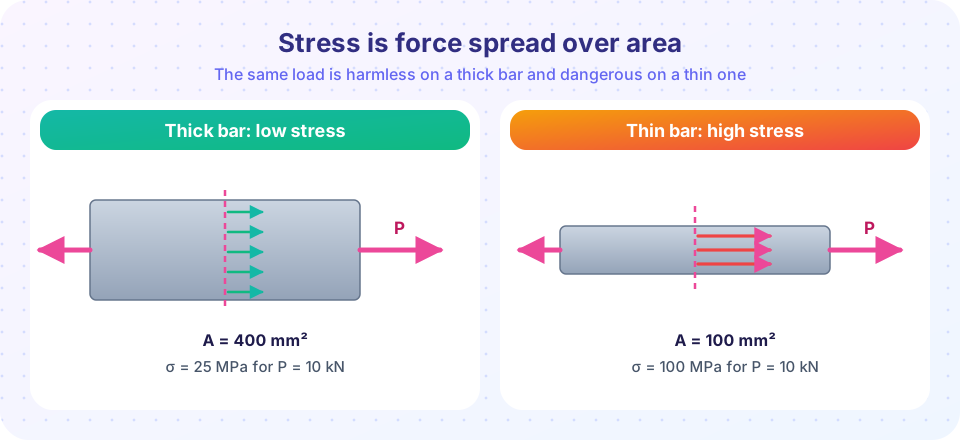
A 10 kN pull on a thick steel bar is harmless. The same 10 kN on a thin wire snaps it. Force alone says nothing about whether a part survives, because what matters is how that force is spread over the material. Dividing force by area gives stress; dividing elongation by length gives strain. These two ideas let a test on a small laboratory specimen predict the behaviour of a bridge cable.
What you will learn
- Why stress and strain are the natural quantities for comparing parts.
- The two basic kinds of stress: normal and shear.
- How the chapter's five lessons fit together.
Key terms
Normal stress σ: force perpendicular to a surface divided by its area.
Shear stress τ: force parallel to a surface divided by its area.
Normal strain ε: change in length divided by original length.
Shear strain γ: change in the angle between two originally perpendicular lines, in radians.
The idea in one sentence
Materials do not feel forces; they feel force per unit area. The thick and thin bars above carry the same 10 kN, but their stresses are 10 000 N / 400 mm² = 25 MPa and 10 000 N / 100 mm² = 100 MPa. If the steel yields at 250 MPa, the first bar is at 10% of its limit and the second at 40%. Stress puts both bars on the same scale as the material's properties.
Strain does the same for deformation. A 2 mm stretch on a 20 mm gauge length is dramatic (10%); the same 2 mm on a 20 m cable is nothing (0.01%). A material's relation between stress and strain, measured once, can be reused for every part made of it.
Two kinds of stress
Normal stress σ
Shear stress τ
Strain
Material law
What each lesson in this chapter covers
- Normal Stress:
σ = P / A, tension and compression, sizing rods and posts, and where the average is not enough. - Shear and Bearing Stress: bolts, pins and rivets in single and double shear, bearing on plates, and punching.
- Strain and the Stress-Strain Curve: what a tensile test shows, yield, ultimate strength, ductile and brittle behaviour.
- Hooke's Law and Material Properties: Young's modulus, Poisson's ratio, shear modulus and how they connect.
- Chapter 2 Review: a summary sheet and a ten-question quiz.
Try it
Press Run (or Ctrl + Enter) to see the result here.
Program input · what you'd type while the program runs
Type the answers before you press Run, one per line. Each time the program reads a line (with input()), it gets the next line from this box.
Common misconceptions
"A bigger force always means a bigger stress." Only if the area is unchanged. Stress is the ratio, so a larger area can carry a larger force at the same stress.
"Strain has units." Strain is a ratio of two lengths. You may write it as a fraction (0.0012), a percent (0.12%) or microstrain (1200 µε), but it is dimensionless.
Check your understanding
Quick check · 4 questions
of 4 answered You scored / 4 · perfect!
-
1. A 10 kN force acts on a 100 mm² area. What is the stress?
σ = 10 000 N / 100 mm² = 100 N/mm² = 100 MPa. -
2. Which stress acts parallel to a surface?
Shear stress is the component parallel to the surface; normal stress is perpendicular to it. -
3. A 2 mm stretch on a 2 m rod gives a strain of…
ε = δ / L = 2 mm / 2000 mm = 0.001, or 1000 microstrain. -
4. Why do engineers use stress instead of force when comparing parts?
A material's yield strength is a stress, so comparing stress with that limit works for any size of part.
Summary
- Stress is force per area, strain is elongation per length; both let you compare different sizes and materials.
- Normal stress acts perpendicular to a surface, shear stress along it.
- The stress-strain curve of a material, measured once, applies to every part made from it.
- This chapter builds from normal stress to shear, strain, and Hooke's law.
Next: Normal Stress
Track your progress
Create a free account to tick off lessons and pick up where you left off on any device.
of Strength of Materials lessons completed